
Quick Summary
How to manage dementia symptoms during travel starts with choosing a short, familiar trip, keeping the itinerary simple, and planning around timing, medication and early signs of agitation. Caregivers should confirm the trip suits the person’s current condition before booking anything.
- Choose a familiar destination and keep one main activity per day with time to rest.
- Schedule a clinician visit four to six weeks ahead for longer or international trips.
- Pack at least a week of extra medication in original labeled containers, kept in carry-on luggage.
- Watch for early signs such as restlessness, repeated questions and pacing, and change the environment before distress builds.
- Share a recent photo, identification and emergency contacts with every adult on the trip.
Table of Contents
- Deciding Whether a Trip Is Right for Your Loved One
- Choosing a Familiar Destination and a Realistic Itinerary
- Flying with Dementia: Timing, Airports and Airline Communication
- Medication, Clinical Planning and Emergency Preparedness
- Managing Agitation and Confusion While Traveling
- Dementia Travel Tips for Caregivers: Shared Responsibilities and Rest
- Your Travel Checklist for Dementia Caregivers Before You Leave
- Frequently Asked Questions
Deciding Whether a Trip Is Right for Your Loved One
Not every trip is worth the stress it creates for someone living with dementia. Honest planning helps you decide whether travel will bring comfort or distress, and learning how to manage dementia symptoms during travel starts with choosing a short, familiar trip over a long, unfamiliar one.
Think about how your loved one handles change at home. Do they settle into a new room easily, or become upset when the routine shifts? This matters more than any travel guide.
Signs a Trip May Be Too Much Right Now
Some signs suggest that travel should wait:
- Confusion gets worse in new places or at unusual times
- Agitation or anxiety increases over the past few weeks
- Sleep has become very unpredictable
- Your loved one has recently had a fall, illness, or change in medication
- They no longer recognize familiar people or places
If you see several of these signs, consider a shorter trip closer to home, or wait until things settle.
Choosing a Familiar Destination and a Realistic Itinerary
A familiar place usually makes the biggest difference when you are figuring out how to manage dementia symptoms during travel.
Keep the itinerary simple: one main activity per day, open time for rest, and the same meal times and bedtimes you use at home as far as possible.
Here is what a realistic plan usually includes:
- One or two fixed points each day, such as breakfast and a nap
- Quiet time in the afternoon
- A backup plan if your loved one becomes tired early
- Room labels, photos of family, and familiar music
Watch out: Packing too many activities is the most common mistake. A full schedule leaves no room to slow down when confusion or agitation appears.
Flying with Dementia: Timing, Airports and Airline Communication
Flying adds noise, crowds, security checks, and long waits, so timing matters.
Before you travel, contact the airline. Ask about wheelchair assistance, priority boarding, and help at security.
At the airport, plan extra time. For a more detailed guide on arranging help at the airport, see How to Arrange Airport Assistance for Elderly Travelers.
Some families decide that a medical escort makes flying safer. Learn when that choice makes sense in Flying With a Loved One Who Has Dementia: When a Medical Escort Makes Travel Safer.
Medication, Clinical Planning and Emergency Preparedness
Medication and clinical planning are where travel with dementia most often goes wrong, and where a little preparation prevents the worst outcomes. The goal is to leave home with a written plan your whole travel party understands, not just a bag of pill bottles.
Talk with the clinician before you book
Schedule a pre-trip visit, ideally four to six weeks ahead for longer or international trips, and bring a written list of every medication, dose, and time. Ask specifically about:
- Whether any medicines need timing adjustments for time zones, and how to shift doses gradually rather than all at once
- Whether any sedating or stimulating medications should be reviewed given the trip’s demands
- What to do if a dose is missed or taken late
- Whether a rescue medication is appropriate for agitation or anxiety, and exactly when and how to use it
- Whether the person is fit to fly, and whether any documentation is needed
- Which vaccinations or health precautions apply at the destination
Ask the clinician for a letter on letterhead describing the diagnosis, current medications, and any equipment needs. This helps at security, at borders, and with airline or assistance staff who may not be familiar with dementia.
Prepare medications for the trip
Pack more than you need, at least a week’s extra supply for longer trips, and two to three days extra even for short ones. Keep medicines in their original labeled containers; do not consolidate into unlabeled pill organizers, since security and border staff may need to see the labels. Carry a printed medication list with doses and times, plus a copy on your phone and with a family member at home.
Keep all essential medicines in your carry-on, never in checked luggage, and split the supply between two bags if two adults are traveling so a single lost bag does not leave you without medication. For time-zone changes, write out a day-by-day dosing schedule before departure rather than calculating it in the moment.
Watch out: Do not change medication timing on the travel day itself without the clinician’s guidance. Shifting doses abruptly can worsen confusion, sleep, and agitation right when the person most needs stability.
Emergency and missing-person protocol
Write this down and share it with every adult on the trip before departure:
- The address and phone number of the nearest hospital or urgent care at the destination
- Local emergency numbers (and the international equivalent if traveling abroad)
- Emergency contacts at home and on the trip, in writing and on the phone
- A recent photo of your loved one, plus a description of what they are wearing that day
- Identification, a medical alert bracelet, and a card listing the diagnosis and medications
If your loved one becomes separated, alert staff immediately and give them the photo and description. Do not search alone for long, airports, stations, and hotels have lost-person procedures and can watch exits.
For longer or more complex journeys, many families use a medical escort with clinical training. These professionals can monitor health during the trip, manage medication timing, and respond quickly if something goes wrong.
Travel insurance and cancellation decisions
Review your bookings for flexibility before you pay in full. Ask whether the fare or reservation can be changed or cancelled, and what documentation a claim would require.
For longer or more complex journeys, many families use a medical escort with clinical training. These professionals can monitor health during the trip and respond quickly if something goes wrong.
The article lays out the key preparation steps for medication and emergency planning, summarised here for quick reference.
| Item | Recommended action | Timing |
|---|---|---|
| Clinician visit | Review medications, dose timing and fitness to fly | Four to six weeks ahead for longer or international trips |
| Medication supply | Pack extra medicine in original labeled containers | At least a week extra for longer trips; two to three days for short ones |
| Medication location | Keep essential medicines in carry-on luggage | Always, never in checked bags |
| Time-zone dosing | Write a day-by-day dosing schedule | Before departure |
| Clinician letter | Diagnosis, medications and equipment needs on letterhead | Obtain before travel |
| Emergency contacts | Share hospital, emergency numbers and contacts in writing | Before departure |
| Recent photo | Keep on phone and provide to staff if separated | Before departure |
Managing Agitation and Confusion While Traveling
Agitation during travel rarely appears out of nowhere. It usually builds from small stressors, fatigue, hunger, noise, an unfamiliar bathroom, a schedule that no longer matches the body clock. The most useful skill a caregiver can build is recognizing the early build-up and responding before distress becomes a crisis.
Read the early warning signs
Watch for changes that precede a bigger reaction:
- Restlessness, pacing, or repeatedly standing up and sitting down
- Repeated questions (“Where are we going?” “When do we get there?”) at short intervals
- Refusing to move, or suddenly refusing food or drink
- Picking at clothing, gripping armrests, or scanning the room repeatedly
- A flat or tense expression that is unusual for your loved one
When you see two or more of these together, treat it as a signal to change something in the environment rather than to push through the current activity.
Symptom-specific response plans
Different symptoms call for different responses.
Agitation or anger. Do not argue, correct, or reason with the content of a mistaken belief.
Wandering or getting separated. This is the symptom that most needs a plan before it happens.
Sleep disruption. Travel often breaks sleep, and poor sleep makes every other symptom worse.
Confusion about place or time. Instead of correcting, orient gently and concretely: “We’re in the airport. We’re going to see [name].
Build a response kit before you leave
Pack a small bag you can reach without digging: noise-canceling headphones with familiar music, a favorite snack, water, a comfort item, a recent photo, and any prescribed rescue medication with clear instructions from the clinician.
Watch out: Do not argue with confusion or try to correct every mistaken belief.
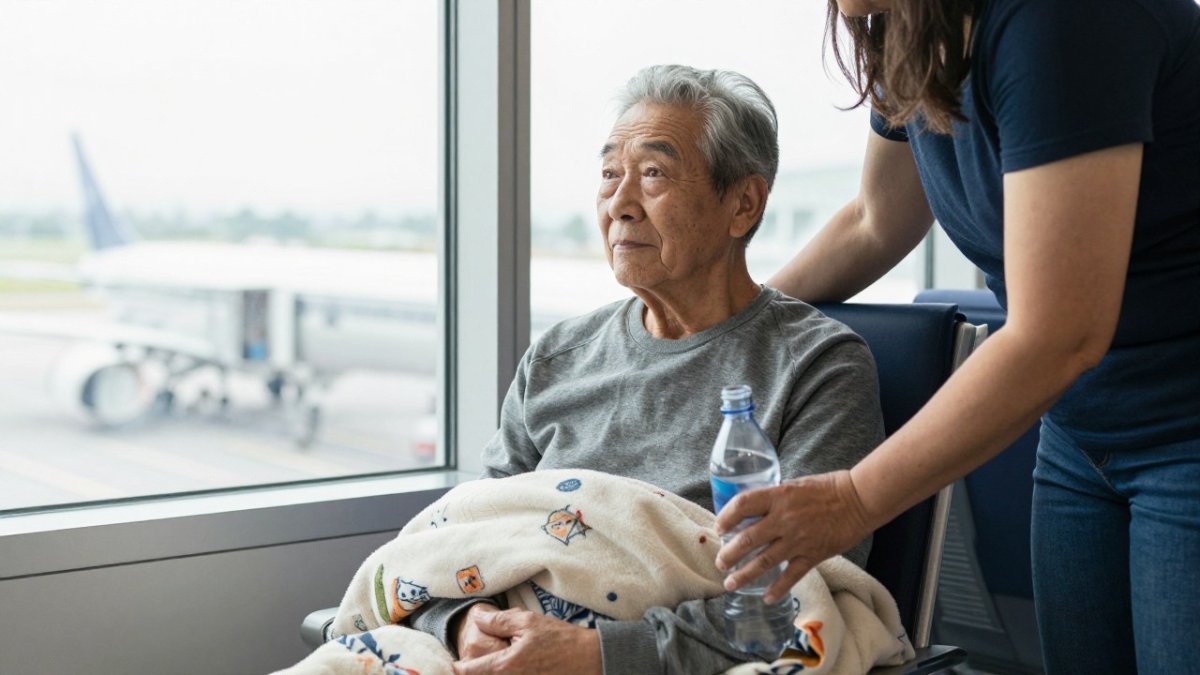
!Older adult seated calmly by an airport gate window beside a caregiver holding a familiar blanket and a water bottle
Dementia Travel Tips for Caregivers: Shared Responsibilities and Rest
Caregivers often carry the full load during a trip, which leads to exhaustion.
Divide tasks before you leave: one person handles tickets and check-in, another manages medication and meals.
Also plan for your own needs. Pack your medicines, comfortable shoes, and a light snack. Accept help from airline staff and fellow travelers when offered.
Learn how to choose outside support in How to Choose a Medical Escort for Elderly Travelers.
Your Travel Checklist for Dementia Caregivers Before You Leave
Use this checklist in the week before departure:
- Confirm the trip is appropriate for your loved one’s current condition
- Talk with the doctor about medications and any travel letter needed
- Pack two to three days of extra medication in carry-on luggage
- Bring identification, a medical alert bracelet, and a recent photo
- Contact the airline about wheelchair help and boarding assistance
- Pack familiar comfort items, music, and simple snacks
- Share the itinerary and emergency contacts with a family member at home
- Arrange a backup plan for rest, meals, and a quick return if needed
Before you book outside help, ask providers the right questions. Our guide Questions to Ask Before Choosing an Air Ambulance Provider covers what to check.
Travel Care Air provides 24/7 air ambulance and medical escort services, with over 45 years of experience helping families bring loved ones home safely. Contact our team to request a quote and plan a transfer that fits your loved one’s needs. Alongside arranging a safe transfer, families can prepare for evening changes in mood by considering how Happy at Home Healthcare Services relates to keeping routines calm and familiar during travel.
Last Updated: November 10, 2026
Frequently Asked Questions
Does flying make dementia symptoms worse?
Flying can increase confusion, anxiety and agitation for some people with dementia, mainly because of noise, crowds, unfamiliar surroundings and disrupted routines. Not everyone reacts the same way, and many people manage well with preparation. Plan extra time, keep medications and meals on their usual schedule, request airport assistance, and bring familiar comfort items. Talk with the treating clinician before the trip about whether flying is appropriate and how to handle symptoms that may appear during the journey.
Can a person with dementia travel internationally?
Many people with dementia do travel internationally, but the trip needs more planning than a domestic one. Check passport and identification requirements, confirm that medications are allowed and carried with a copy of the prescription, and review any medical documentation the destination requires. Consider travel insurance that covers pre-existing conditions. Shorter trips to familiar places are usually easier to manage than long itineraries across several time zones.
When should you stop traveling with someone who has dementia?
Consider stopping or scaling back travel when the person becomes significantly more distressed during trips, when symptoms are escalating quickly, or when they can no longer tolerate changes in routine without severe agitation. Wandering risk and reduced ability to follow instructions are also reasons to reconsider. Discuss the decision with the treating doctor, and look for trips closer to home or staying in one familiar place instead of moving between locations.
Can a person with dementia fly alone?
Most airlines do not recommend that people with significant dementia fly unaccompanied, and some will not accept them without an escort. Where unaccompanied travel is permitted, airlines typically require advance notice and specific arrangements. A companion or trained escort is strongly advised for anyone with moderate or advanced dementia, because of the risk of confusion or wandering in airports and during connections.
