
Last Updated: October 30, 2026
Quick Summary
A medical escort for dementia patients is a trained professional who accompanies the patient from door to destination, watching for distress and managing transitions between environments. It is most valuable when a patient has frequent confusion, wandering, or a complex medical condition during transit. Stable patients who recognize family may travel with a relative instead.
- Roughly 5.7 million Americans were living with dementia in 2026, according to a national prevalence analysis.
- Confirm the itinerary and the patient’s stability with the treating physician at least 72 hours before travel.
- Request wheelchair or gate assistance at booking, not at the airport, since same-day requests are often denied or delayed.
- Call the airline’s accessibility desk at least 48 hours before departure to flag the reservation for pre-boarding.
- Do not correct the patient’s mistaken beliefs during travel; acknowledge the feeling and redirect instead.
Table of Contents
- Why Dementia Patients Need More Than a Standard Ride
- What a Medical Escort Does for a Dementia Patient
- When a Medical Escort Is Necessary and When It Is Not
- Dementia Patient Travel Safety Tips Before and During the Journey
- Air Ambulance for Dementia Patients: When Long-Distance Flight Makes Sense
- How Much Medical Escort Services Cost and What Affects the Price
- Legal, Liability, and Family Responsibilities
- Requesting a Quote and Planning Your Dementia Patient’s Transfer
- Frequently Asked Questions
Why Dementia Patients Need More Than a Standard Ride
Travel is hard for anyone living with dementia, and a standard ride or commercial flight rarely accounts for the cognitive changes that make unfamiliar places disorienting, which is why a medical escort for dementia patients is often the safer choice.
A routine trip can become a crisis when a patient gets confused, agitated, or wanders from a gate or curbside pickup.
What a Medical Escort Does for a Dementia Patient
A medical escort for dementia care is a trained professional who accompanies the patient from door to destination, watching for signs of distress and managing the transition between environments. Families can review what a medical travel companion service provides for patients who cannot travel without support. Our flight nurse escort service-style support is built around keeping the same familiar face beside the patient throughout the trip.
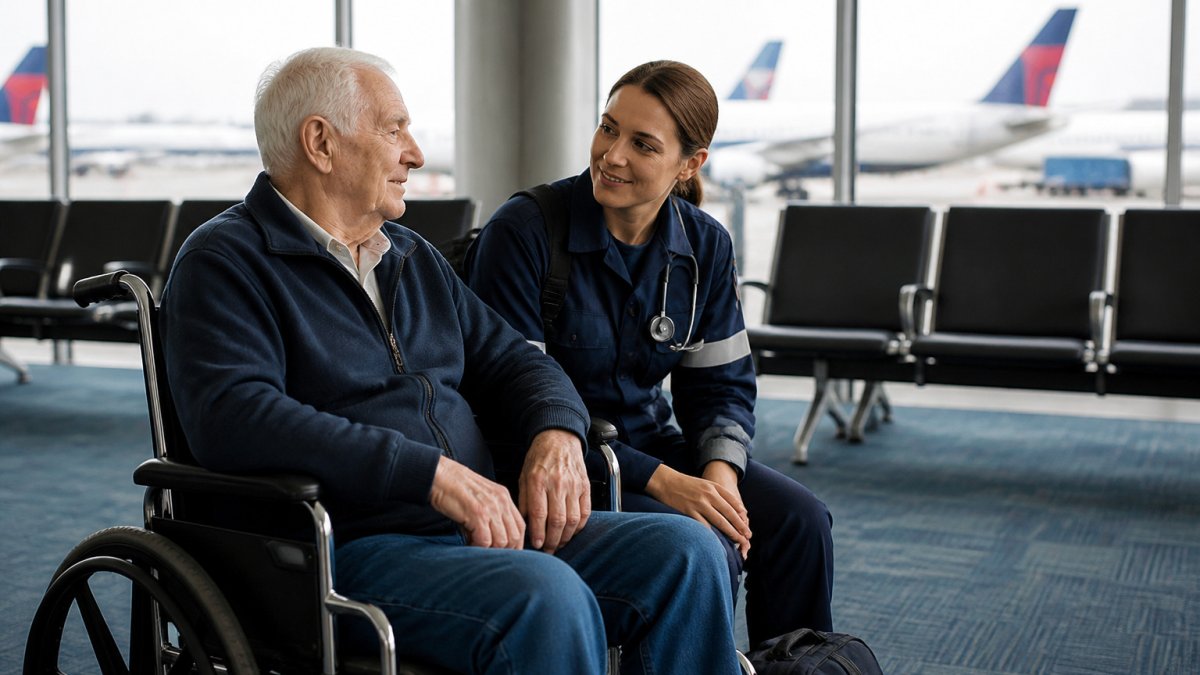
The escort’s job goes beyond carrying bags. They maintain a steady routine, explain each step before it happens, and coordinate with airline staff and receiving clinicians. That continuity often separates a manageable trip from a traumatic one.
When a Medical Escort Is Necessary and When It Is Not
A medical escort is not required for every dementia patient who travels. Readers new to the concept can learn how medical escort services on commercial flights work for non-emergency travel.
If you are unsure, consult the treating physician. Families choosing a provider for an elderly relative can read how to choose a medical escort for elderly travelers before comparing quotes.
Dementia Patient Travel Safety Tips Before and During the Journey
Preparation is the single largest lever a family has over how a dementia patient experiences a medical trip. The goal is to reduce the number of unfamiliar transitions the patient must process in a single day. Planning a trip around the patient’s existing daily rhythm can help: meals, medication times, rest periods, and bathroom routines kept at roughly the same clock times as at home may reduce disruption, even if that means a later flight or an overnight drive.
Before departure: the 72-hour preparation window
In the three days before travel, confirm the itinerary in writing with the patient’s care team and the receiving clinician. Ask the treating physician whether the patient is stable enough for the planned mode of travel and whether medication timing needs to shift for time zones. Bring a current medication list with doses and schedules, a one-page care summary (diagnosis, allergies, mobility limits, behavioral triggers, preferred name and calming phrases), and copies of insurance cards, identification, and any healthcare proxy or guardianship paperwork.
Request wheelchair or gate assistance at booking, not at the airport, most airlines require advance notice, and same-day requests are frequently denied or delayed. Label any walker or cane with the patient’s name and a phone number. Pack a change of clothes, incontinence supplies, snacks, and a water bottle in a bag the escort or family member carries, not in checked luggage.
Call the airline’s accessibility desk (not the general reservations line) at least 48 hours before departure. They can flag the reservation for pre-boarding, aisle-chair transfer, and a quiet waiting area, and they can note that the passenger is traveling with a cognitive impairment so gate staff are not surprised.
At the airport and during transit
Airport security screening is one of the most common distress points for a dementia patient, because the process involves queues, commands, removal of belongings, and strangers touching the patient. Explain each step in short, concrete sentences before it happens (“The officer will ask you to step through the frame.
During the flight or drive, keep a predictable routine: same seat position, same comfort item, same simple explanations of what happens next.
Do not correct the patient’s mistaken beliefs during travel (for example, that they are going home when they are not). Correction often increases agitation. Redirect instead: acknowledge the feeling, then offer a simple, pleasant alternative activity or topic. Maintaining a stable environment helps minimize these moments of confusion, underscoring the importance of consistent caregivers who provide a sense of security throughout the journey.
Preparing the Go-Bag for Medical Appointments
A go-bag keeps essentials within reach so no one has to search mid-trip. Pack it once and restock it after every appointment. A practical checklist:
- Current medications in original labeled bottles, plus a printed dosing schedule and a few doses of any as-needed medication the physician has approved for agitation or anxiety
- A one-page care summary: diagnosis, allergies, mobility limits, behavioral triggers, calming phrases, preferred name
- Emergency contacts (family, physician, receiving clinician) printed on paper, not only in a phone
Keep copies of insurance cards and identification in a separate pocket from the originals so a lost bag does not strand the trip.
De-escalation Techniques Transport Staff Should Use
When a patient becomes agitated, the first move is to slow down and lower your voice rather than raise it.
Watch for early signs of sundowning, increased confusion, restlessness, or irritability in the late afternoon and early evening, and schedule travel earlier in the day when possible.
The three phases of preparation below summarize when each step should happen and how far ahead to act.
| Phase | What to do | Timing |
|---|---|---|
| Before departure | Confirm itinerary and stability with physician | 72 hours before travel |
| Before departure | Request wheelchair or gate assistance at booking | At booking, not at the airport |
| Before departure | Call airline accessibility desk for pre-boarding flag | At least 48 hours before departure |
| During transit | Explain each step in short, concrete sentences | Before each step |
| During transit | Board early to avoid gate crowding | At boarding |
Air Ambulance for Dementia Patients: When Long-Distance Flight Makes Sense
For long-distance trips or medically complex transfers, a dedicated air ambulance can be a better fit than a commercial flight. Compare the commercial air ambulance option with escort services before deciding. A private medical flight can avoid crowded terminals and long layovers, and a clinical team can stay with the patient for the journey.
Commercial flights remain a viable choice for many stable patients. The deciding factor is usually how much unpredictability the trip will add to the patient’s day.
How Much Medical Escort Services Cost and What Affects the Price
Medical escort pricing is not a single number and depends on the patient’s situation. The cost of a dementia escort is built from a small set of drivers, and understanding them lets a family compare quotes apples-to-apples instead of reacting to the bottom line.
The main cost drivers
- Distance and mode of travel. A local door-to-door appointment escort is priced very differently from a commercial-flight escort with a connecting leg, and both are priced differently from a dedicated air ambulance. Long-distance and international legs add crew time, positioning, and sometimes customs coordination.
- Level of clinical support. A non-clinical companion escort, a licensed practical nurse, a registered nurse, and a flight nurse with critical-care experience sit at different price points. The right level depends on the patient’s medical stability, not on the family’s budget alone.
- Crew time versus trip time. Escort pricing usually reflects the professional’s total time away from base, including positioning to the patient, waiting during the appointment, and the return leg, not just the hours the patient is in transit. A short flight with a long wait can cost more than a longer flight with a tight schedule.
Because these variables interact, most providers quote per trip rather than per mile. Ask any provider to break down the quote into its components so you can see what you are paying for.
Private pay versus insurance-covered transport
This is the part most families get wrong, and it is where the real money is decided. Non-emergency medical transportation (NEMT), the curb-to-curb or door-to-door ride to a medical appointment, is sometimes covered by Medicaid, by some Medicare Advantage plans, and by certain commercial plans, but coverage is narrow and documentation-heavy.
A practical way to sort it out:
- Call the plan first, before booking. Ask specifically whether “non-emergency medical transportation” and “medical escort” are covered benefits, what the prior-authorization process is, and whether the plan uses a specific NEMT broker.
- Get the medical necessity documentation in writing. A note from the treating physician explaining why the patient cannot travel alone or use public transportation is usually required for any insurance or Medicaid coverage.
- Separate the ride from the escort. The transportation leg may be covered while the professional escort is not, or vice versa. Ask the provider to quote them separately so you can see which portion, if any, insurance will reimburse.
- Keep receipts and itemized invoices. If you are appealing a denial or submitting for reimbursement, itemized invoices that show crew time, transport, and equipment separately are far more likely to be paid than a single lump-sum receipt.
Official Medicare guidance on non-emergency transportation explains which situations may qualify under Medicare, and state Medicaid programs publish their own NEMT rules, the eligibility bar and the broker used vary significantly by state.
Before you book, ask three questions: (1) Is this trip a covered NEMT benefit under the patient’s plan? (2) What documentation does the plan require, and who signs it? (3) Which parts of the quote, transport, escort, equipment, are private pay? The answers usually determine whether the family pays out of pocket or not, and they are far easier to get before the trip than after.
What families can control
The controllable levers are timing, flexibility, and documentation. Booking early, traveling mid-week, choosing a commercial flight with a companion escort instead of a dedicated air ambulance when the patient is stable, and having medical-necessity paperwork ready before you call the provider all reduce cost. The uncontrollable levers are the patient’s medical stability and the distance, which is exactly why the treating physician’s assessment should come before the quote request, not after.
Legal, Liability, and Family Responsibilities
Family members remain responsible for the patient’s decisions and documentation, even when a professional escort is involved. Before travel, confirm guardianship or healthcare proxy paperwork is current and carried with the patient. Ask the transport provider to explain its liability terms and what it will and will not handle on the patient’s behalf. Keeping these documents organized protects everyone involved.
Requesting a Quote and Planning Your Dementia Patient’s Transfer
Start by gathering the patient’s diagnosis summary, current medications, mobility needs, and your desired travel dates. Then request a quote from Travel Care Air so the team can recommend the right level of escort and transport. Good planning reduces stress for the patient and the family, and it gives the care team time to prepare for a safe arrival.
Frequently Asked Questions
What does a medical escort do for dementia patients?
A medical escort can accompany the patient during the transfer, watch for confusion or agitation, and offer a familiar, steady presence. For dementia patients, the escort may also communicate with airport and airline staff and can reduce the stress that a stranger-only transport can create. Some experts note that an unfamiliar escort can be counterproductive for patients who no longer recognize people, so the right fit depends on the individual. Travel Care Air can discuss the escort level needed for a specific case when you request a quote.
Is a medical escort necessary for long-distance travel with dementia?
It depends on how far the patient can cope with travel, their stage of dementia, and their medical needs. Patients who wander, become agitated in new places, or need help with mobility, toileting, or medication during transit usually benefit from a trained escort. Patients in earlier stages with a dependable family member travelling alongside may need less support. Industry guidance indicates that a professional escort is a recognized way to reduce stress for both patient and caregivers, but the decision should be based on an assessment of the individual rather than a general rule.
What are the cost factors for a medical escort service?
Pricing depends on distance, transport mode, escort qualifications, time of day, and whether the trip is a one-way transfer or a round trip. Travel Care Air does not publish fixed prices in this article; for a figure that reflects your patient’s situation, request a quote directly from the company, and ask for the escort level, included services and any additional charges in writing before booking.
