
Last Updated: November 4, 2026
Quick Summary
To arrange airport assistance for an elderly traveler, request wheelchair or guided help from the airline when you book, then reconfirm it before departure. Ask for assistance on every flight segment, and contact TSA Cares at least 72 hours before flying if the traveler needs help through security.
- Request assistance when you book your ticket, then confirm again a day or two before flying.
- Airline assistance under U.S. Department of Transportation rules covers curb or check-in through the gate.
- Ask that assistance codes be added to each segment, since a request may not transmit on connecting flights.
- Contact TSA Cares at least 72 hours before flying to get a Passenger Support Specialist for screening.
- Arrive early and build an extra hour’s buffer, since assistance can be delayed at busy times.
Table of Contents
- Why Airport Assistance Matters for Elderly Travelers
- When to Request Airport Assistance: Timing Your Booking
- How to Request Wheelchair Assistance at Airport Check-In
- Getting Help Through Security with the TSA Cares Program for Seniors
- Personalizing Support to the Traveler’s Abilities
- Medical Transport Services for Elderly Travelers Who Need More Than Airport Help
- Booking Your Airport Assistance Request Step by Step
- Frequently Asked Questions
Airport assistance can make the difference between a stressful trip and a smooth one for elderly travelers. Travel Care Air has spent more than 45 years helping families plan safe journeys. Travel is harder with mobility limits, and most seniors can get help at almost every stage of a trip. The trick is knowing what to ask for and when to ask. This guide walks through how to arrange airport assistance for elderly travelers, from timing your booking to getting help through security and on to the gate.
Why Airport Assistance Matters for Elderly Travelers
Airports are large, busy, and tiring. Long walks, crowded security lines, and tight connections can wear down an older traveler fast. Airport assistance gives them support at each point where they might struggle.
Good assistance usually covers a few key needs:
- Help getting from the curb or parking area to the check-in counter
- Escort through security screening
- Transport between gates, especially on long connections
- Help boarding and getting off the plane
A U.S. Department of Transportation guidance on wheelchair and guided assistance explains that airlines must provide this help when it is requested. Knowing that right makes it easier to ask with confidence.
When to Request Airport Assistance: Timing Your Booking
The earlier you ask, the better. Most airlines and airport services need advance notice to arrange staff and equipment.
Booking as early as you can gives airlines and airport services time to arrange staff and equipment. Contact the TSA Cares program well ahead of your flight if you need a Passenger Support Specialist to guide you through screening.
Tip: Request help when you book your ticket, then confirm again a day or two before you fly.
Booking early also gives you time to fix problems. If the request is missed, you can still sort it out before you travel. Before you commit to a ride, check who pays for non-emergency medical transportation and what to verify first.
How to Request Wheelchair Assistance at Airport Check-In
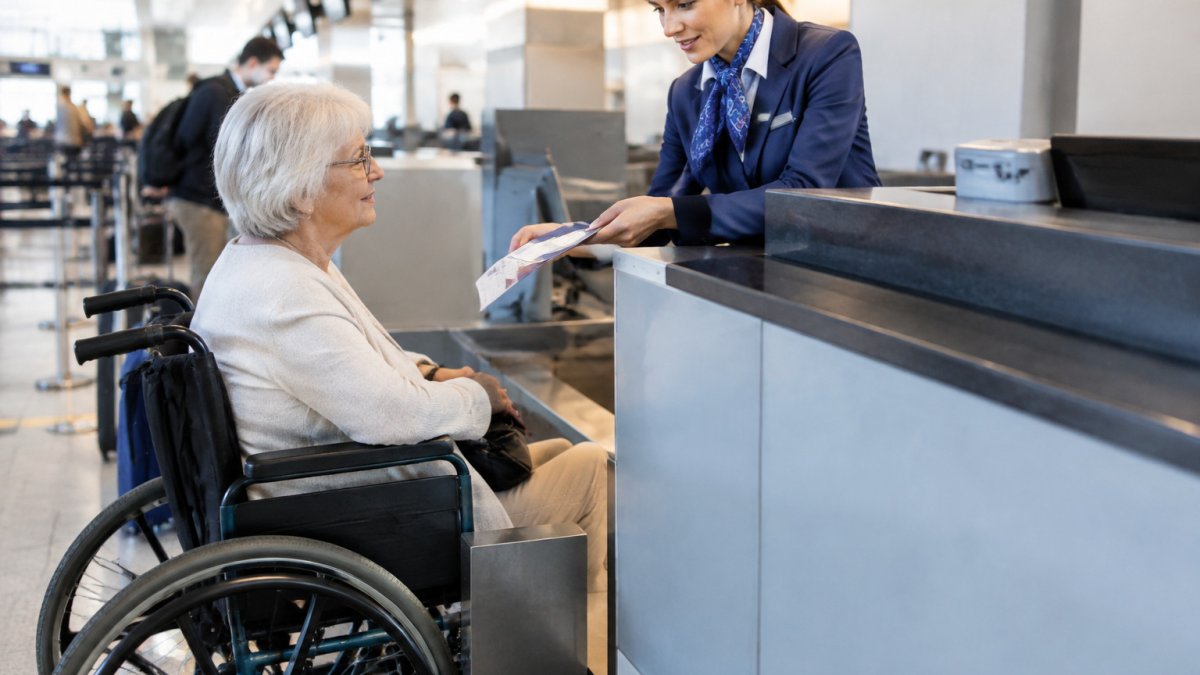
Wheelchair assistance is the most common type of airport help, but the request often gets muddled because three different parties can provide it: the airline, the airport, and private third-party companies. Understanding who does what prevents the common mistake of assuming one request automatically arranges every type of help.
The Three Providers and What Each Covers
Airline assistance is the baseline. Under U.S. Department of Transportation rules, airlines must provide wheelchair and guided assistance to passengers who request it. This typically covers help from the curb or check-in counter through security to the gate, boarding and deplaning, and gate-to-gate transport on connections.
Airport assistance is provided by airport staff or contracted passenger-service teams. At many large airports, this is the same workforce the airline dispatches, but the airport may also operate its own information desks, golf-cart transports, or terminal navigation services. Airport-run help can assist with getting around the terminal or locating services.
Third-party assistance comes from private travel companies, concierge services, or medical escort providers. When assistance needs extend beyond the terminal, coordinating private transport options with the provider can help keep the journey consistent from airport pickup to the final destination.
A common pattern is that families request airline wheelchair assistance and assume it covers everything, then discover at the gate that no one is available to help with a tight connection or that the traveler needs more support than a shared wheelchair queue allows.
Step-by-Step Request Process
- Note the traveler’s flight details and specific mobility needs (walking distance, device used, stairs or jet-bridge difficulty, any medical equipment).
- Contact the airline when you book, or call customer service, and ask the agent to add wheelchair or guided assistance to the reservation.
- Ask the agent to read back the request and confirm it appears on the passenger record.
- Write down the confirmation number and the agent’s name.
- Arrive at check-in early and tell staff you have a reservation for assistance.
Watch out: A request added only in a comment field or noted verbally may not transmit to the operating carrier on a codeshare or connecting flight. Ask specifically that the assistance code be added to each segment of the itinerary.
What to Say When You Call
Be concrete rather than vague. Instead of “my mother needs help,” say: “She can walk short distances with a cane but cannot stand in line for more than ten minutes, and she will need a wheelchair from check-in to the gate and help boarding.” Specific details let the airline assign the right equipment and staffing. If the traveler uses a powered wheelchair or scooter, mention the battery type and whether it is spillable, because that affects handling and documentation.
Confirming and Updating the Request
Confirm the request a day or two before departure by calling the airline or checking the reservation online. If the itinerary changes, re-confirm assistance for the new flights rather than assuming it carried over. On travel day, remind staff at check-in and again at the gate. Keep the confirmation number and any written correspondence accessible in case a request is questioned.
The three main sources of airport help each cover different parts of the journey:
| Provider | What it covers | Best for |
|---|---|---|
| Airline assistance | Curb or check-in to gate, boarding and deplaning, gate-to-gate on connections | Core journey support |
| Airport assistance | Terminal navigation, information desks, golf-cart transports | Getting around the terminal |
| Third-party assistance | One-on-one support, luggage and paperwork, accompaniment beyond the airport | Complex needs; fees may apply |
Getting Help Through Security with the TSA Cares Program for Seniors
Security screening can be the hardest part of the airport for an older traveler. The TSA Cares program helps travelers with disabilities, medical conditions, and other needs get through screening more smoothly.
A Passenger Support Specialist can guide you through the checkpoint, explain each step, and help with equipment. Contact TSA Cares before your trip so the request is on file. Bring any medical devices, medication, and documentation you may need, and tell the officer about them at the checkpoint.
Personalizing Support to the Traveler’s Abilities
Not every older traveler needs the same help. Someone who walks slowly but steadily may only need an escort through the terminal. Someone with limited mobility may need a wheelchair from curb to gate.
Before you book, think through the traveler’s real abilities:
- How far can they walk without rest?
- Do they use a walker, cane, or mobility device?
- Do they need help with stairs or jet bridges?
- Do they have any medical needs during the flight?
Share these details with the airline so staff can plan the right support. Clear information avoids surprises at the gate.
Medical Transport Services for Elderly Travelers Who Need More Than Airport Help
Some travelers need more than standard airport assistance. A person with a serious medical condition may require a medical escort or a specialized transport arrangement.
For critically ill patients, how safe air medical transport is depends on advanced equipment and trained crews. Families sometimes also consider liver transplant travel options when a transfer must happen quickly. Travel Care Air provides air ambulance and medical escort services, and it can help families understand what a medical flight involves. Our team offers guidance on arranging air ambulance transport for elderly patients and on choosing a medical escort for elderly travelers. These services are different from standard airport help, so ask a medical professional whether your situation calls for them.
Booking Your Airport Assistance Request Step by Step
Use this checklist to keep your request organized from first call to boarding, then read the notes below on confirmation and troubleshooting, which are where most plans break down.
- Note the traveler’s mobility needs and any medical details
- Contact the airline at least 48 hours before departure
- Request wheelchair or guided assistance on every segment of the itinerary
- Contact TSA Cares at least 72 hours before flying if screening help is needed
- Confirm all requests a day or two before the flight
- Save confirmation numbers and agent names
- Arrive at check-in early and remind staff of the request
- Re-confirm at the gate and ask about connection logistics
Confirming the Request Before Travel Day
A request is only as good as its confirmation. Call the airline or open the reservation online a day or two before departure and ask the agent to read back the assistance codes for each flight. Confirm the type of help (wheelchair to gate, guided escort, boarding assistance) and the meeting point. If you booked through a travel agent or online agency, confirm directly with the operating airline, because the agency may not pass the request through.
Handling Itinerary Changes and Connections
If flights change, re-request assistance for the new itinerary rather than assuming it transferred. For connections, ask at the departure gate how the arrival airport will know assistance is needed, and whether a wheelchair will meet the aircraft. A common pattern is that the departure airport arranges help but the connecting airport does not have the request, so the traveler waits at the gate. Asking the gate agent to send a message to the connecting station is a practical safeguard.
Day-of-Travel Troubleshooting
If assistance does not arrive, go to the airline’s customer service desk or the airport information desk and ask them to dispatch help. Keep the confirmation number ready. If a wheelchair is delayed, ask for an estimated time and whether a different provider can assist. For security, if a Passenger Support Specialist is not available, tell the screening officer about the traveler’s needs and ask for the standard accommodation process.
Watch out: At some airports, assistance is dispatched from a central desk and wait times can stretch during peak periods. Build a buffer of at least an hour beyond the airline’s recommended arrival time for elderly travelers who use assistance, and ask the check-in agent for a realistic estimate.
Costs and Service Boundaries
Some airline-provided assistance may be free, while optional paid services are typically separate. Confirm which services are included. Ask before you book whether a service is part of the airline’s required assistance or an optional paid add-on, and get the answer in writing. Medical transport and air ambulance services are separate from airport assistance and are arranged through specialized providers.
Frequently Asked Questions
How can elderly people get free airport assistance?
Many airlines and airports provide assistance for passengers who identify their needs. Contact the airline when booking or at least 48 hours before departure to request wheelchair or guided help. The TSA Cares program can also support travelers through security screening and should be contacted at least 72 hours before departure. Ask at the check-in counter or an airport assistance desk if you did not book in advance, though availability on arrival is not guaranteed.
Can elderly people get assistance at airports?
Yes. Airports and airlines offer wheelchair assistance, escort help through security, support with long walks between gates, and priority boarding. Passengers should state their needs clearly to airline staff so the right level of help is arranged. For travelers with complex conditions, confirm that ramps, lifts and accessible bathrooms are available at the departure and connecting airports before finalizing bookings.
How far in advance should I request airport assistance?
Request wheelchair and guided assistance from the airline as early as possible, well in advance of the flight. For TSA Cares passenger support through security, contact the program at least 72 hours before departure. Booking early gives time to confirm the request, check the flight status and arrange changes if the itinerary shifts.
Do I need to pay for airport wheelchair assistance?
Airlines in the United States are generally expected to provide wheelchair and guided assistance under federal aviation consumer rules. Confirm the specific terms with the carrier when you book. Rules and service boundaries can differ by country and airline, so confirm the terms with the carrier when you book.
