
Last Updated: November 12, 2026
Quick Summary
Traveling with dementia and mobility challenges can be safe with careful planning, but the right choice depends on the person rather than the diagnosis alone. Start by getting medical clearance, pick a familiar, short trip, and prepare documents, medications and equipment well in advance.
- Talk with your loved one’s doctor before any trip to understand what the journey may demand.
- Choose a familiar destination and keep the trip to two or three days so you can head home early.
- Assemble a documentation pack with medication lists, medical summary and emergency contacts, in paper and digital form.
- Keep all medications in carry-on luggage, never checked baggage, so a lost bag does not separate them from prescriptions.
- Most airlines require at least 48 hours of notice for wheelchair or motorized cart requests.
Table of Contents
- Deciding Whether Travel Is Right for Your Loved One
- Preparing a Person With Dementia for Travel
- Dementia Travel Safety Tips for Every Stage of the Journey
- Flying With Dementia: Airport and Boarding Logistics
- Traveling With Limited Mobility: Equipment, Transfers and Pacing
- When Medical Transport for Dementia Patients Is the Safer Choice
- Booking Your Next Step: Planning a Safe Trip With Expert Help
- Frequently Asked Questions
Deciding Whether Travel Is Right for Your Loved One
Traveling with dementia and mobility challenges is possible, but it takes careful planning. Families and care teams often face the same first question: should we go at all?
The answer depends on the person, not just the diagnosis. Some people with dementia handle a short trip well, while others become distressed by even a familiar drive. Thinking this through before you book saves stress for everyone.
Ask yourself these questions first:
- Does your loved one get confused or agitated in new places?
- Can they stay seated and comfortable for the length of the trip?
- Do they have the mobility aids and medications they need?
Medical Clearance and Stage of Dementia
Before any trip, talk with your loved one’s doctor. A medical check helps you understand what the journey may demand. Many families are surprised to learn that travel is not always off the table.
Stage matters too. Early-stage patients often cope with short, planned trips. Later stages bring more risk. Disorientation and stress can build quickly, and the same trip that felt manageable last year may now be too much.
Choosing a Familiar, Manageable Destination
Pick a place your loved one already knows, or one that feels similar to home. Familiar surroundings reduce confusion. A nearby relative’s house, a favorite lake cabin, or a trip to a well-known city works better than a long-haul adventure to a new country.
Keep the trip short. Two or three days often works better than a week. Short trips give you room to head home early if things go badly.
Preparing a Person With Dementia for Travel
Preparation starts weeks before departure. Familiar routines are the best tool you have, but they need to be paired with a documentation pack and a medication plan that will hold up if something goes wrong away from home.
Build a travel documentation pack
Assemble one folder, paper and a digital copy, that a companion, clinician, or emergency responder could use without you:
- A current medication list with doses, times, and prescriber names
- A short medical summary: diagnoses, allergies, and any implanted devices
- Doctor and specialist contacts, including after-hours numbers
Ask the doctor’s office for a letter summarizing the diagnosis and current treatment; it can smooth airport security screening and help a clinician at the destination understand the situation quickly. Keep the folder in a pouch your loved one can reach, and give a duplicate to the companion traveling with them.
Plan medications for the whole trip
- Pack all medications in their original labeled containers, plus a few extra days’ supply in case of delay.
- Keep medications in carry-on luggage, never checked baggage, so a lost bag does not separate your loved one from their prescriptions.
- Ask the pharmacist whether any medication needs refrigeration or timing adjustments across time zones, and write the answer down.
Watch out: a companion who manages medications informally can miss a dose during a long travel day, assign one person to hold the medication bag and the schedule, and confirm each dose out loud.
Prepare the person, not just the bag
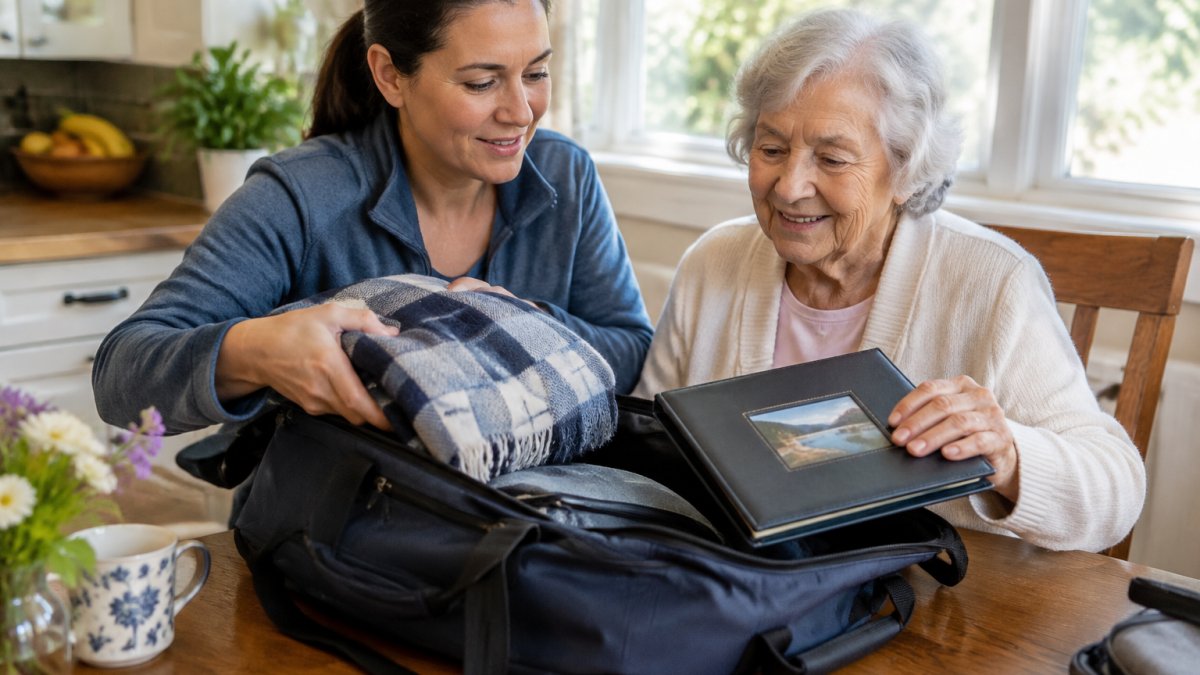
Pack items your loved one knows and trusts. A favorite blanket, a photo album, or a familiar pillow can calm them when the surroundings feel strange. Talk through the trip in simple, calm terms, show photos of the destination, and keep your tone steady and positive. Keeping that calm, familiar routine in mind can also help you plan accessible transportation, including whether a wheelchair-accessible rental van from Universal Cabs will make the journey feel more manageable.
Ask the insurer and providers the right questions before departure
Before you book, confirm with your health insurer and any travel insurer whether the policy covers care related to a pre-existing dementia diagnosis, what documentation a claim requires, and whether evacuation or repatriation is included. Ask the airline or rail operator what assistance requires advance notice and what documentation they need for mobility equipment. Getting these answers in writing before departure is far easier than resolving them at a ticket counter.
Dementia Travel Safety Tips for Every Stage of the Journey
Safety depends on supervision. Never leave your loved one alone in an unfamiliar place, even for a few minutes.
Plan for rest. Schedule quiet time in the middle of each day, and avoid crowded or noisy spaces when possible. Fatigue makes confusion worse.
Practical safety habits:
- Use a name tag or medical ID bracelet with your phone number
- Keep your loved one within arm’s reach in busy areas
- Book rooms on the ground floor or near elevators
Watch for signs of distress, such as pacing, hand-wringing, or asking repeatedly for home. If you see these, slow down and return to a familiar routine.
Flying With Dementia: Airport and Boarding Logistics
Air travel is one of the hardest parts of a trip. A University of Minnesota study described airport travel as so stressful that participants called the experience “sick with stress” (University of Minnesota’s 2024 study on airport travel with dementia).
Request airport assistance early. Most airlines require at least 48 hours of notice for wheelchair or motorized cart requests, according to the Alzheimer’s Association’s guidance on air travel safety. Book this as soon as your ticket is confirmed.
For practical airport help, see our guide on how to arrange airport assistance for elderly travelers. Families who want extra help on board can also read about flying with a loved one who has dementia and when a medical escort makes travel safer, and our 9 medical escort tips for dementia patient travel.
Traveling With Limited Mobility: Equipment, Transfers and Pacing
Mobility challenges add another layer to dementia travel because every transfer is a chance for a fall, and every piece of equipment is a single point of failure. Instead of treating accessibility as one booking decision, audit the journey from front door to destination and back. Walking through each handoff in advance can help families avoid common problems such as a wheelchair that does not arrive or a transfer that happens too fast.
Run a step-by-step accessibility audit
List every transition on the itinerary and write down the specific question you will ask the provider for each one:
- Home to vehicle: Can the vehicle accommodate a folded walker or wheelchair, and does the driver assist with loading? Ask the transport company, not the booking app.
- Vehicle to terminal or station: Is there a curb cut, a drop-off zone close to the entrance, and a bench within sight of the door?
- Check-in to gate: Where is the nearest accessible restroom, and how far is the walk? Ask the airline or station for a terminal map with accessible routes marked.
Watch out: a provider confirming “wheelchair accessible” may mean only that a ramp exists, not that the bathroom, elevator, or seating will work for your loved one, ask for the specific feature, not the label.
Arrange, transport, and label mobility equipment
- Book equipment early. Most airlines and rail operators require advance notice for wheelchair or mobility-aid carriage; confirm the deadline when you book the ticket, and keep the confirmation number with your travel documents.
- Label everything. Put a luggage tag with your name, phone number, and destination on the wheelchair, walker, and any bag attached to them. Equipment without an identifying tag can be routed to the wrong baggage claim.
- Know the battery rules. Powered wheelchairs and scooters usually need the battery type declared in advance, and some carriers require the battery to be removed or disconnected. Ask the carrier for its written policy before you leave home.
Build a contingency plan for delayed or damaged equipment
- Photograph the equipment before check-in so you have a record of its condition.
- Ask the carrier for its damage and delay policy in writing at the time you check the equipment.
- Identify a rental source at the destination before you travel, a medical equipment supplier or hotel that can deliver a wheelchair or walker within a day.
Pace the trip to reduce fatigue
Fatigue makes confusion worse, so treat rest as part of the itinerary rather than an afterthought.
If you need someone trained to help with transfers and boarding, read how to choose a medical escort for elderly travelers before you decide who will travel with your loved one.
Mobility problems tend to surface at predictable points, so the table below sets out the common equipment and transfer problems, their causes and the fixes the article recommends.
| Problem | Cause | Fix |
|---|---|---|
| Wheelchair or mobility aid does not arrive | No advance notice given to carrier | Book equipment early and confirm deadline |
| Equipment routed to wrong baggage claim | No identifying tag on equipment | Label with name, phone and destination |
| Powered chair refused or delayed | Battery type not declared in advance | Ask carrier for written battery policy |
| Equipment damaged in transit | No photo record before check-in | Photograph equipment before check-in |
| Stranded after equipment delay | No rental source identified at destination | Identify a local rental supplier before travel |
| Traveler left alone during equipment search | Companion chasing a lost bag | Keep person seated and supervised |
When Medical Transport for Dementia Patients Is the Safer Choice
Sometimes the honest answer is that commercial travel is not safe. A frail patient, a person with severe confusion, or someone who needs ongoing medical care may be better served by medical transport.
Air ambulance and medical escort services exist for these situations. They provide trained staff, stretcher or seated transport, and oversight throughout the journey.
If you have decided that commercial travel is unsafe, learn how to arrange air ambulance transport for elderly patients.
Booking Your Next Step: Planning a Safe Trip With Expert Help
Planning a trip with dementia and mobility challenges takes time, but you do not have to solve every problem alone. Travel Care Air has helped bring loved ones home safely for over 45 years, and our team can review your loved one’s needs and suggest the safest option. Request a quote today to talk through your specific situation.
Frequently Asked Questions
Can a person with dementia travel safely?
Yes, in many cases. Medical experts note that travel is generally acceptable from a medical standpoint for people with Alzheimer’s or other dementias, according to medical experts. Safety depends on the stage of the disease, the destination and how well the trip is planned. Early-stage travel with a familiar companion and a short itinerary carries far less risk than a long, complex journey later in the disease. Confirm readiness with the treating physician before booking.
Does flying make dementia symptoms worse?
It can. Airport travel is described as highly stressful by people living with dementia and their caregivers, and people living with dementia often describe the experience as highly stressful. A person may become more disoriented when traveling, which can increase the risk of injuries, infections and other dementia-related complications. Plan extra time, quiet waiting areas, and a companion who knows the person’s routines.
Can people with dementia travel internationally?
Possibly, but international trips add layers of documentation, medication rules and emergency planning. Carry a letter from the physician listing diagnoses, medications and allergies, plus copies of identification. Check the rules for carrying prescription medicines into the destination country before departure. For complex cases, medical transport providers such as Travel Care Air can coordinate the logistics of a long-distance journey, so request a quote early rather than leaving arrangements to the last minute.
When should a family consider medical transport instead of a regular flight?
Consider medical transport when mobility is severely limited, when the person needs a wheelchair or stretcher, or when medical oversight is needed during the journey. Airlines generally require advance notice for wheelchair or motorized cart requests, so commercial options may need early booking. A medical escort can monitor the person, handle transfers and respond to disorientation or distress. Travel Care Air offers 24/7 air ambulance and medical escort services; contact the team for a quote tailored to the situation.
