
Quick Summary
Airport assistance for a traveler with dementia usually covers a guided escort or wheelchair from the curb to the gate, security screening support, and a companion who stays with the traveler through the terminal. Arrange it with three separate parties: the airline, the airport, and TSA Cares.
- Study found 43.2% of people living with dementia were separated from their travel companion at the airport.
- Ask the airline to record the dementia diagnosis and specific help on the reservation.
- Request TSA Cares screening support through an online form or by phone, ideally 72 hours before travel.
- Confirm each service separately, since an airline request does not automatically reach the airport or security.
- Keep medications, a medication list, and an emergency contact in carry-on luggage, not checked bags.
Table of Contents
- What Airport Assistance Covers for a Traveler With Dementia
- Airline, Airport, and Security Assistance: Who Does What
- Step-by-Step Timeline: From Booking to Arrival
- TSA Assistance Request and the TSA Disability Notification Card
- Airport Assistance for Elderly Travelers: Services and Cost
- Caregiver Checklist and Safety Planning at the Airport
- Booking Your Next Step With Travel Care Air
- Frequently Asked Questions
What Airport Assistance Covers for a Traveler With Dementia
Last Updated: November 22, 2026
Flying with a parent or partner who has dementia can feel overwhelming, but help is available at most major airports. Airport assistance for a traveler with dementia usually covers guided help from the curb to the gate, screening support, and a companion who stays with the traveler through the terminal. For a full guide on arranging this help for elderly travelers, see airport assistance for elderly travelers.
Research from the University of Minnesota study on airport travel experiences of people living with dementia found that 43.2% of people living with dementia reported being separated from their travel companion at the airport. Separation like this is one of the main risks families want to plan around.
Assistance generally falls into a few groups:
- Guided or wheelchair help from the curb to the gate
- Security screening support before the checkpoint
- Gate and boarding help so the traveler is not left alone
- Companion accompaniment for the full trip
The right mix depends on the traveler’s stage of dementia, mobility, and how well they handle crowds and noise. Plan these needs before the trip, not at the airport.
Airline, Airport, and Security Assistance: Who Does What
Three different organizations can help, and each controls a different part of the trip. The most common planning mistake is treating one request as covering all three. The table below summarizes the boundaries, followed by what each party can and cannot do for a traveler with dementia.
| Party | Typically handles | Usually cannot handle |
|---|---|---|
| Airline | Check-in, seat assignment, boarding, special service requests noted on the reservation, pre-boarding, and sometimes gate-to-gate escort for unaccompanied minors or medical cases | Terminal wheelchair dispatch, security screening, or continuous one-to-one supervision |
| Airport | Wheelchair and guided escort from curb to gate, meet-and-assist, terminal navigation, quiet waiting areas | Screening decisions, boarding, or medical care |
| Security (TSA or equivalent) | Screening support, companion accompaniment through the checkpoint, alternative screening procedures | Terminal escort, boarding, or waiting with the traveler |
The airline is the first call because it controls the reservation. Ask the airline to record the dementia diagnosis and the specific help needed, such as pre-boarding, a seat near the front, or a companion seat. Airline special-assistance pages, such as American Airlines’ American Airlines special assistance information page, describe how to request help when booking. Each carrier sets its own rules, so ask directly what it will and will not do.
The airport operates the terminal. Wheelchair dispatch, guided escorts, and meet-and-assist services are usually run by the airport or its contractor, not the airline. Ask the airport whether the service is free, whether it must be booked in advance, and whether the escort stays with the traveler until boarding. Some airports require notice for meet-and-assist; others provide it on arrival. If the traveler is prone to wandering, ask whether the airport has a quiet room or family area and whether staff can be alerted to the traveler’s name.
Security is separate again. TSA Cares (or the equivalent outside the U.S.) handles screening support requests. Screening officers decide how screening is conducted, including whether a companion can stay with the traveler. The TSA Disability Notification Card can help communicate the condition, but it does not replace a request for assistance. Ask the screening officer what will happen before the traveler steps forward, so the process is predictable.
Where the handoffs happen. The airline hands the traveler to the airport escort at check-in or the gate; the airport escort hands the traveler to security at the checkpoint; security hands the traveler back to the airport escort or companion after screening. Each handoff is a point where the traveler can be left alone if no one confirms the next step. A practical rule is to ask at each handoff: who is responsible for the traveler right now, and where will they be taken next?
Communicating needs. Keep a one-page summary with the traveler’s name, diagnosis, communication preferences, triggers, medication schedule, and emergency contact. Give a copy to the airline at check-in and show it to the airport escort and screening officer. Tell staff what calms the traveler and what to avoid; a calm, familiar voice usually helps more than explanation. The Alzheimer’s Association travel safety guidance offers practical advice on preparing for these situations.
Watch out: Do not assume a wheelchair request made to the airline will produce a wheelchair at the curb, or that a TSA Cares request will be visible to the screening officer. Confirm each service with the organization that provides it, and keep the confirmation with the travel documents.
Step-by-Step Timeline: From Booking to Arrival
A sequenced plan prevents the most common failure: assuming one request covers the whole journey. The timeline below separates what to do at each stage and how to confirm it, with dementia-specific notes where they matter.
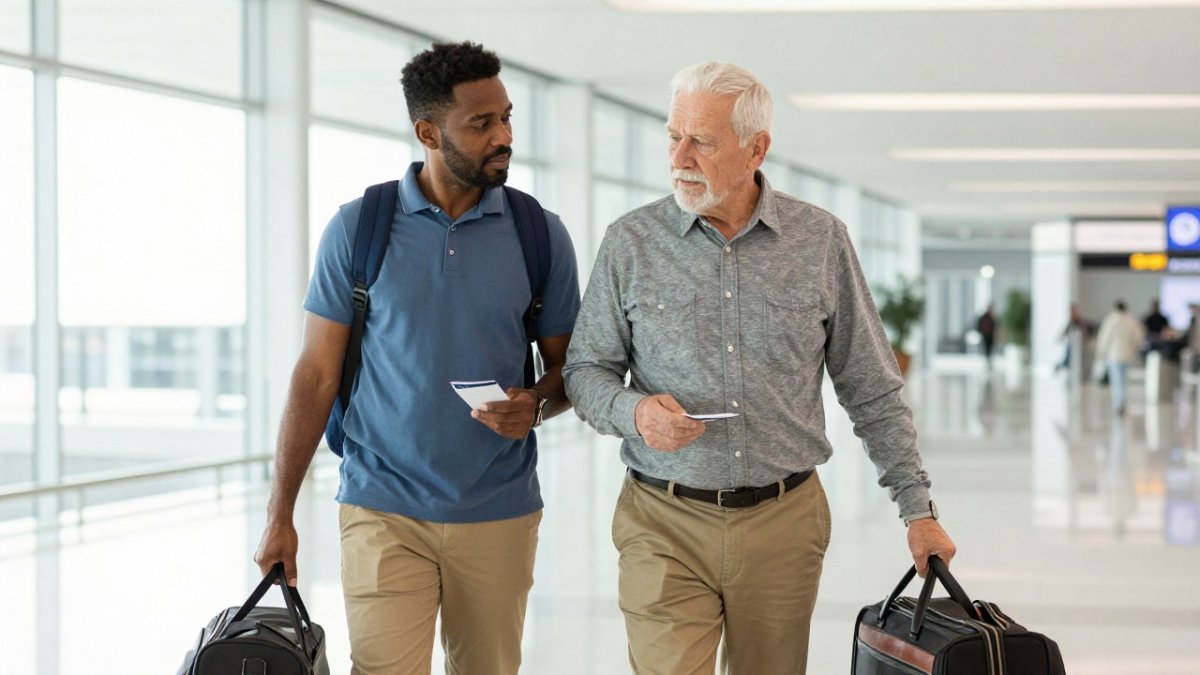
1. At booking (or as early as possible). Tell the airline the traveler has dementia and request special assistance. Once the request is recorded, you can also weigh whether flying is the right fit for the traveler’s needs by comparing medical transport options for dementia patients.
2. Two to four weeks before departure. Call the departure and arrival airports directly and ask what meet-and-assist or guided services they offer and whether they require advance notice. Ask whether the airport uses the Sunflower Lanyard or a similar hidden-disability program and how to obtain one.
3. Up to 72 hours before departure. Contact TSA Cares (or the equivalent security authority outside the U.S.) to request screening support. Provide the traveler’s name, flight number, date, and a short description of needs. Ask what to do if the request is not reflected when you arrive.
4. The day before travel. Reconfirm the airline assistance request by phone or app. Pack medications, a medication list, a recent photo, and an ID card with an emergency contact number in the carry-on, not checked luggage. Brief the travel companion on the plan and the quiet waiting spots at each airport.
5. At check-in. Do not assume the request carried over. Tell the check-in agent the traveler has dementia and ask them to verify the assistance request on the reservation. Ask where the wheelchair or escort will meet you and how long the wait is.
6. At the airport curb or terminal entrance. Request the wheelchair or guided escort. Give the escort the gate number and ask them to stay until the traveler is seated at the gate.
7. At security. Present the TSA Disability Notification Card if used, and tell the screening officer the traveler has dementia and may need extra time or a companion’s help. Ask whether the companion can stay with the traveler through screening; in most cases the companion should not be separated.
8. At the gate. Tell gate staff the traveler has dementia and ask for pre-boarding. Confirm the traveler is not left alone if the companion steps away. Ask staff to note the traveler’s name and seat so they can check on them during delays.
9. On arrival. Confirm before departure that a meet-and-assist plan exists at the destination. Ask the airline to note that the traveler should not be left at the gate or baggage claim without a companion.
Watch out: A request made to the airline does not automatically reach the airport’s terminal services or the security checkpoint. Confirm each one separately, and keep written confirmation for each.
TSA Assistance Request and the TSA Disability Notification Card
TSA Cares is the main route for requesting extra help at security screening. The AARP guide on airport adaptations for travelers with dementia notes that travelers can request this help through an online form or by phone, ideally 72 hours before travel.
The TSA Disability Notification Card is a related tool. It helps a traveler communicate a disability or condition to screening officers. Check the current TSA guidance for how to obtain and use it, since the rules and forms can change.
Bring any medical documents you think may help, and keep them easy to reach at the checkpoint.
Airport Assistance for Elderly Travelers: Services and Cost
Many older adults with dementia need more than screening help. Airport concierge and escort services can fill that gap, but prices vary.
Airport concierge and escort services vary in price, so compare the total cost of any service rather than just the base rate. You can review medical travel companion services that provide in-person escort support.
Pricing depends on the route, the level of medical support needed, and the dates of travel. Contact Travel Care Air directly for a current quote.
Caregiver Checklist and Safety Planning at the Airport
Use this checklist before every trip:
- Request airline special assistance when booking
- Contact TSA Cares at least 72 hours before departure
- Book wheelchair or guided help from the curb to the gate
- Pack medications and a list of medical needs in carry-on luggage
- Bring a recent photo and an ID card with a contact number
- Choose a companion who knows the traveler well
- Plan a quiet place to wait during delays
A dementia travel companion should stay with the traveler at all times, including during security screening and while waiting at the gate. If the traveler becomes agitated, a calm, familiar voice usually helps more than explanation. The Alzheimer’s Association travel safety guidance offers practical advice on preparing for these situations.
Some airports now use the Sunflower Lanyard, which signals to staff that the wearer may need extra time or support. Ask whether your departure and arrival airports offer it.
Watch out: Do not rely on a single request. Confirm each service with the airline, the airport, and TSA Cares separately.
Booking Your Next Step With Travel Care Air
Planning airport help is much easier when you have a team to coordinate it. Travel Care Air provides medical transport and flight nurse escorts for travelers who need more support than a standard airport service can give. Stable travelers can review commercial air ambulance options that suit their needs. Request a quote today to see what Travel Care Air can do for your family.
Frequently Asked Questions
Can elderly people get assistance at airports?
Yes. Most major airports and airlines offer wheelchair, guided, and escort assistance for older travelers, including those with dementia. Assistance generally needs to be requested in advance through the airline or the airport’s accessibility service, and some services, such as curbside wheelchair help or a volunteer escort from arrival to departure, must be arranged ahead of time. Request the service when you book, then confirm it again 72 hours before departure.
How do I request airport assistance for a traveler with dementia?
Start with the airline’s special-assistance request, which you can usually make when booking or by calling the reservations line. Then contact the airport’s accessibility office for curb-to-gate or meet-and-assist help, and ask whether a volunteer can accompany the traveler. Write down the confirmation numbers and the name of each person who agreed to help, and check again a few days before travel.
Can a caregiver stay with a traveler with dementia through airport security?
Often, yes. The TSA allows a traveler’s companion to accompany them through security screening when extra support is needed, and TSA Cares can help plan screening assistance if you contact it at least 72 hours before departure. Ask the TSA or airport in advance which parts of the process a companion can join, since rules can differ between checkpoints.
What assistance can TSA provide to travelers with dementia?
TSA Cares can help arrange extra support at the security checkpoint, such as a slower pace, a private screening area when available, and clear explanation of each step. Travelers can request this through an online form or by phone. The TSA Disability Notification Card can also help a traveler communicate a hidden disability to officers. Assistance is focused on screening, so airline and airport help for check-in, gates and boarding must be requested separately.
