
A fall can change everything for an older adult in a matter of seconds. Like a broken hip on vacation, a head injury at a relative’s home in another state, or a fall that leads to a hospital stay far from family, suddenly the question isn’t just about recovery; it’s about how to get your loved one home or to the right hospital safely.
For many seniors after a serious fall, a commercial flight isn’t very realistic. Pain, limited mobility, confusion, and the risk of blood clots can all make an airline seat unsafe. That’s when air ambulance transport after a fall becomes the right choice.
Travel Care Air has been bringing older adults home safely since 1980. After a fall, we plan every flight around the injury, pain control, mobility, and the extra care older patients need, whether that’s a stretcher on a commercial flight, a nurse escort, or a fully equipped air ambulance. Consultations are free and available 24/7/365. Contact Travel Care Air or call U.S./Canada: 1-800-524-7633 | International: +1-715-479-8881.
Why Are Falls So Serious for Older Adults?
Falls are one of the most common reasons older adults end up in the hospital. As we age, bones become more fragile, balance changes, and recovery takes longer. A fall that might bruise a younger person can cause a serious injury in an older adult, including:
- Hip fractures, one of the most common and serious fall injuries in seniors
- Wrist, arm, pelvis, or spine fractures
- Head injuries, including bleeding in the brain, especially for people on blood thinners
- Rib fractures, which can make breathing painful and raise pneumonia risk
- Long periods on the floor, which can lead to dehydration, muscle breakdown, and pressure sores
Older adults also face complications that make recovery harder, such as delirium, blood clots, infections, and loss of strength from time in bed. All of these affect whether, when, and how a patient can travel.
Can an Older Adult Fly Commercially After a Serious Fall?
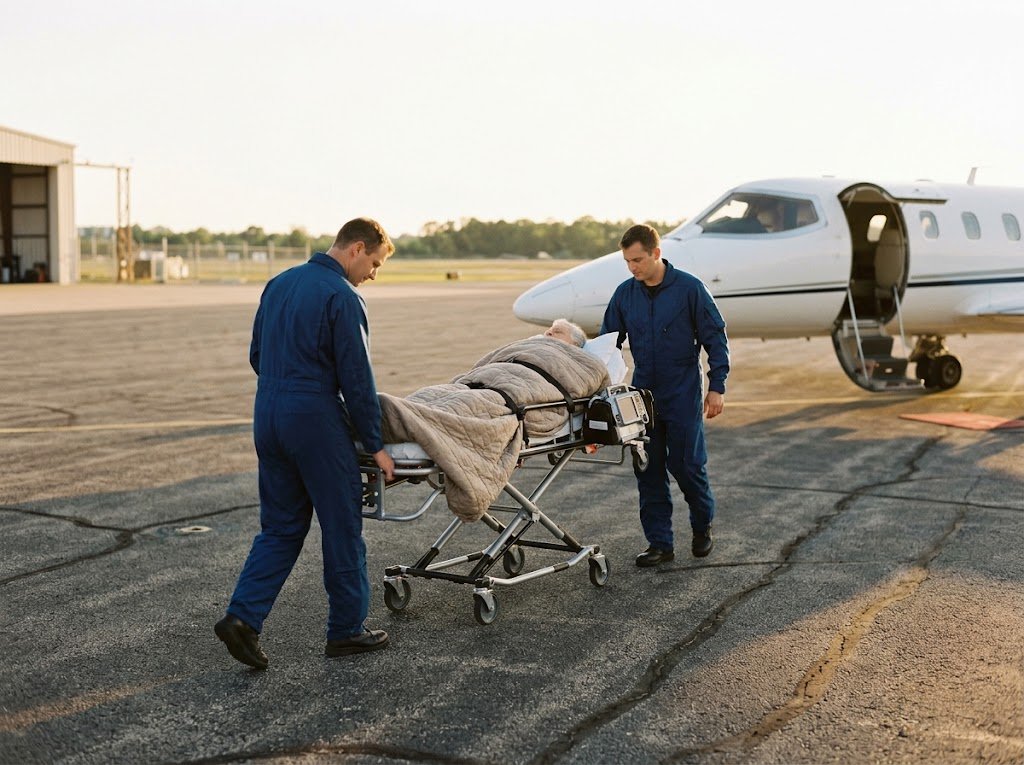 Sometimes, after recovery. Right after a serious fall, usually not. A commercial flight requires a passenger to sit upright through takeoff and landing, walk through airports, get through security, and manage connections and delays. After a hip fracture or other major injury, most older adults can’t do that safely or comfortably.
Other common barriers include:
- Pain that’s hard to manage over a long travel day
- Limited mobility that makes boarding, restrooms, and connections difficult
- Higher blood clot risk after a fracture, surgery, and long periods of sitting
- Confusion or delirium, which is common in older adults after an injury, surgery, or a hospital stay
- Other health conditions, such as heart or lung disease, that need monitoring
For a broader look at why some conditions rule out commercial flights, see our guide to health conditions you should not fly with.
Should a Hip Fracture Be Repaired Before Flying Home?
This is one of the most common questions families ask, and the answer depends on the patient. Hip fractures in older adults are usually repaired surgically within a day or two, because waiting longer can raise the risk of complications. That often means surgery happens where the fall occurred.
But there are situations where flying home first makes sense, such as when the family wants surgery with a trusted local team, the destination is close enough to avoid a long delay, or the local hospital can’t provide the needed care. There are also situations where the patient should have surgery first and recover enough to travel safely.
That decision belongs to the treating physicians, and our Medical Director is part of the conversation. We speak directly with the treating doctor to understand the injury, the timing, and the safest plan, whether that means flying before or after surgery.
What Are the Transport Options After a Fall?
Travel Care Air matches the transport to the patient’s injury and overall health:
- Air Ambulance. For patients with unrepaired fractures, head injuries, unstable vital signs, or complications like pneumonia or delirium. A private aircraft with a medical crew provides continuous monitoring and pain control, and the patient stays lying down the entire trip.
- Commercial Stretcher. For stable patients who need to lie flat, mainly on international routes, with a medical crew on board.
- Flight Nurse Medical Escort. For patients who have recovered enough to sit for a commercial flight but still need help with mobility, pain medicine, and monitoring.
- Medical Traveling Partner. For older adults who are mostly recovered but shouldn’t travel alone after a fall.
We’ll tell you honestly which option fits. Our elderly medical transport page covers more on how we support older travelers.
How Does an Air Ambulance Crew Care for an Older Adult After a Fall?
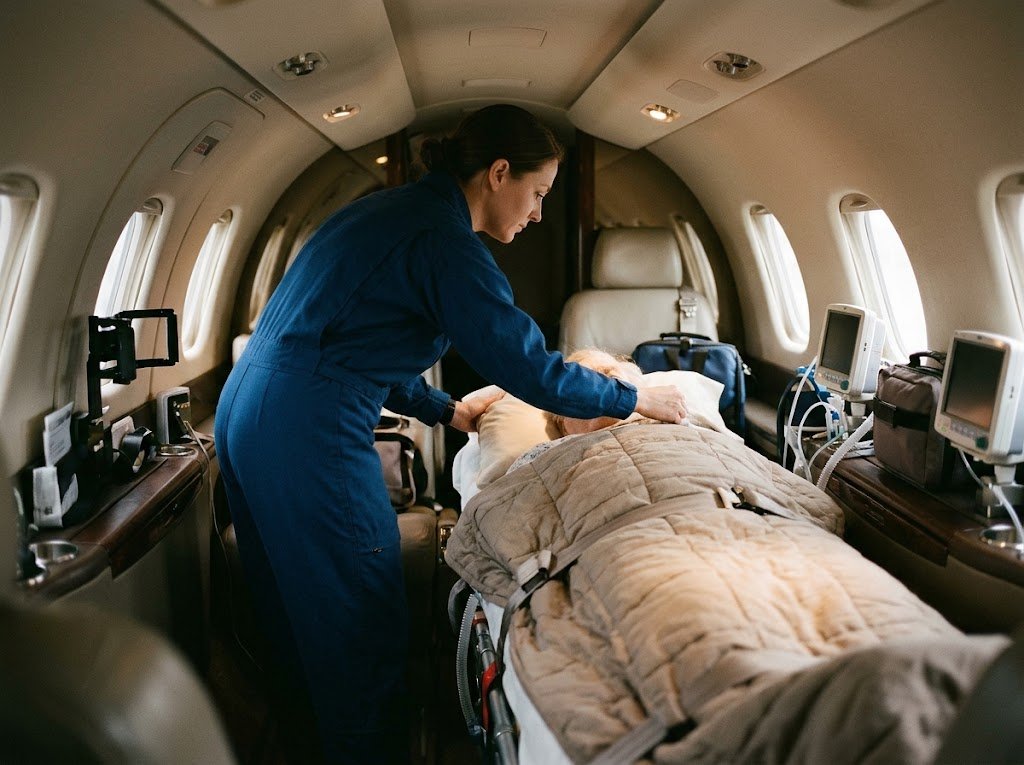
Older patients need care that goes beyond the injury itself. During an air ambulance flight, our crew focuses on:
- Keeping the injury stable, with proper positioning, padding, and immobilization during every transfer
- Managing pain so the patient stays as comfortable as possible
- Preventing blood clots, following the treating physician’s plan
- Watching for delirium, keeping the patient oriented, calm, and reassured
- Monitoring the heart, breathing, and oxygen levels, especially for patients with other conditions
- Protecting fragile skin from pressure during a long trip
- Watching for signs of a head injury getting worse in patients who hit their head, especially those on blood thinners
If the fall caused an injury to the spine, see our guide to unstable spinal fractures during medical repatriation. If it caused bleeding in the brain, see air ambulance after a brain bleed.
Why Does Every Patient Need a Medical Review Before Flying After a Fall?
A medical professional reviews every patient before any transport plan is finalized. After a fall, that review looks at:
- The injuries, including any fractures and whether they’ve been repaired
- Any head injury and whether the patient takes blood thinners
- Pain control and current medications
- Mental status, including any confusion or delirium
- Heart, lung, and kidney health
- Mobility and how the patient can be safely moved
- Recent imaging and lab results
Our Medical Director conducts peer-to-peer discussions with the treating physician to decide whether the patient is ready to fly, what type of transport is safest, and what needs to happen first if they’re not ready.
Who Cares for an Older Patient During an Air Ambulance Flight?
The crew is matched specifically to the patient’s needs. A Travel Care Air crew can include critical care flight nurses, paramedics trained in advanced aeromedical protocols and pre-hospital trauma care, respiratory therapists, and physicians for the most complex cases. Learn more in Who Are the Medical Professionals on an Air Ambulance Team?
How Does Bed-to-Bed Coordination Help After a Fall?
For an older patient with a fracture, every move from bed to stretcher, stretcher to ambulance, and ambulance to aircraft can cause pain or shift an injury. Fewer handoffs and smoother transfers make a real difference.
Travel Care Air manages every transition as part of a single plan. We arrange ground ambulances at both ends, confirm a physician is ready to accept the patient before the mission launches, and keep the same medical team with the patient from the sending bedside to the receiving one. See How an Air Ambulance Transfer Works from Start to Finish.
What If an Older Parent Falls While Traveling Abroad or on Vacation?
Falls on vacations and cruises are common, and they leave families scrambling. The local hospital may speak another language, follow different practices, or simply be far from everyone who can help. Many families want their loved one home to recover near family and their own doctors.
Travel Care Air coordinates medical repatriation across six continents. For practical steps, see How to Bring a Loved One Home from a Resort and Medical Repatriation Explained. You can also read how other families made it home in our Mission Stories.
What Should Families Do Right After a Loved One Falls Far From Home?
- Get the full picture from the treating doctor, including all injuries and whether surgery is planned.
- Ask about timing: when would it be safe to travel, and in what way?
- Gather documents: ID or passport, insurance cards, medication list, and any health care power of attorney.
- Call the insurance or travel insurance company to ask about medical transport coverage.
- Contact the patient’s own doctor at home so they’re ready to take over.
- Call a medical transport provider early, even if you’re still deciding. It gives you options.
What Does an Air Ambulance Cost After a Fall?
Costs depend on distance, the type of transport, the medical crew needed, and whether the trip is domestic or international. A stretcher on a commercial flight or a nurse escort usually costs significantly less than a private air ambulance.
A Travel Care Air air ambulance quote typically includes the aircraft, pilots, the full medical crew, ground ambulances at both ends, and all logistics coordination, with no hidden fees. For more, see How Much Does a Medevac Cost and What Medical Repatriation Insurance Covers.
When Should I Contact Travel Care Air?
Contact us as soon as a loved one has had a serious fall away from home, or when an older parent needs to move to a hospital or rehab facility closer to family. You can fill out a brief contact form on our website and receive a response within 15 minutes, or call directly: U.S./Canada: 1-800-524-7633 | International: +1-715-479-8881.
Bringing Your Loved One Home After a Fall

After a serious fall, older adults recover best near the people and doctors who know them. Travel Care Air plans every flight around the injury, the pain, and the whole person, so your loved one arrives safe, comfortable, and ready for the next step in recovery.
Medical emergencies don’t follow business hours, and neither do we. Travel Care Air is available 24 hours a day, 7 days a week, 365 days a year. Contact us for a free consultation and flight quote or call U.S./Canada: 1-800-524-7633 | International: +1-715-479-8881.
Frequently Asked Questions About Air Ambulance Transport After a Fall
Can an elderly person fly after a hip fracture?
Not usually right away on a commercial flight. Once the fracture is repaired and the patient has recovered enough, they may be able to fly with a nurse escort or on a commercial stretcher. Before that, an air ambulance is often the safest option.
Should a hip fracture be fixed before flying home?
It depends. Hip fractures in older adults are usually repaired within a day or two, so surgery often happens where the fall occurred. The treating physicians decide whether flying before or after surgery is safest.
How long after hip surgery can an older adult fly?
It varies by patient and recovery. Blood clot risk is higher after hip surgery, so the treating surgeon will advise on timing and precautions.
Can a family member fly with the patient?
In many cases, one family member can travel with the patient on an air ambulance, depending on the aircraft and the equipment needed. We confirm this during planning.
What if my parent fell on a cruise?
The cruise ship’s medical team will usually transfer the patient to a hospital at the next port. From there, Travel Care Air can coordinate a medical flight home once the patient is stable enough to travel.
Does Medicare cover an air ambulance after a fall?
Medicare may cover air ambulance transport when it’s medically necessary and ground transport isn’t appropriate, but it generally doesn’t cover transport from outside the U.S. Travel insurance often fills that gap.
Does insurance cover an air ambulance after a fall abroad?
Many travel insurance policies with medical evacuation benefits do. Check your policy and call the insurer early. Travel Care Air can provide documentation to support a claim.
How quickly can an air ambulance be arranged after a fall?
Many domestic missions can be organized within 24 to 48 hours once medical clearance and logistics are confirmed. International transfers may take longer.