
A cancer diagnosis often comes with one hard practical question: how to get the care your loved one needs. The right oncologist, clinical trial, transplant center, or surgical team for you may be hundreds or thousands of miles away. For many patients, a regular airline seat works fine. But when treatment has weakened the immune system, lowered blood counts, caused breathing problems, or left a patient too ill to sit through a commercial itinerary, air ambulance transport for cancer patients becomes the safer way to travel.
Travel Care Air has helped patients reach specialized care since 1980, and we’ve seen how much a well-planned flight matters when someone is already fighting an illness. We plan every cancer patient’s flight around their treatment schedule, blood counts, infection risk, and comfort, whether that means a nurse escort on a commercial flight or a fully equipped air ambulance. Consultations are free and available 24/7/365. Contact Travel Care Air or call U.S./Canada: 1-800-524-7633 | International: +1-715-479-8881.
Why Do Cancer Patients Need Long-Distance Medical Travel?
Cancer care is increasingly specialized. A rare tumor, a complex surgery, or a clinical trial may only be available at a handful of centers in the country, or in the world. Common reasons cancer patients travel long distances include:
- Specialized surgery at a high-volume cancer center
- Clinical trials that are only enrolling at specific hospitals
- Bone marrow or stem cell transplants, which are performed at designated transplant centers
- Proton therapy or other advanced radiation that only some facilities offer
- Second opinions from specialists in a specific cancer type
- Returning home to finish treatment, recover, or be closer to family
- Getting home from abroad after becoming ill while traveling
Each of these trips raises the same question: can the patient travel safely on their own, or do they need medical support in the air?
Can Cancer Patients Fly on Commercial Airlines?
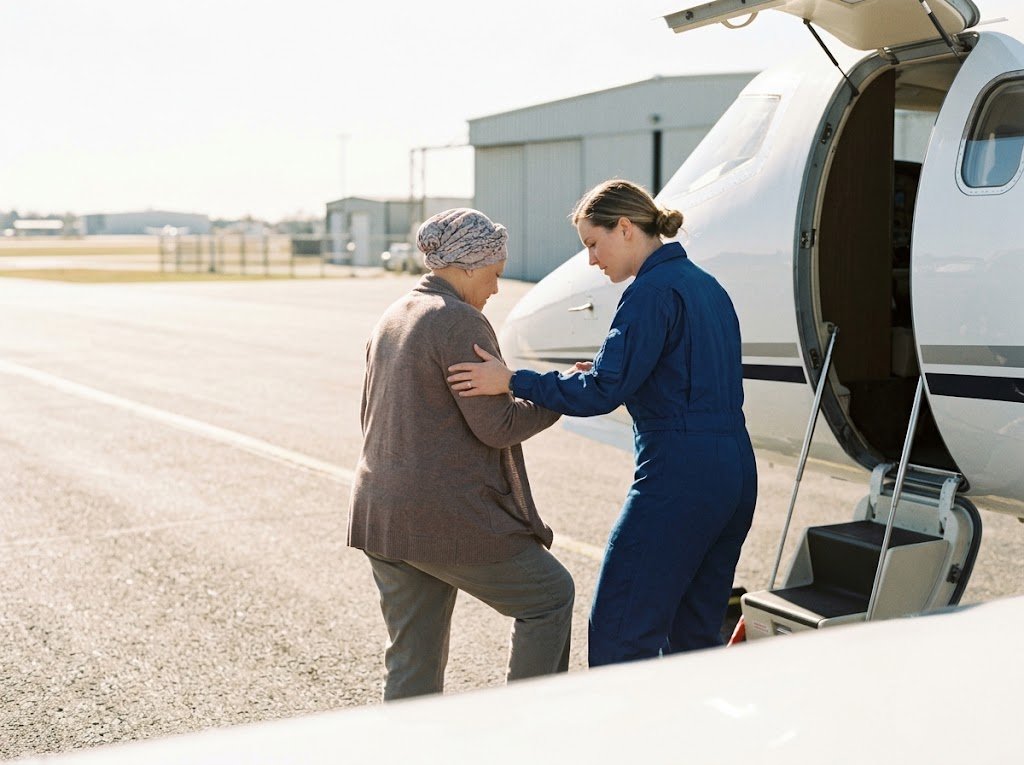 Many can. Plenty of people fly to appointments and treatments with nothing more than their oncologist’s approval and some extra planning. The decision depends on the patient’s current condition, not the diagnosis alone.
Commercial travel becomes risky when treatment or the cancer itself has affected the body in ways that cabin conditions can make worse. Aircraft cabins are pressurized to the equivalent of roughly 6,000 to 8,000 feet, which lowers the oxygen available in every breath. Cabins are also crowded, and flights can be long, with few options if something goes wrong. For a broader look at which conditions make commercial travel unsafe, see our guide to health conditions you should not fly with.
What Makes Flying Risky for Cancer Patients?
Cancer and its treatment can affect nearly every system in the body. These are the issues our Medical Director looks at most closely:
- Low white blood cell counts. Chemotherapy can leave patients with very weak immune defenses, making a crowded cabin and airport a real infection risk.
- Low platelet counts. Low platelets raise the risk of bleeding, and a fall or bump during travel can be more serious than usual.
- Anemia. Low red blood cell counts reduce how much oxygen the blood carries, and lower cabin oxygen can leave patients short of breath or exhausted.
- Lung involvement. Tumors in or near the lungs, fluid around the lungs, or treatment-related lung damage can make it hard to breathe at altitude.
- Blood clots. People with cancer have a higher risk of blood clots, and long periods of sitting add to that risk.
- Brain involvement. Tumors in the brain can raise pressure inside the skull and the risk of seizures. Our guide on flying with a brain AVM explains why cabin pressure changes matter for the brain.
- Recent surgery. Trapped air and fresh incisions can be affected by cabin pressure. See air travel after surgery for more.
- Pain, nausea, and fatigue. These can make a long day of airports and connections hard to tolerate, even when nothing else is wrong.
None of these automatically rules out flying. They are the reasons a medical review should come before any booking.
When Is an Air Ambulance the Right Choice for a Cancer Patient?
An air ambulance is usually the right choice when a patient needs closer monitoring, faster intervention, or more protection than a commercial cabin can offer. That often includes patients who:
- Are currently hospitalized and need to transfer to a cancer center
- Have very low blood counts and a high risk of infection or bleeding
- Need oxygen or have trouble breathing
- Cannot sit upright for the length of a commercial trip
- Need IV medications, fluids, or pain management during travel
- Have recently had major surgery or a serious complication
- Are too ill or weak to manage airports, security, and connections
A private aircraft also gives patients with weak immune systems a controlled environment, away from crowded terminals and full cabins. Every air ambulance flight we coordinate is planned bedside to bedside, so the patient goes directly from one care team to the next.
What Are the Other Options for Cancer Patients Who Need Support?
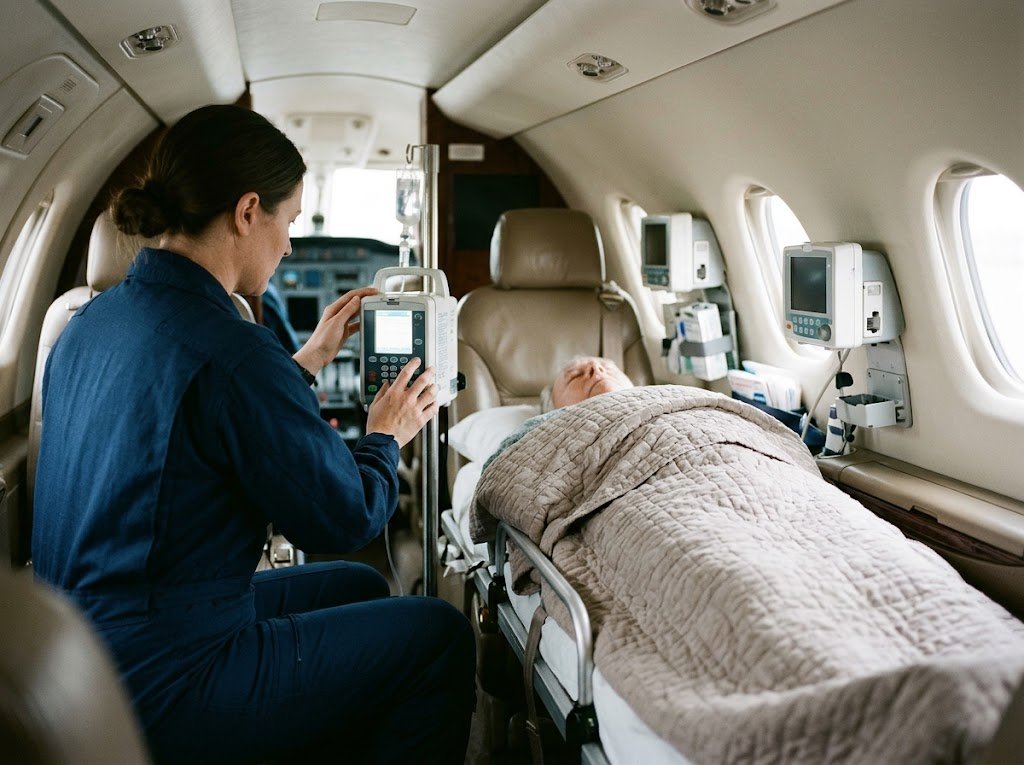
Not every cancer patient needs a private aircraft. Travel Care Air matches the level of support to the patient:
- Flight Nurse Medical Escort. A flight nurse travels with the patient on a commercial flight, often in business or first class, managing medications, watching for warning signs, and handling the airport.
- Commercial Stretcher. For patients who need to lie flat but are stable enough for a commercial flight, mainly on international routes.
- Medical Traveling Partner. For patients who are fairly independent but shouldn’t travel alone, especially after a tiring round of treatment.
The medical review tells us which option is safe, and we’ll tell you honestly if a lower-cost option will work.
How Does Travel Care Air Plan a Flight Around Cancer Treatment?
Timing matters as much as the aircraft. Before any flight, our team works with the patient’s oncology team to plan around:
- Where the patient is in their treatment cycle. Blood counts often dip at predictable points after chemotherapy, and travel may be safer before or after that window.
- Recent lab results, especially white cell counts, platelets, and hemoglobin.
- Infection protection, from mask use to limiting exposure during ground transfers.
- Medications on board, including pain control, anti-nausea medicines, and any IV therapy.
- Oxygen needs at cabin altitude.
- The receiving team, so the next treatment, appointment, or admission is confirmed before the patient lands.
Our Medical Director speaks directly with the treating oncologist or physician before any mission is scheduled. If the patient isn’t ready to fly yet, that conversation identifies what needs to happen first.
Who Cares for a Cancer Patient During an Air Ambulance Flight?
The crew is matched to the patient’s needs rather than assigned generically. Depending on the patient’s condition, a Travel Care Air crew can include critical care flight nurses, paramedics trained in advanced aeromedical protocols, respiratory therapists for patients who need breathing support, and physicians for the most complex cases. Our crews are trained in advanced cardiac life support, pediatric advanced life support, and pre-hospital trauma care. For a closer look at how crews are built, see Who Are the Medical Professionals on an Air Ambulance Team?
What If a Cancer Patient Gets Sick While Traveling Abroad?
Some patients travel during remission or between treatments and then become seriously ill overseas. The local hospital may not be able to provide the specialized cancer care they need, and families usually want their loved one back with the oncology team that knows their history.
That’s a medical repatriation, and it takes coordination on both ends: gathering and translating records, confirming acceptance at a hospital at home, and timing the flight around the patient’s condition. Travel Care Air has coordinated these transfers across six continents. Learn more in Medical Repatriation Explained, and see how other families made it home in our Mission Stories.
How Should Cancer Patients Prepare for a Long-Distance Medical Flight?
Whatever type of flight you take, these steps help:
- Get clearance from your oncologist and ask specifically about blood counts, clot risk, and oxygen needs.
- Carry a medical summary with your diagnosis, treatment plan, recent labs, medication list, and care team contacts.
- Keep medications in your carry-on, with extra for delays.
- Ask about clot prevention, such as compression stockings or medication, before a long flight.
- Protect yourself from infection with a well-fitting mask and hand hygiene, especially if your counts are low.
- Plan for comfort: pillows, layers, and snacks or fluids your care team approves.
- Confirm your next appointment or admission before you leave.
- Know the warning signs that need medical attention right away: fever, bleeding, shortness of breath, chest pain, confusion, or new swelling in a leg.
What Does an Air Ambulance Cost for a Cancer Patient?
Costs depend on distance, the type of transport, the medical crew needed, and whether the trip is domestic or international. A nurse escort on a commercial flight costs significantly less than a private air ambulance, which is one reason the medical review matters.
A Travel Care Air air ambulance quote typically includes the aircraft, pilots, the full medical crew, ground ambulances at both ends, and all logistics coordination. We are committed to transparent, upfront pricing with no hidden fees. For more, see How Much Does a Medevac Cost and Will My Health Insurance Pay for an Air Ambulance? We can also provide documentation to support an insurance claim.
When Should I Contact Travel Care Air?
Contact us when a loved one with cancer needs to travel for treatment and you’re not sure a commercial flight is safe, or when they’re hospitalized away from home and need to get back to their care team. You can fill out a brief contact form on our website and receive a response within 15 minutes, or call directly: U.S./Canada: 1-800-524-7633 | International: +1-715-479-8881.
Getting to the Right Care Shouldn’t Be Another Battle

A cancer diagnosis is hard enough without worrying whether the trip to treatment is safe. Whether your loved one needs a nurse at their side on a commercial flight or a flying ICU, Travel Care Air will tell you honestly which option fits.
Medical needs don’t follow business hours, and neither do we. Travel Care Air is available 24 hours a day, 7 days a week, 365 days a year. Contact us for a free consultation and flight quote or call U.S./Canada: 1-800-524-7633 | International: +1-715-479-8881.
Frequently Asked Questions About Air Ambulance Transport for Cancer Patients
Can cancer patients fly?
Yes, many cancer patients fly commercially with their oncologist’s approval. Patients with very low blood counts, breathing problems, recent surgery, or serious complications may need a medical escort or an air ambulance instead.
Is it safe to fly during chemotherapy?
It can be, depending on where you are in your treatment cycle and your blood counts. Your oncologist can tell you whether your counts are safe for travel and whether timing the flight differently would lower the risk.
Can you fly with low platelets or low white blood cell counts?
Very low counts raise the risk of bleeding and infection, which can make commercial travel unsafe. A private air ambulance offers a more controlled environment, and your care team can advise on what counts are safe for your situation.
Do cancer patients need oxygen when flying?
Some do, especially those with lung involvement or anemia. Your doctor can assess whether you need supplemental oxygen at cabin altitude, and an air ambulance can provide it throughout the flight.
Can an air ambulance take a patient to a clinical trial or transplant center?
Yes. Air ambulances routinely move patients to specialized centers for surgery, transplants, and clinical trials. We confirm acceptance at the receiving hospital before the flight.
Can a family member fly with the patient?
In many cases, one family member can travel with the patient on an air ambulance, depending on the aircraft and the equipment needed. We confirm this during planning.
Does insurance cover air ambulance transport for cancer patients?
Coverage depends on the plan and on whether the transport is considered medically necessary. Travel Care Air can provide documentation to support a claim.
How quickly can a medical flight for a cancer patient be arranged?
Many domestic missions can be organized within 24 to 48 hours once medical clearance and logistics are confirmed. International transfers may take longer because of permits and coordination with foreign hospitals.