
Last Updated: October 30, 2026
Quick Summary
An air ambulance rural transfer is most justified when time to definitive care decides the outcome, such as severe trauma, stroke, heart attack, or time-sensitive hospital transfers. For stable patients with a short drive, a ground ambulance is often faster in practice because it can leave immediately.
- One in 10 rural patients waits 30 minutes or more for EMS personnel to arrive.
- Air ambulances extend the reach of local crews; they do not replace them.
- Air medical transport improves survival for selected trauma patients, per a 2026 study.
- Ask whether the flight has launched and what the ground plan is if it is cancelled.
- Weather, landing zone and night conditions can prevent a helicopter from flying.
Table of Contents
- Why Rural Emergency Patients Face Longer Waits
- How Air Ambulances Connect Rural Communities to Emergency Care
- When Is an Air Ambulance Needed for a Rural Emergency?
- Air Ambulance vs Ground Ambulance: How Crews Decide
- Fixed-Wing vs Rotary-Wing: Aircraft, Crews and Onboard Care
- Weather, Landing Sites and When Flights Cannot Fly
- Air Ambulance Insurance Coverage and Out-of-Pocket Costs
- Arranging Your Rural Air Transfer With Travel Care Air
- Frequently Asked Questions
Air ambulances can reach a rural patient far faster than a ground unit, but an air ambulance rural transfer is not the answer to every emergency out in the country. Travel Care Air has spent more than 45 years moving patients by air, and the first thing we tell families and hospital teams is that the right choice depends on the injury, the distance and the weather. Here is how to think about it.
Some rural residents wait a long time for help. According to the National Rural Health Association’s report on rural EMS, one in 10 rural patients waits 30 minutes or more for EMS personnel to arrive. Our guide to air ambulances and small towns covers how rural hospital closures add to these access gaps. A study covering 41 states found that Rural Emergency Medical Services (EMS) and Trauma 2.3 million people live in rural counties classified as ambulance deserts.
Why Rural Emergency Patients Face Longer Waits
Distance is the core problem. A patient on a remote ranch or farm may be an hour or more from a trauma center, and the ground ambulance that reaches them still has to make the same drive back. Each mile adds time, and in serious trauma or cardiac events that time matters.
Rural hospitals close, services consolidate, and the nearest appropriate facility moves farther away. Patients who once needed a short transfer now need a long one.
How Air Ambulances Connect Rural Communities to Emergency Care
An air ambulance rural response does not replace the local crew. It extends their reach. A rural EMS team stabilizes the patient on scene, then hands off to a flight crew that can cover a hundred miles in the time a road ambulance covers twenty. For planned transfers, you can schedule a non-emergency air ambulance transport with time to prepare.
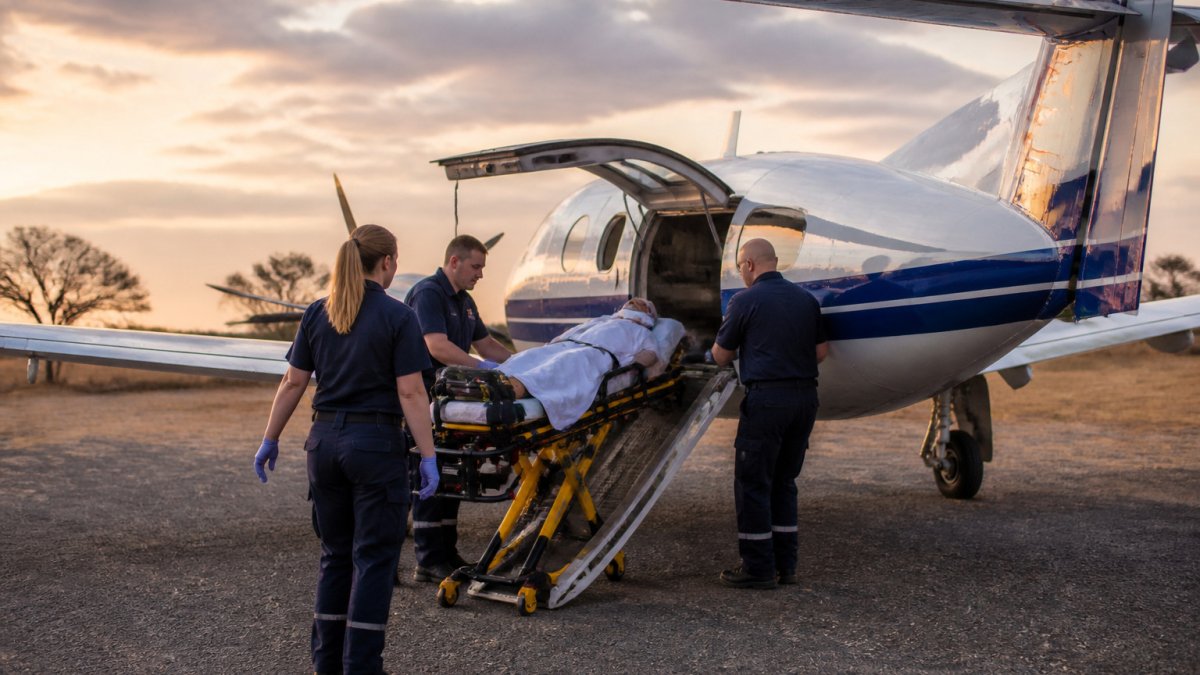
Air medical transport improves survival for selected trauma patients, according to a 2026 study on defining air medical transport need for rural injured patients. The catch is that deciding who qualifies is still difficult. The same research notes that better triage is limited by thin evidence and the lack of a standard definition of need.
When Is an Air Ambulance Needed for a Rural Emergency?
Air transport is usually justified when time to definitive care is the deciding factor: severe trauma, stroke or heart attack, and time-sensitive transfers between hospitals. Our page on what an air ambulance is explains how these flying ICUs are used and when they apply. It is less useful for conditions a local hospital can treat fully and quickly.
Where a patient is stable and the drive is short, a ground ambulance is often faster in practice, because it can leave immediately and does not depend on an aircraft being ready. If you are unsure, the dispatcher or the sending physician makes the call, and it is reasonable to ask them why they chose one mode over the other.
Air Ambulance vs Ground Ambulance: How Crews Decide
Most families assume the choice between a ground ambulance and an air ambulance is made by whoever answers the 911 call. In practice it is a layered decision, and understanding the layers helps you ask better questions when minutes matter.
Layer 1: The 911 dispatcher. Dispatchers follow locally approved protocols, often called emergency medical dispatch (EMD) cards. These scripts sort calls by chief complaint and severity, for example, an unresponsive patient with a head injury versus a stable patient with a sprained ankle. The dispatcher generally sends the closest appropriate ground unit first.
Layer 2: The on-scene EMS crew. Paramedics and EMTs apply triage criteria such as the CDC Field Triage Guidelines, which flag red flags like a Glasgow Coma Scale score below 14, systolic blood pressure under 90, respiratory rate below 10 or above 29, or a penetrating injury to the torso. When any of those are present and the drive to a trauma center exceeds a set time, the crew typically requests air.
Layer 3: The flight crew and medical director. The pilot and flight clinician have final say on whether the aircraft can safely launch and land. A helicopter may be requested and then declined because of weather, weight and balance, or a landing zone that cannot be secured. That is not a failure, it is the safety layer working.
Layer 4: The receiving facility. The trauma center or specialty hospital confirms it can accept the patient and has the right bed and team ready. A transfer that arrives before the receiving team is prepared wastes the speed advantage.
A practical way to think about it: air wins when the patient’s condition is time-sensitive and the ground route is long, rough, or congested. Ground wins when the patient is stable, the hospital is close, or the aircraft cannot fly. The two are not competitors, they are a relay team.
If you are the family member on scene, you can ask the crew three direct questions: (1) How long will the ground drive take? (2) What is the helicopter’s estimated time to scene and to the hospital? (3) What is the plan if the aircraft cannot fly? The answers usually make the decision obvious.
A common pattern in rural systems is that the ground crew requests air early, sometimes before the patient is fully packaged, so the aircraft can be launching while the crew is still stabilizing. That overlap is where the real time savings come from, not from the flight itself.
The choice between air and ground transport is made in layers, and this table summarises who makes each call.
| Layer | Who decides | Key factor |
|---|---|---|
| Dispatcher | 911 dispatcher | Locally approved EMD protocols |
| On-scene crew | Paramedics and EMTs | CDC Field Triage Guidelines red flags |
| Flight crew | Pilot and flight clinician | Weather, weight and balance, landing zone |
| Receiving facility | Trauma or specialty hospital | Ability to accept patient and bed readiness |
Fixed-Wing vs Rotary-Wing: Aircraft, Crews and Onboard Care
Fixed-wing aircraft fly faster and farther, which suits long interfacility transfers. They need a runway, so they cannot reach every scene. Our side-by-side comparison of fixed wing and rotary wing covers range, landing needs and costs in more depth. Rotary-wing helicopters land almost anywhere with a clear zone, which makes them the usual choice for scene response.
Crews are critical-care teams, typically a flight nurse and a paramedic or a second clinician, depending on the patient. Travel Care Air offers flight nurse medical escorts for patients with complex needs.
Weather, Landing Sites and When Flights Cannot Fly
Air medical transport is one of the safest forms of aviation, but it is also one of the most weather-sensitive, because helicopters and fixed-wing aircraft often fly low and into unfamiliar terrain. Patients requiring continuous respiratory support face even greater risks during these delays, necessitating a more comprehensive approach to medical transport services that accounts for specialized equipment needs.
The weather factors crews watch. Flight crews and pilots evaluate ceiling (the height of the lowest cloud layer), visibility, wind speed and gusts, icing conditions, and thunderstorms. Helicopters operating under visual flight rules generally need to stay clear of clouds and maintain visual reference to the ground; low ceilings and fog can make a scene landing impossible even when the sky looks merely overcast from the ground.
Landing zone requirements. For a scene response, the crew needs a landing zone (LZ) that is flat, clear of obstacles, and large enough for the rotor diameter plus safety margin. A common planning figure is a square of roughly 100 feet by 100 feet, free of power lines, trees, fences, and loose debris that can become projectiles. The LZ should be marked and secured so bystanders stay back.
Night operations. Many rural agencies and air medical programs have limited night-vision capability or restrict scene landings after dark. A patient injured at dusk on a farm may be transported by ground to a lighted landing zone or to a local hospital first, then flown from there. That two-step sequence is common and is not a downgrade in care, it is how the system adapts.
What happens when the aircraft cannot fly. The contingency is almost always the ground ambulance, sometimes redirected to a closer facility for stabilization before a later transfer. The key point for families is that the ground unit should not be released on the assumption that a helicopter is coming until the flight is confirmed airborne.
Never assume a helicopter is en route just because someone said it was requested. Ask whether the flight has been accepted and launched, and what the ground plan is if it is cancelled. In rural areas, weather can change faster than the aircraft can arrive.
A useful mental model: air transport is a speed multiplier, not a guarantee. The system is designed so that when the multiplier is unavailable, the ground path still works, just more slowly. Planning for that slower path in advance is what keeps rural patients safe when the weather does not cooperate.
Air Ambulance Insurance Coverage and Out-of-Pocket Costs
Cost is a fair concern, and it should be answered directly. Coverage varies by plan, and a transport that is medically necessary is not always fully covered.
For that reason, we do not quote prices or typical costs for our services here. Our air ambulance cost guide explains insurance coverage and Medicare rules to help you avoid surprise bills. Pricing depends on the route, aircraft, medical escort requirements and transfer details, and it is best confirmed for your situation.
Arranging Your Rural Air Transfer With Travel Care Air
If you are a case manager, family member or care team coordinating a rural transfer, speed and clear information matter most. Travel Care Air operates around the clock and arranges flight nurse escorts and commercial stretcher options.
When you are ready to arrange a transfer or want to understand your options, request a quote from Travel Care Air and our team will walk you through the next steps.
Frequently Asked Questions
When is an air ambulance used for a rural emergency?
An air ambulance is typically requested when a patient needs time-sensitive care that cannot be reached quickly by road, such as serious trauma, stroke, cardiac events, or a critical transfer to a specialized center. Distance to the nearest hospital, road conditions and the patient’s clinical condition all factor into the decision. Clinicians and dispatchers weigh whether the expected travel time by ground would put the patient at risk, and whether the receiving facility has the capabilities the patient needs.
Is an air ambulance faster than a ground ambulance in rural areas?
Often it is, when the destination is far away. A helicopter or fixed-wing aircraft can cover long distances in a fraction of the time a ground ambulance needs over rural roads, which is why rural hospitals frequently rely on air transport for trauma and critical-care transfers. Speed is not the only factor, though. Ground crews may arrive faster when the patient is nearby, and weather or landing-site access can delay a flight. The right choice depends on the specific distances and conditions involved.
Does insurance cover air ambulance transport?
Coverage varies by insurer, plan type and whether the transport is medically necessary. Many plans cover air ambulance transport when it is deemed medically necessary and no closer appropriate facility is available, but patients may still face deductibles, coinsurance or balance billing. You can request a quote from Travel Care Air for current pricing details.
What factors can delay or prevent an air ambulance flight?
Weather is the most common constraint. Low visibility, high winds, storms, icing and darkness can ground an aircraft or limit when it can land. Landing-site access also matters, since remote locations may need a suitable clear area that is safe for the aircraft. Aircraft availability, crew duty limits and the need to coordinate with ground EMS can add time. Because of these variables, air transport is best arranged alongside ground options rather than as the only plan.
