
“I seriously thank God to be alive and know I have had many miracles performed on my behalf.”
— Molly Deimeke
When the Deimeke family asked us to bring their daughter, Molly, home after a serious injury abroad, we moved quickly, coordinated across multiple countries, and kept the plan tight from bedside to bedside. Here is Molly’s story.
For nine months, Molly Deimeke had been doing something most people only dream about — traveling the world alone, with nothing but a backpack and a sense of adventure. She navigated foreign countries, made friends in hostels and on dusty roads, and built a life that moved from one horizon to the next. Then, on a hillside in Laos on May 28, 2014, everything changed in a single second.
What happened next is a story worth telling, not just because of what Travel Care Air did, but because of Molly. She survived, she fought back, and she found a way to turn one of the worst experiences of her life into a message for every traveler who comes after her about safety, insurance, and being prepared.
Solo Travel in Southeast Asia
Molly was from Martinsburg, Missouri — a small-town girl with big dreams. She wanted to travel, and she made it. For nine months, Molly traveled solo through Asia, and now she had a job lined up in Thailand. To get there on time, she had to pass through Laos in late May 2014.
Along the way, she met a small group of Americans on the road. That chance meeting would turn out to save her life.
A Split Second Changes Everything
In Laos, the local taxi is a tuk-tuk, a truck. Passengers can sit on the truck bed or on a higher elevated bench along the side. On the evening of May 28, a few passengers climbed down from that elevated bench, and Molly climbed up. It seemed like a reasonable thing to do, but unfortunately, she fell.
That fall was devastating. Molly hit her head on the ground and rolled twenty feet down the hillside. The Americans she had met two days earlier thankfully stopped the tuk-tuk and pulled her off the ground. With quick thinking, they found a local hospital and got her there as fast as they could.
The medical care in Laos, as Molly would later say herself, was not enough. The hospital put her in a bed and told her companions there was nothing they could do. This is not unusual. The U.S. Embassy in Laos states plainly on its own website that “medical facilities and services in Laos are limited and do not meet Western standards,” and that U.S. citizens in Laos often seek care in Thailand. It’s for this reason that we publish guides like What Medical Repatriation Insurance Covers and Why You Need It.
Emergency Response Abroad: U.S. Embassy Assistance in Laos
One of the Americans Molly met, who happened to know a doctor, helped Molly through her first few hours. The group then contacted the U.S. Embassy, reached Molly’s family back in Martinsburg, Missouri, and arranged for her to be airlifted across the border to Bangkok, Thailand, where she could receive the level of care she needed to survive.
Traumatic Brain Injury Abroad
In Bangkok, a brain surgeon assessed the full picture, and it was serious.
When Molly fell and struck the right side of her head on the ground, she fractured her skull. But the more serious injury happened on the opposite side of her brain. The left side of her brain slammed against the inside of her skull; this is what surgeons call a contrecoup injury. The left side of her brain bled and swelled, giving Molly an epidural hematoma, a subdural hematoma, and a severe traumatic brain injury. She also had five broken ribs.
Surgeons in Bangkok got to work to save her life, but the road ahead would be long. Traumatic brain injury is life-changing. The left hemisphere of the brain controls, among many other things, language, reading, analytical thinking, memory, and movement on the right side of the body.
Unfortunately, Molly woke up with right-sided weakness that affected her hand and arm. She couldn’t walk without support, and she had lost her ability to read entirely. She would later describe having to start again at a kindergarten level. She developed benign paroxysmal positional vertigo, a condition where calcium crystals disrupt the inner ear, causing dizzy spells that lasted up to 35 minutes at a time.
Molly was alive. She was thousands of miles from home. And needed better care.
Bedside to Bedside Care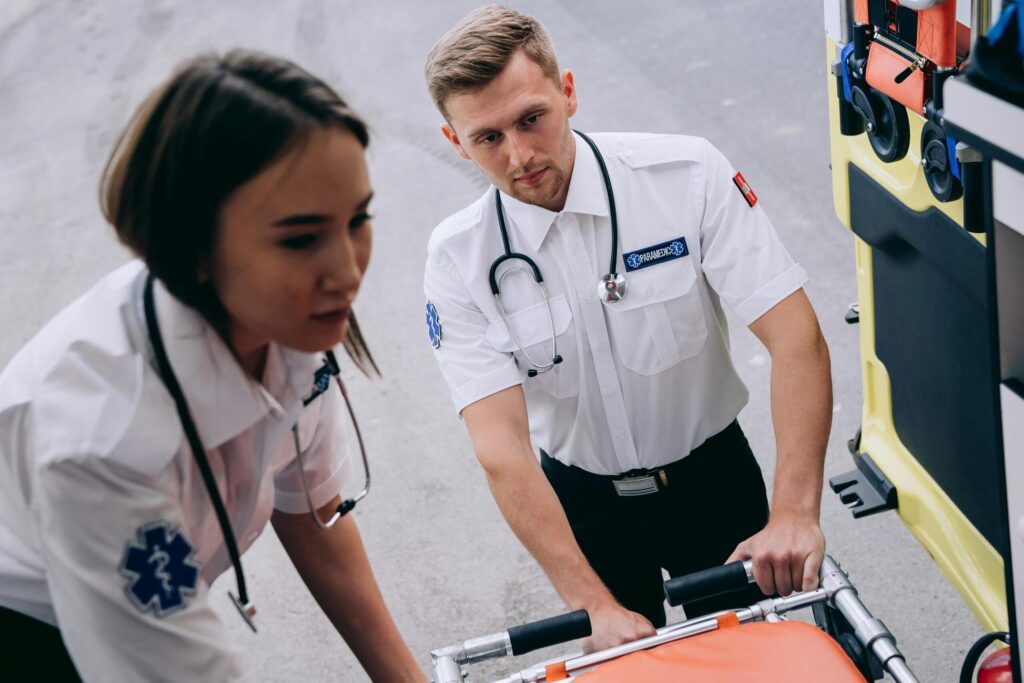
Molly’s mother flew to Bangkok to be at her side. Together, the family decided she should recover closer to home. They contacted our team at Travel Care Air, and we began planning the Bangkok-to-St. Louis air ambulance route, crews, and equipment.
Our clinicians met Molly in Bangkok at her bedside in Bangkok. They reviewed her records, confirmed her medications, and stabilized her for the first leg of the journey. For a patient recovering from emergency brain surgery, a skull fracture, and broken ribs, in-flight care had to be continuous and responsive throughout a multi-day, multi-stop journey across the Pacific.
Bangkok to St. Louis Air Ambulance: Route and Medical Planning
What the Deimeke family was asking us to do was not simple. Bangkok to St. Louis, across the Pacific Ocean, through multiple international flight segments, with a patient recovering from brain surgery, a skull fracture, and broken ribs, is one of the most logistically demanding transport routes we can run. We knew that going in, and we moved quickly.
Our team planned a commercial medical escort route staged across five segments to account for crew duty limits, fuel, and clinical checks at every stop: Bangkok → Manila, Philippines → Marshall Islands → Honolulu, Hawaii → Salinas, California → St. Louis, Missouri.
We launched on Thursday at 8:30 a.m. Bangkok time. At every stop along the route, our clinicians conducted clinical checks, coordinated with receiving staff, and maintained the schedule.
“Love for Molls” — A Community Shows Up
While we were coordinating flight segments and clinical logistics, something equally powerful was happening back home. Molly’s friend, Kate Eissinger, launched a GoFundMe campaign called “Love for Molls,” and the response was extraordinary. Friends, former classmates, family members, and complete strangers who heard the story came together to help offset Molly’s medical and transport costs. The campaign spread across Facebook and Twitter, carried by people who had never met Molly but understood exactly what it meant to need help and be far from everyone who loved you.
TBI Recovery After an International Medical Emergency
Coming home to St. Louis was not the end of Molly’s journey. It was the beginning of the hardest part.
What followed were months of intense physical therapy to rebuild the right-side strength in her hand and arm, to correct the vertigo, and to re-learn how to walk without support — followed by five months of speech therapy and hours of her own focused effort every single day to work her way back from a kindergartner reading level to a 5th or 6th grade level. But anyone with a traumatic brain injury knows that the real journey is lifelong.
“This brain injury has changed my life incredibly. I seriously thank God to be alive and know I have had many miracles performed on my behalf. I care more about my safety than ever before. I’m so thankful for small things in life.”
Molly’s family, grateful and generous in the way farming families from Martinsburg, Missouri, tend to be, named one of their newborn calves after our President, Ron. We still think about that cow from time to time today.
International Travel Safety Tips: Lessons from a Medical Emergency Abroad
Molly has been generous enough to share her story publicly, in her own words, because she wants it to matter. She wants other travelers to take their safety seriously. Here is what her experience makes plain:
- Things can change in a split second. Molly wasn’t being reckless. She climbed onto a bench. That’s it. Travelers don’t need to do anything dramatic for a medical emergency to happen abroad. Awareness and preparation matter even on ordinary evenings.
- The people around you may become your first lifeline. Two people Molly had known for 48 hours were the reason she ended up in a hospital in Bangkok. Solo travelers especially should cultivate situational awareness and make genuine connections — you never know when those connections will be the ones who stop the truck and pick you up off the ground.
- Local medical care may not be enough. In some parts of the world, local hospitals simply do not have the equipment, specialists, or infrastructure to treat a severe traumatic brain injury. Knowing in advance how to escalate care and who can help you do that is important.
- Understand your travel insurance before you leave. A Bangkok-to-St. Louis air ambulance transport across five flight segments is an expensive, complex undertaking. Travel medical evacuation coverage exists specifically for situations like this. Review your policy carefully and verify that emergency air transport is included. If it isn’t, consider adding it before your next trip.
- Contact the U.S. Embassy in a crisis. Molly’s fellow travelers reached out to the U.S. Embassy in Laos, and that connection helped activate the chain of events that got her home. American travelers abroad often don’t realize this is an option. It is, and it matters.
- Call for help early, not when you’re out of options. The earlier you make the call to Travel Care Air, the more time you have to plan the route, coordinate the crew, and stage logistics before the situation becomes even more critical.
24/7 International Air Ambulance Services Worldwide
Medical emergencies don’t wait for business hours, and neither do we. Whether your loved one is in Bangkok, Buenos Aires, or anywhere in between, Travel Care Air is available 24 hours a day, 7 days a week, 365 days a year.
We have been helping patients and their families for over 40 years. Our crews are trained in advanced cardiac life support, pediatric advanced life support, and pre-hospital trauma care. We have handled transports across six continents, including complex neurological cases that require specialized in-flight monitoring and multistep international routing. We answer the phone. Every time.
If your family needs help, contact Travel Care Air for a consultation and flight quote. We will walk you through every step, just like we did for Molly.
Frequently Asked Questions About International Medical Transport for Traumatic Brain Injury
What is a contrecoup brain injury?
A contrecoup injury occurs when the brain strikes the inside of the skull on the opposite side of the initial impact. When Molly fell and hit the right side of her head, the force caused the left side of her brain to slam against the skull, causing bleeding and swelling. Contrecoup injuries can be more dangerous than the point of impact itself and require immediate surgical evaluation.
Can a patient recovering from brain surgery be transported by air ambulance?
Yes, in many cases — but it requires careful clinical evaluation. Factors including intracranial pressure, time since surgery, current neurological status, medications, and altitude considerations all affect whether transport is safe and how it should be structured. Travel Care Air works with medical directors to assess every case individually before committing to a route and timeline.
How much does an international air ambulance from Southeast Asia cost?
International medical repatriation costs vary widely based on distance, patient condition, required equipment, and the number of flight segments. A multi-leg transport from Southeast Asia to the United States can range from $80,000 to well over $200,000. Travel Care Air provides free consultations and detailed cost estimates upfront so families can make fully informed decisions.
Does travel insurance cover medical evacuation from Laos or Thailand?
Some travel insurance policies include medical evacuation coverage; many do not, or contain significant limitations on coverage amounts and qualifying conditions. Review your specific policy carefully before international travel, and contact your insurer immediately if an emergency occurs abroad. Travel Care Air can work directly with your insurance company and provide the documentation needed to support your claim.
How long does it take to arrange an air ambulance from Southeast Asia?
International medical repatriations typically take 24–72 hours to coordinate, depending on the patient’s stability, location, and international flight clearance requirements. A multi-segment route like Bangkok to St. Louis requires additional planning for crew duty limits, fuel staging, and clinical coordination at each stop. The sooner you call, the more runway the logistics team has to work.
Can family members travel with the patient?
In many cases, yes. Molly’s mother traveled home with her. Whether a family member can accompany the patient depends on aircraft configuration, medical equipment requirements, and the patient’s condition. Travel Care Air evaluates this on a case-by-case basis.
What should I do if a family member is injured abroad right now?
Call Travel Care Air immediately for a free consultation. You do not need to have all the answers before you call; that is exactly what we are here for. We will assess the situation, explain what transport would involve, provide an honest timeline, and give you a detailed cost estimate. Even if you are still in the early stages of figuring out your options, we are here to help you think it through. Contact Travel Care Air
Last updated: 2/25/2026