
“They met me at the hospital in Beijing and flew my brother (sedated and on a ventilator), and me, back home, directly to the ICU in New Jersey. They could not have been more professional and pleasant.” — Hans Bauer
Yes — a patient on a ventilator can fly on a plane, and ventilated patients are transported safely every day. Whether that happens on a commercial flight with a medical escort or through a dedicated air ambulance depends entirely on the patient’s clinical status. Getting that distinction right is the most important decision a family will make.
Travel Care Air has been coordinating ventilator-dependent patient transport since 1980 — domestically across the United States and internationally across six continents. Depending on where your loved one is and what they need clinically, we can help in two distinct ways:
- Medical escort on a commercial flight — for ventilator-dependent patients who are stable and mobile but need a credentialed clinician alongside them during travel
- Dedicated air ambulance transport — for critically ill or ICU-level patients who require continuous clinical intervention and cannot fly commercially under any circumstances
This guide explains both options, how to know which applies to your situation, and exactly what the process looks like from first call to arrival.
Does It Matter How Sick the Patient Is?
Absolutely, and this is where many families start with the wrong assumption. “Can a patient on a ventilator fly on a plane?” does not have a single answer. It has two, depending on clinical status.
Stable, ventilator-dependent patients — someone who is home on a ventilator, mobile, and medically managed — may qualify for commercial air travel with airline approval, an FAA-approved device, and a medical escort for safety. This is a real and often overlooked option that allows patients to travel without the cost or logistics of a full air ambulance.
Critically ill or ICU-level ventilated patients — someone still in the hospital, on multiple medications, or requiring continuous clinical monitoring — cannot fly commercially regardless of ventilator approval status. These patients need a dedicated air ambulance configured as a flying ICU, with a full critical care crew on board.
Knowing which category your loved one falls into is the starting point for every conversation we have with families.
Can a Stable Ventilated Patient Fly Commercially? What Are the Airline Policies?
For stable ventilator-dependent patients, commercial travel is possible — but it requires advance planning, documentation, and ideally a clinician on board. Most major U.S. airlines allow FAA-approved ventilators, but policies vary. Always confirm directly with the airline before booking, as requirements change and documentation standards differ.
| Airline | Ventilator Policy | Advance Notice | Notes |
| Delta | FAA-approved ventilators permitted | 48–72 hours | Medical clearance form required |
| United | Approved POVs and ventilators allowed | 48 hours | Must be battery-powered for full flight duration |
| American | Approved devices permitted | 48 hours | MEDIF form may be required |
| Southwest | Approved ventilators allowed | 48 hours | Power outlet availability varies by aircraft |
| International carriers | Varies widely | 72 hours+ | Physician-completed forms often required; policies differ by country |
Requirements that apply across most airlines:
- The ventilator must be FAA-approved for in-flight use
- Battery life must cover the full flight duration plus a safety buffer — typically 150% of flight time
- A physician’s letter or medical clearance form is usually required
- Some airlines require advance seat assignments near a power outlet
Even with all of this in place, commercial travel carries risk for a ventilated patient if something changes mid-flight. That is where a Travel Care Air medical escort makes the difference.
How Does Travel Care Air Support Patients on Commercial Flights?
For patients who are stable enough to fly commercially but still need clinical oversight, Travel Care Air provides medical escort services — placing a qualified nurse or flight paramedic directly on the commercial flight alongside the patient for the entire journey.
This is not a companion service. It is clinical care on a commercial aircraft. A Travel Care Air medical escort:
- Manages ventilator settings and monitors for changes related to altitude and cabin pressure
- Tracks vitals and responds to any in-flight deterioration
- Coordinates directly with cabin crew and, if needed, with ground medical teams at diversion airports
- Handles all medical documentation and provides a full clinical handoff upon arrival
This service fills a gap that many families do not know exists — between “well enough to travel alone” and “needs a full air ambulance.” For many ventilator-dependent patients returning home from a hospital stay or traveling for ongoing care, it is exactly the right level of support at a fraction of the cost of a dedicated flight.
For ventilated patients who require a recumbent position during a long-haul international flight, Travel Care Air also arranges commercial stretcher services — a dedicated stretcher setup within a commercial aircraft cabin that allows patients to travel lying flat with full medical supervision, at significantly lower cost than a private air ambulance.
When Is a Dedicated Air Ambulance Required?
For critically ill, ICU-level, or actively unstable ventilated patients, a dedicated air ambulance is the only safe option. Commercial travel is not appropriate regardless of the ventilator equipment involved, because the environment, crew training, and available intervention simply cannot match what a critically ill patient requires.
Flying with a ventilator through an air ambulance is not the same as bringing a device on a plane. The aircraft is configured as a flying ICU. The crew is trained specifically in aeromedical critical care. Every clinical variable — ventilator settings, oxygen supply, medication management, airway contingencies — is planned before departure based on that specific patient’s status. For a detailed look at what goes into building a medically safe flight, read What Makes an Air Ambulance Medically Safe.
Transferring a patient on a ventilator without this level of preparation is not a transport. It is a risk.
What Does Transferring a Ventilated Patient on an Air Ambulance Actually Involve?
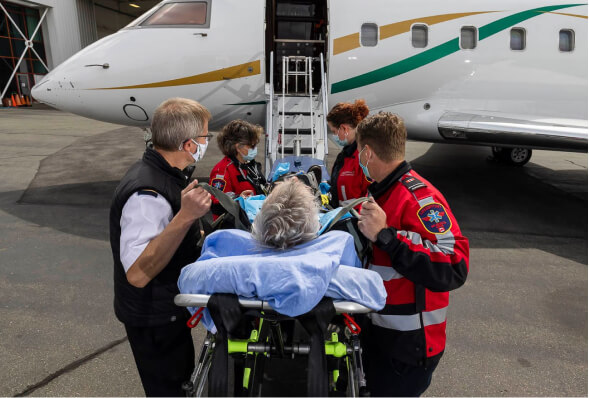
The moment a ventilated patient leaves a hospital room, they are in a clinical environment that must replicate — and in some cases exceed — what the sending facility was providing. The transport team must be capable of managing all of the following simultaneously:
- Ventilator settings and real-time adjustments in response to altitude and cabin pressure changes
- Oxygenation and continuous CO2 monitoring via capnography
- Hemodynamic stability, including IV medications, vasopressor drips, and fluid management
- Suctioning, circuit management, and airway emergencies in a confined space
- Sedation, comfort, and communication for patients who are conscious during transport
This is one of the most clinically demanding missions in air medical transport, and it requires the right equipment, the right crew, and a logistics structure with no gaps.
What Equipment Does Travel Care Air Use for Ventilator Transports?
Each air ambulance mission is loaded based on a pre-flight medical review of the patient’s current clinical status — not a generic checklist. For ventilated patients, the aircraft typically carries:
- Travel ventilator/transport ventilator — a portable ventilator selected specifically for aircraft use, matched to the patient’s current settings and diagnosis. Portable ventilator use in flight requires continuous clinician oversight; a home device is not a substitute
- Portable oxygen systems — sufficient for the full flight duration plus contingency reserves
- Cardiac monitor and defibrillator
- Infusion pumps for sedation, vasopressors, and IV medication management
- Suction equipment for airway management
- Capnography for continuous CO2 monitoring
- Emergency airway supplies including, intubation equipment and backup circuits
For patients with a tracheostomy, a portable ventilator for tracheostomy patients is selected based on the patient’s specific trach type, size, and current settings, alongside specialized airway management supplies.
Who Is on the Medical Crew for a Ventilator Transport?
Crew composition is determined during the pre-mission medical review and matched to the patient’s specific needs. For ventilator-dependent patients, Travel Care Air deploys teams that can include:
- Respiratory therapists credentialed in flight transport with direct experience managing ventilators at altitude
- Critical care nurses with flight certification and an ICU background
- Paramedics trained in advanced aeromedical critical care protocols
- Physicians for the most complex cases — patients on multiple vasoactive drips, unstable airways, or pediatric ventilated patients
The same review that determines crew composition also evaluates whether the patient is stable enough to move at all, or whether additional stabilization at the sending facility is required before transport begins.
How Does Travel Care Air Manage a Ventilator Transfer Step by Step?
Understanding how air medical transport works helps families know what to expect and what decisions they will need to make. For a ventilated patient, the process follows these stages:
1. Initial consultation
A family member or physician contacts Travel Care Air. A coordinator gathers information about the patient’s diagnosis, current ventilator settings, location, and destination. There is no obligation — early contact gives the team more time to plan and more options to work with.
2. Medical review
Our Medical Director reviews the patient’s clinical picture, including records, imaging, and a peer-to-peer discussion with the treating physician when needed. This review determines whether transport is appropriate, what crew and equipment are required, and whether any stabilization steps need to occur first.
3. Mission planning
Aircraft selection, crew assignment, ground ambulances at both origin and destination, and receiving hospital confirmation all happen in parallel. For international transfers, this includes regulatory permits, customs clearance, and alignment of documentation between different healthcare systems.
4. Departure and in-flight care
The medical team performs a full clinical handoff at the sending facility bedside, assuming responsibility for the patient from that moment. All transitions — hospital bed to ground ambulance, ground ambulance to aircraft — are managed as a single coordinated sequence with no unsupervised gaps.
5. Arrival and handoff
The same team that received the patient delivers them to the accepting physician with a complete clinical summary. Nothing is lost in the transition. The receiving team knows exactly what happened during transport.
This bed-to-bed model eliminates the moments between care environments where patients most commonly deteriorate.
Can a Ventilated Patient Be Transferred Internationally?
Yes. International ventilator transfers are among the most complex missions Travel Care Air coordinates and require additional layers of planning that go well beyond booking an aircraft.
Healthcare systems were not designed to communicate with each other. Medical records may be in a different language or format. Medication names differ by country. Stabilization thresholds vary. What one hospital considers stable for discharge may not meet the requirements for long-distance flight transport.
Travel Care Air manages all of it — gathering and translating documentation, conducting peer-to-peer physician discussions, confirming acceptance at the receiving facility, securing international permits, and aligning ground transport on both ends. Families do not navigate this alone. For a closer look at how that cross-border coordination works in practice, see How We Coordinate Hospital Care Worldwide.
What Should Families Ask Before Choosing a Provider?
Not every air ambulance provider is equipped to handle ventilated transports. A full list of questions to ask before choosing an air ambulance provider is available, but for ventilator-specific missions, ask the following:
- Does your medical crew include a respiratory therapist on ventilator missions?
- What transport ventilator do you use, and how is it selected for each patient?
- How do you manage ventilator setting adjustments at altitude?
- Do you conduct a peer-to-peer medical review before every mission?
- Who confirms acceptance at the receiving hospital, and when does that happen?
- What is your protocol if the patient deteriorates mid-flight?
A provider that cannot answer these questions specifically and confidently is not equipped for this level of care.
How Much Does Ventilator Transport Cost?
Ventilator missions are among the higher-acuity air ambulance transports, and pricing reflects the specialized crew, equipment, and coordination involved. Costs vary based on distance, aircraft type, crew composition, and whether the mission is domestic or international.
Travel Care Air provides transparent, all-inclusive pricing covering the aircraft, pilots, full medical crew, ground ambulances at both ends, and all logistics coordination. There are no hidden fees added after the mission.
An early call — even before a family has made a final decision — gives the team the best opportunity to identify the most clinically appropriate and cost-effective solution. For a detailed breakdown of what drives transport costs, see How Much Does a Medevac Cost.
When Should You Call Travel Care Air?
Call as early as possible. Families often wait until the situation is urgent, but earlier contact creates better outcomes — more time to confirm the receiving facility, secure international permits, and ensure the right crew configuration is available.
Contact Travel Care Air when:

- A ventilated patient needs to move from an ICU toa hospital closer to home
- A family wants to repatriate a critically ill loved one from abroad
- A stable ventilator-dependent patient needs clinical support to fly commercially
- A specific specialist or facility is required that is not locally available
- A patient has been told they need to transfer, but the family does not know how to arrange it
Ventilator-Dependent Air Transport Available 24/7/365
Travel Care Air is available 24/7/365. Fill out the contact form and receive a response within 15 minutes, or call directly:
U.S./Canada: 1-800-524-7633 | International: +1-715-479-8881 Contact us today — even a brief early conversation costs nothing and gives you a clearer picture of what is possible.
Frequently Asked Questions About Transporting a Patient on a Ventilator by Air
Can a patient on a ventilator fly on a plane?
Yes. Whether a ventilated patient can fly commercially depends on their clinical status. Stable, mobile ventilator-dependent patients may be approved for commercial travel with airline clearance, an FAA-approved device, and a medical escort. Critically ill or ICU-level patients cannot fly commercially and require a dedicated air ambulance with a full critical care crew.
Can you fly on a ventilator?
Yes, under the right conditions. Stable patients can fly commercially on an FAA-approved device with proper documentation and ideally a medical escort. Critically ill patients fly safely via air ambulance, where the aircraft, crew, and equipment are purpose-built for ventilator management in flight.
Can you fly with a ventilator on a commercial airline?
Stable ventilator-dependent patients can fly commercially if the device is FAA-approved, battery life meets airline requirements, and medical clearance is obtained. Airlines require 48 to 72 hours advance notice and documentation from a physician.
Can a patient on a ventilator be transferred to another hospital?
Yes. Ventilated patients are transferred between hospitals regularly via air ambulance. Travel Care Air has coordinated these missions domestically and internationally since 1980, managing everything from crew selection to receiving hospital confirmation.
Can you transport a patient on a ventilator?
Yes. Transporting a patient on a ventilator requires a dedicated air ambulance with a transport ventilator, adequate oxygen reserves, and a credentialed critical care crew trained in aeromedical respiratory management. Ground ambulances used at both ends of the mission also carry compatible transport ventilators.
Can a patient on a ventilator be conscious?
Yes. Some ventilated patients are fully or partially conscious during transport, particularly those on non-invasive ventilation or lighter sedation. Travel Care Air’s crew is trained to manage both conscious and sedated patients, including communication, comfort, and anxiety management throughout the flight.
Who manages the ventilator during the flight?
A respiratory therapist or critical care clinician trained in aeromedical transport manages the ventilator throughout the flight, monitoring oxygenation and CO2 levels and adjusting settings in response to altitude and cabin pressure changes.
What type of ventilator is used during air transport?
A transport ventilator designed specifically for aircraft use is selected based on the patient’s current settings and diagnosis. For patients with a tracheostomy, a portable ventilator for tracheostomy patients is chosen based on trach type, size, and current clinical requirements.
Can a ventilated patient be transferred internationally?
Yes. International transfers require additional coordination — documentation, permits, physician acceptance at the receiving facility, and alignment between different healthcare systems — all of which Travel Care Air manages as part of the mission across six continents.
How long does it take to arrange a ventilator transport?
Many domestic missions can be arranged within 24 to 48 hours once medical clearance is complete. International transfers may take longer depending on permits, documentation, and receiving facility logistics. Early contact gives the team the best opportunity to move efficiently.
Will insurance cover a ventilator air ambulance transfer?
Coverage depends on the policy and documented medical necessity. Travel Care Air provides clinical documentation to support insurance claims and works with families and case managers throughout the reimbursement process.
What if the patient deteriorates during the flight?
The crew is trained and equipped to manage in-flight deterioration. The aircraft carries emergency medications, advanced airway supplies, and defibrillation equipment. Diversion protocols are in place for situations that require immediate ground access to a medical facility.
Can a family member travel on the aircraft with the patient?
In many cases, one family member may accompany the patient depending on aircraft size, the patient’s condition, and weight and space requirements. This is evaluated during the planning phase and confirmed for each specific mission.
Travel Care Air coordinates ventilated patient transfers across the United States and internationally. Whether your loved one needs a medical escort on a commercial flight or a fully equipped air ambulance, see where we fly or contact our team any time — day or night.