
A chest tube changes the travel conversation completely. Whether it was placed for a collapsed lung, fluid around the lung, chest surgery, or trauma, a chest tube is a sign that something inside the chest still needs active management. Commercial airlines generally won’t let a passenger board with one in place, and cabin pressure can make an air leak in the chest more dangerous. So if a patient with a chest tube needs to travel, the question isn’t whether they can take a regular flight. It’s whether they need medical air transport, and how to plan it safely.
Travel Care Air has coordinated medical flights for patients with complex lung and chest conditions since 1980. For patients flying with a chest tube or recovering from one, we plan around the drainage system, cabin altitude, oxygen needs, and what the crew will do if something changes mid-flight. Consultations are free and available 24/7/365. Contact Travel Care Air or call U.S./Canada: 1-800-524-7633 | International: +1-715-479-8881.
What Is a Chest Tube and Why Is It Used?
A chest tube is a flexible tube placed through the chest wall into the space around the lung. It drains air, fluid, or blood that has collected there and lets the lung re-expand. Common reasons for a chest tube include:
- Pneumothorax, or a collapsed lung, where air leaks into the space around the lung
- Pleural effusion, a buildup of fluid around the lung, often linked to infection, heart failure, or cancer
- Hemothorax, blood in the chest after an injury
- Chest or heart surgery, to drain the area while it heals
- Empyema, an infected fluid collection around the lung
The tube is connected to a drainage system or a one-way valve that lets air and fluid out but not back in.
Can You Fly on a Commercial Airline With a Chest Tube?
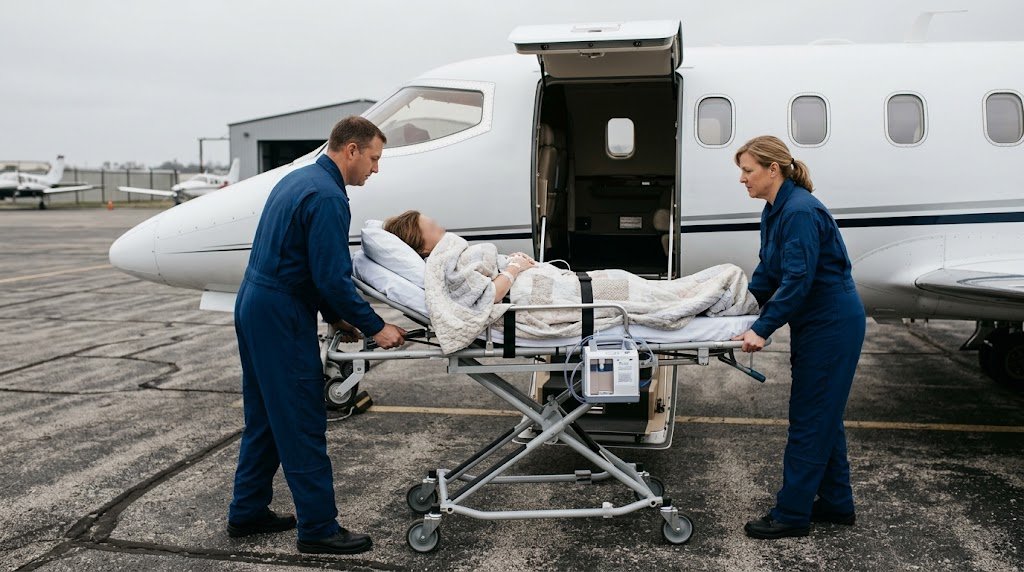 In general, no. Commercial airlines don’t allow passengers to fly with a chest tube in place, and an untreated or recently treated collapsed lung is one of the most widely recognized reasons not to fly. There’s no one on a commercial flight trained to manage a chest drain, and nowhere to go if the patient’s breathing gets worse over the ocean.
After the tube is removed, most doctors recommend waiting until imaging confirms the lung has fully healed before flying commercially, and many guidelines suggest waiting at least a week or two after that. Exact timing varies by the cause, the patient, and the treating physician’s judgment. For a broader look at conditions that rule out commercial travel, see our guide to health conditions you should not fly with.
Why Is Altitude Dangerous for a Patient With a Chest Tube?
Commercial aircraft cabins are pressurized to the equivalent of roughly 6,000 to 8,000 feet. At that pressure, trapped gas inside the body expands. For most people that just means popping ears. For a patient with air around the lung, it can mean:
- A small pneumothorax getting bigger. Expanding air can press on the lung and make it harder to breathe.
- Tension pneumothorax. In the worst case, air builds up with no way out and presses on the heart and lungs, which is a life-threatening emergency.
- Lower oxygen levels. The thinner air at cabin altitude means less oxygen with each breath, which hits harder when part of a lung isn’t working.
A working chest tube and drainage system are designed to let that air escape, but they need to stay open, secured, and monitored the entire trip. That’s why chest tube patients need a medical crew, not just a seat.
When Is Medical Air Transport Necessary for a Chest Tube Patient?

Medical air transport is usually needed when a patient with a chest tube must move before the tube can come out. Common situations include:
- Transfer to a hospital with thoracic or cardiac surgery for a problem the current hospital can’t fix
- A persistent air leak that isn’t healing and needs specialist care
- Trauma patients with chest injuries who need a trauma center
- Patients hospitalized abroad after a collapsed lung or chest injury who need to come home
- Patients with a chest tube for cancer-related fluid who need to reach their cancer center
- Patients who also need oxygen or a ventilator
In these cases, an air ambulance gives the patient a medical crew, continuous monitoring, and the equipment to respond if anything changes. Some aircraft can also fly with a lower cabin altitude when the patient’s condition calls for it, which reduces gas expansion. Whether that’s possible depends on the aircraft, the route, and the distance.
How Does an Air Ambulance Crew Manage a Chest Tube in Flight?
Managing a chest tube in flight takes preparation before the aircraft ever leaves the ground. Our crews:
- Review recent chest imaging and the tube’s purpose, size, and output before departure
- Secure the tube and drainage system so nothing kinks, disconnects, or tips over during loading and turbulence
- Use a drainage setup suited to flight, such as a one-way valve or a sealed system, as directed by the treating physicians
- Monitor breathing, oxygen levels, and vital signs continuously
- Watch the drainage for changes in air leak, fluid, or blood
- Carry the equipment and skills to treat a worsening air leak if the patient’s breathing suddenly gets worse
- Coordinate with the receiving hospital so a surgeon or pulmonary team is ready on arrival
A crew trained in aeromedical care understands how altitude affects trapped air and adjusts the plan before problems start. For more on what’s on board, see the equipment on board an air ambulance.
What About Flying After a Chest Tube Is Removed?
Once the chest tube is out and the lung has healed, many patients can fly commercially again. But “healed” has to be confirmed, usually with follow-up imaging, and the timing should come from the treating physician. Patients who are still short of breath, need oxygen, or had a complicated recovery may need a flight nurse medical escort on their first flight home, so someone trained is watching for warning signs.
If you were treated for a collapsed lung after surgery, our guide to air travel after surgery covers related timing questions.
Why Does Every Chest Tube Patient Need a Medical Review Before Flying?
A medical professional reviews every patient before any transport plan is finalized. For a chest tube patient, that review looks at:
- Why the tube was placed and how long it has been in
- Recent chest X-rays or scans
- Whether there’s an ongoing air leak
- Drainage amount and type
- Oxygen needs and breathing effort
- Other injuries or conditions
- The receiving hospital’s plan for the tube
Our Medical Director conducts peer-to-peer discussions with the treating physician to decide whether the patient can safely fly, under what conditions, and what needs to happen first if they’re not ready.
Who Cares for a Chest Tube Patient During an Air Ambulance Flight?
The crew is matched to the patient’s needs. A Travel Care Air crew can include critical care flight nurses, paramedics trained in advanced aeromedical protocols, respiratory therapists for patients who need breathing support, and physicians for the most complex cases. Our crews are trained in advanced cardiac life support, pediatric advanced life support, and pre-hospital trauma care. If the patient is on a ventilator, see Can a Patient on a Ventilator Fly on a Plane?
How Does Bed-to-Bed Coordination Protect Chest Tube Patients?
Every transfer, from bed to stretcher, stretcher to ambulance, and ambulance to aircraft, is a chance for a chest tube to be pulled, kinked, or disconnected. That’s why the handoffs matter as much as the flight.
Travel Care Air manages every transition as part of a single plan. We arrange ground ambulances at both ends, confirm a physician is ready to accept the patient before the mission launches, and keep the same medical team with the patient from the sending bedside to the receiving one. See How an Air Ambulance Transfer Works from Start to Finish for a step-by-step look.
What If a Loved One Gets a Collapsed Lung While Traveling Abroad?
A collapsed lung or chest injury overseas often means a family is stuck: the patient can’t fly commercially, and the local hospital may not be where they want to recover. Travel Care Air coordinates medical repatriation across six continents, handling records, receiving-hospital acceptance, and the flight. Learn more in Medical Repatriation Explained, and see how other families made it home in our Mission Stories.
What Does Medical Air Transport Cost for a Chest Tube Patient?
Costs depend on distance, the aircraft, the medical crew needed, and whether the trip is domestic or international. A Travel Care Air air ambulance quote typically includes the aircraft, pilots, the full medical crew, ground ambulances at both ends, and all logistics coordination, with no hidden fees. For more, see How Much Does a Medevac Cost and Will My Health Insurance Pay for an Air Ambulance?
When Should I Contact Travel Care Air?
Contact us when a patient with a chest tube needs to move to another hospital or get home, or when you’re unsure whether a recently removed chest tube means it’s safe to fly commercially. You can fill out a brief contact form on our website and receive a response within 15 minutes, or call directly: U.S./Canada: 1-800-524-7633 | International: +1-715-479-8881.
When a Regular Flight Isn’t an Option

A chest tube means the patient’s lungs still need protection, and that protection has to travel with them. Travel Care Air plans every chest tube flight around the drainage system, cabin altitude, and the receiving team, so the patient arrives breathing as well as when they left.
Medical emergencies don’t follow business hours, and neither do we. Travel Care Air is available 24 hours a day, 7 days a week, 365 days a year. Contact us for a free consultation and flight quote or call U.S./Canada: 1-800-524-7633 | International: +1-715-479-8881.
Frequently Asked Questions About Flying With a Chest Tube
Can you fly with a chest tube?
Not on a commercial airline. Patients with a chest tube in place generally need medical air transport with a trained crew who can monitor the tube and treat breathing problems in flight.
How long after a collapsed lung can you fly?
Most doctors recommend waiting until imaging shows the lung has fully healed, and many guidelines suggest waiting at least one to two weeks after that before flying commercially. Your doctor will decide based on your situation.
How long after chest tube removal can you fly?
It depends on why the tube was placed and how you’ve recovered. Your doctor will usually confirm healing with an X-ray before clearing you to fly commercially.
Why is flying dangerous with a pneumothorax?
Trapped air in the chest expands at cabin altitude, which can make a collapsed lung worse and, in rare cases, cause a life-threatening tension pneumothorax.
Can an air ambulance fly at a lower cabin altitude?
Some aircraft can maintain a lower cabin altitude to reduce gas expansion, depending on the aircraft, the route, and the distance. The medical team and flight crew plan this together when the patient’s condition calls for it.
Can a chest tube patient fly home from another country?
Yes, with medical air transport. Travel Care Air coordinates international repatriation for patients with chest tubes, including records, receiving-hospital acceptance, and ground ambulances at both ends.
Does insurance cover medical air transport with a chest tube?
Coverage depends on the plan and whether the transport is medically necessary. Travel Care Air can provide documentation to support a claim.
How quickly can medical air transport be arranged?
Many domestic missions can be organized within 24 to 48 hours once medical clearance and logistics are confirmed. International transfers may take longer.