
Not every hospital is equipped to treat a serious burn. When a patient needs specialized burn center care, the question is rarely whether to transfer, but how to do it without losing ground on stabilization. An air ambulance can be the difference between a patient arriving at a burn center ready for the next phase of treatment and arriving in worse condition than when they left the first facility.
Call us 24/7/365 at U.S./Canada: 1-800-524-7633, or International: +1-715-479-8881, or contact us online for a free consultation and quote. To see how families have navigated similarly complex transports, read our mission stories.
Why Some Burns Need a Burn Center, Not Just the Nearest ER
The American Burn Association maintains specific criteria for which burn injuries belong in a specialized burn center rather than a general emergency department or hospital ward. Burns that meet these thresholds need the kind of expertise, equipment, and multidisciplinary team that only a dedicated burn center can provide:
- Partial-thickness burns covering more than 10% of total body surface area
- Full-thickness burns of any size in any age group
- Burns involving the face, hands, feet, genitalia, perineum, or major joints
- Electrical burns, including lightning injuries
- Chemical burns
- Inhalation injury, even when skin involvement is limited
- Pediatric burns, especially in very young children
- Burns in patients with other medical conditions or simultaneous trauma
These criteria exist because burn treatment is not just wound care. It involves fluid resuscitation, temperature management, airway protection when inhalation injury is suspected, pain control, infection prevention, and often skin grafting or other surgical interventions that general hospitals are not set up to handle.
Why Air Transport Matters for Burn Patients
When a burn center is hours away, ground transport can be too slow, too rough, or too risky for a patient who is already hemodynamically fragile. Air transport shortens the distance, but it also creates a controlled clinical environment where the care team can keep working rather than just monitoring. Current guidance on burn center access notes that air transport is heavily used in rural areas or by hospitals far from burn centers, precisely because it allows the patient to reach specialized care without deteriorating en route.
That said, a flight is not automatically the right call for every burn. The decision depends on the burn’s severity, the patient’s stability, the distance to the burn center, and whether the patient needs interventions during transport that a ground ambulance cannot provide. A quick way to frame it:
- Choose air when the burn center is far enough that ground transport would delay critical care or expose the patient to hours of road vibration and stops.
- Choose air when the patient needs ICU-level monitoring, fluid management, or airway support that requires a dedicated medical crew.
- Choose ground when the burn center is close, the patient is stable, and the transfer is short enough that air would add complexity without meaningful benefit.
If you are weighing those options, our guide on ground transport vs. air ambulance walks through the decision in more detail.
What Changes in the Air for a Burn Patient
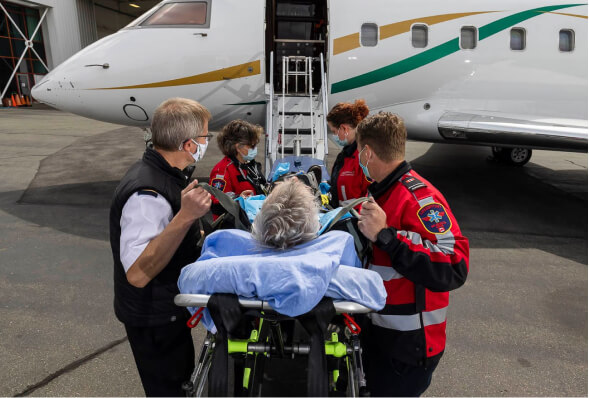
A burn patient’s needs do not pause during flight, and the aircraft environment introduces its own set of clinical challenges that the transport team has to manage actively.
Cabin pressure and fluid shifts. Most air ambulances maintain cabin pressure equivalent to 6,000 to 8,000 feet of altitude, which is standard for civilian fixed-wing flight. For most patients this is manageable, but for burn patients who are already losing fluids through damaged skin, that environment can accelerate dehydration and fluid shifts. The medical team has to plan fluid resuscitation not just for the flight’s duration but for the altitude effects on top of it.
Hypothermia risk. Burn patients lose the ability to regulate body temperature through damaged skin, and longer flights increase that risk. Literature on aeromedical transport of critically ill patients specifically notes that burn patients require active temperature management during flight, since hypothermia can worsen outcomes and complicate the next phase of treatment.
Inhalation injury and altitude. If a patient has airway involvement from smoke or chemical exposure, the reduced oxygen pressure at cabin altitude adds another layer of risk. Patients with significant inhalation injury may need intubation before transport rather than during it, since airway swelling can progress quickly once the patient is in the air.
Pain and positioning. Burn patients need careful positioning to protect injured areas while still allowing the medical team to monitor and treat them. That coordination has to happen continuously, not just at takeoff and landing.
How the Transfer Process Works
A burn center transfer is not booked and launched on the same call. The sequence matters because each step protects the next one.
- Referral and acceptance. The sending hospital contacts the burn center, confirms the patient meets transfer criteria, and secures acceptance. The burn center team reviews the case and confirms they can receive the patient.
- Stabilization at the sending facility. Before transport, the sending team focuses on airway protection if needed, fluid resuscitation, pain control, wound coverage, and preventing further heat loss. The goal is to hand off a patient who is as stable as possible, not a patient who still needs the most urgent interventions.
- Transport planning. The air ambulance provider reviews the medical record, confirms the aircraft and crew are matched to the case, and coordinates with both facilities on timing, ground ambulance legs, and handoff logistics. If the case crosses state lines or involves an international leg, permits and clearances are part of this step.
- In-flight care. The medical team continues fluid resuscitation, monitoring, pain management, and temperature support throughout the flight, adjusting as the patient’s condition changes.
- Handoff at the burn center. The receiving team takes over with a full clinical picture, not a summary. This is where a well-coordinated transport shows its value most clearly.
If you want a fuller picture of how this coordination works across borders or between unfamiliar systems, our guide on arranging medical transport across borders covers the paperwork and handoff side.
What Travel Care Air Actually Does Step by Step
Families often ask what happens between the first call and the moment the patient is handed off at the burn center, so here is exactly how Travel Care Air runs a burn transfer, in the order it actually unfolds.
- Medical review before anything is booked. The first step is always a clinical review, not a flight quote. Our medical director looks at the burn type, size, depth, location, whether inhalation injury is involved, and how far along the fluid resuscitation is. This determines whether air transport is appropriate at all and, if so, what the aircraft and crew need to look like before we confirm anything.
- Burn center coordination starts immediately. We do not wait until the flight is confirmed to contact the receiving burn center. Our team reaches out directly to confirm acceptance, share the clinical picture, and make sure the receiving team is ready for the patient’s specific injuries, not just a generic intake. This is also when we coordinate with the sending hospital so both sides are working from the same information.
- The aircraft and crew are matched to the case, not the other way around. A burn patient with inhalation injury needs a different setup than a burn patient without airway involvement. We assign the crew – which can include critical care nurses, paramedics, and respiratory support depending on the case – based on what the patient actually needs, and we configure the aircraft’s equipment accordingly, including fluid management capability and temperature control measures.
- Ground legs are handled as part of the plan, not as an afterthought. Burn patients are especially vulnerable during transitions, so we arrange and coordinate the ground ambulances at both the sending and receiving ends rather than leaving those to the family or the hospitals to sort out separately. The same positioning and monitoring standards apply from bed to aircraft and from aircraft to bed.
- In-flight care continues the work the sending hospital started. The flight team manages fluid resuscitation, pain control, temperature support, and monitoring throughout the flight, adjusting as the patient’s condition changes rather than treating the flight as a passive waiting period. Because cabin altitude and longer flight times affect burn patients differently than most other critical care cases, this is an active clinical role, not just a transport role.
- The handoff at the burn center is a clinical transfer, not a drop-off. When the aircraft lands, our team provides a full clinical handoff directly to the burn center team – the current fluid status, what has been given, any changes during flight, and the exact condition on arrival – so the receiving team is continuing a care plan, not rebuilding one from scratch.
This is the same bed-to-bed structure we use across all our missions, and it is why the earlier questions in this guide – about experience with burn patients specifically, fluid and temperature management in flight, and coordination with both facilities – are not hypothetical. They describe exactly what our team does on every case.
Questions to Ask Before You Commit to a Transfer
Not every air ambulance provider has specific experience with burn patients, and that gap matters more for this type of case than for many others. Before confirming a transport, ask:
- Has the medical director reviewed the specific burn type and size, and does the crew have experience with burn patients specifically?
- How will the team manage fluid resuscitation and temperature control during a flight of this length?
- Is the receiving burn center already in contact with the sending hospital, or is that coordination still being arranged?
- What happens if the patient’s airway becomes compromised during the flight?
- Does the provider handle the ground ambulance legs at both ends, or is that a separate arrangement?
A provider who can answer these without hesitation is one that understands burn transport as a clinical operation, not just a faster ride.
If You Need to Arrange a Burn Center Transfer

A burn injury that meets transfer criteria is one of the clearest cases where the quality of the transport matters as much as the destination. Travel Care Air has coordinated critical care flights, including burn patients, since 1980, working directly with sending hospitals and burn centers so the patient arrives ready for the next phase of treatment, not needing to be rescued from the transport itself.
Call us 24/7/365 at U.S./Canada: 1-800-524-7633, or International: +1-715-479-8881, or contact us online for a free consultation and quote. To see how families have navigated similarly complex transports, read our mission stories.
Frequently Asked Questions
Does every burn need a burn center?
No. Small, superficial burns can often be treated locally. The ABA criteria are specifically for burns that meet thresholds for size, depth, location, or type, since those are the cases where specialized care changes outcomes
Can a burn patient be transported before they are fully stabilized?
The goal is always to stabilize first. Current guidance is consistent that burn patients should be assessed and stabilized at the initial facility before transfer, with the transport team prepared to continue that care rather than start it mid-flight.
Is air transport safe for patients with inhalation injury?
It can be, but the airway has to be secured before departure if there is significant involvement, because airway swelling can progress quickly once the patient is airborne and at altitude.
How far can a burn patient be safely flown?
Distance is less important than stability. A well-prepared burn patient with a properly equipped crew can be flown long distances, but the medical plan has to account for fluid management, temperature control, and any airway issues throughout the entire flight.
What if the nearest burn center is in another state or country?
Interstate and international burn transfers happen regularly, but they require additional coordination for permits, medical record transfer, and hospital acceptance. A provider experienced in cross-border cases will handle that as part of the transport plan rather than leaving it to the family.