
Table of Contents
- What Commercial Stretcher Service Requirements Cover
- Who Is Eligible for a Commercial Stretcher Service
- Medical Clearance for Commercial Flights: What Airlines Require
- Commercial Stretcher Transport Documentation and Medical Assessment
- The Commercial Stretcher Service Booking Process, Step by Step
- Stretcher Installation, Aircraft Configuration, and Medical Escort Requirements
- Commercial Stretcher Flight Cost and Contingency Planning
- Frequently Asked Questions
Last Updated: October 18, 2026
What Commercial Stretcher Service Requirements Cover
Commercial stretcher service requirements in 2026 are the rules, approvals, and paperwork that let a patient fly on a scheduled airline while lying flat instead of sitting upright. At Travel Care Air, we have handled these arrangements since 1980, and the short version is this: the medical side is only half the job. The other half is airline approval, aircraft setup, and timing.
Here is what most guides get wrong. They treat a stretcher flight like a bigger version of a wheelchair request. It is not. A stretcher removes seats, needs a cabin crew briefing, and requires a medical clearance signed off before the ticket is even issued.
Below, we break down eligibility, clearance, documentation, booking, installation, cost, and what happens when plans change. By the end, you will know exactly which boxes to tick and in what order.
Who Is Eligible for a Commercial Stretcher Service
A patient qualifies for a commercial stretcher service when they cannot sit upright for a full flight but are stable enough to travel with medical supervision. The deciding factor is fitness to fly, not the diagnosis itself.
Typical candidates include:
- Patients recovering from major surgery or trauma
- People with serious illness who cannot tolerate a seated position
- Patients who must lie down during transport for medical reasons
- Elderly travelers with conditions that make standard seating unsafe
A common mistake is assuming a stretcher is only for critical cases. In practice, many stretcher patients are stable. They simply cannot sit for hours.
The opposite error also happens. Families sometimes book a stretcher for someone who is too unstable for any commercial flight. In that case, an air ambulance is the correct option, not a stretcher.
Booking a stretcher for a patient who is not medically stable wastes time and money. If the patient needs continuous critical care, a dedicated air ambulance is the right call. Ask for a medical assessment first.
Medical Clearance for Commercial Flights: What Airlines Require
Medical clearance is the airline’s written approval for a patient to fly with a stretcher. No clearance means no flight, no matter how much planning you have done.
Airlines generally ask for:
- A medical assessment from a qualified clinician
- A fitness to fly statement covering the patient’s condition
- Details of any medical escort traveling with the patient
- Confirmation that the patient can handle the flight duration
- Signed medical documentation on the airline’s own forms
Each airline runs its own medical approval process. Some respond within days. Others take longer, especially for international routes with connecting flights.
Timing matters here. Clearance should be requested well before the travel date. A last-minute request can stall the whole itinerary.
According to airline guidance on medical clearance for air travel, passengers with reduced mobility or medical needs should confirm requirements directly with the airline before booking.
Commercial Stretcher Transport Documentation and Medical Assessment
Commercial stretcher transport documentation is the paper trail that proves the patient is fit to fly and that the airline agreed to carry them. Missing paperwork is the most common reason stretcher bookings fall apart.
Expect to gather:
- A letter from the treating physician describing the condition
- Fitness to fly confirmation with a date
- The airline’s medical information form, completed and signed
- Passport and visa details for international transport
- Insurance details, including travel and medical cover
- Contact details for the receiving hospital or care team
The medical assessment behind these documents should cover oxygen needs, medication schedules, mobility limits, and infection-control concerns. It also flags whether a medical escort is required.
What most guides miss is that documentation has an expiry. A fitness to fly letter signed weeks ago may not satisfy the airline on travel day. Keep it current.
The Commercial Stretcher Service Booking Process, Step by Step
The commercial stretcher service booking process follows a fixed order, but the steps are not equal. Some are owned by the treating physician, some by the airline’s medical team, some by the transport provider, and some by the family. The 2026 checklist below assigns an owner and a decision point to each step so nothing stalls in a handoff.
- Confirm the patient is stable enough to fly, owner: treating physician. Get a written medical assessment before anything else. Decision point: if the patient needs continuous critical care, oxygen titration, or cardiac monitoring, stop and evaluate a dedicated air ambulance instead of a commercial stretcher.
- Choose the route and flight itinerary, owner: transport coordinator with family input. Prefer direct flights on wide-body aircraft. Decision point: if the only viable route involves a connection through a small airport or a narrow-body aircraft, confirm stretcher availability on every leg before proceeding.
- Request airline medical clearance, owner: transport provider submits; airline medical team approves. Submit the airline’s own medical information form, the physician’s fitness-to-fly letter, and escort credentials. Decision point: clearance is written approval, not a verbal yes. Do not book until it is in hand.
- Confirm stretcher availability on the specific aircraft, owner: airline reservations and engineering. Not every plane or route can carry a stretcher, and availability can change when the airline swaps equipment. Decision point: get the aircraft type and stretcher confirmation in writing, and re-confirm after any schedule change.
- Arrange the medical escort, owner: transport provider. Match the escort’s training (flight nurse, paramedic, or physician) to the patient’s condition. Decision point: if the airline requires an escort for all stretcher cases, the escort’s airfare and fee must be in the quote before booking.
- Book ground ambulance transfers at origin and destination, owner: local ambulance providers coordinated by the transport provider. Decision point: confirm both ends can handle the patient’s mobility level and equipment (stretcher, oxygen, bariatric needs).
- Lock in the flight and send the full document pack, owner: transport provider. Send the complete pack to the airline, the escort, and the receiving care team. Decision point: the pack is complete only when the airline confirms receipt and the receiving team confirms the arrival plan.
- Run a final check 48 hours before departure, owner: named coordinator. Confirm seats, stretcher setup, escort assignment, ground transfers, and contacts. Decision point: if anything is unconfirmed, escalate before the 24-hour mark, when rebooking options shrink sharply.
Build the itinerary around the stretcher, not the other way round. Direct routes and wide-body aircraft give you far more stretcher availability than tight connections through small airports. A common pattern is that families book the flight first and then discover the aircraft cannot take a stretcher, reversing that order saves days.
Airlines differ in notice periods, forms, and escort rules, so verify the specific carrier’s requirements directly rather than assuming one airline’s process applies to another. The IATA guidance on passengers with medical needs is a useful starting reference, but each carrier applies its own rules and timelines.
Stretcher Installation, Aircraft Configuration, and Medical Escort Requirements
Stretcher installation changes the aircraft configuration. Cabin crew remove a block of seats, usually in the economy cabin, and fit an approved stretcher system in their place. The airline’s engineering team signs off the setup, not the medical team.
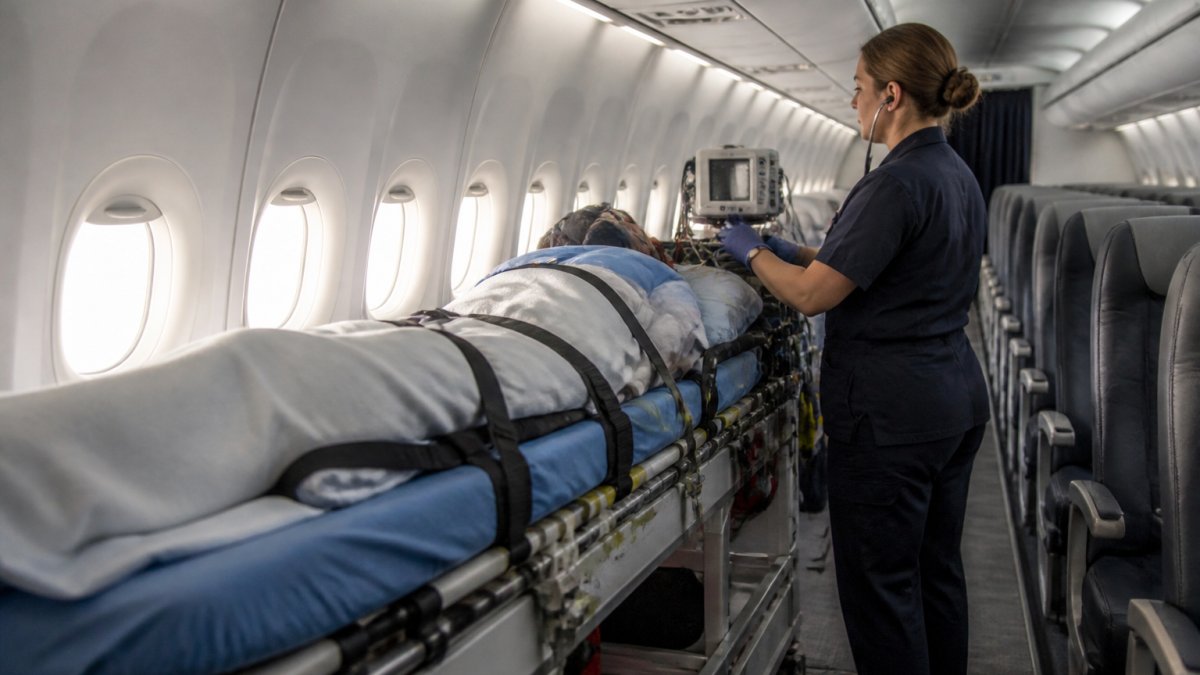
Medical escort requirements depend on the patient. A medically trained professional may be a flight nurse, a paramedic, or a physician. The escort handles in-flight care, medication, oxygen, and monitoring, and stays with the patient from ground transfer to arrival.
Some airlines require an escort for every stretcher patient. Others assess case by case. Confirm this early, because the escort fee and airfare affect the total service cost.
Commercial Stretcher Flight Cost and Contingency Planning
Commercial stretcher flight cost varies by route, and no two quotes look the same. What most guides leave out is the itemized structure behind the quote. A transparent breakdown usually separates into these lines:
- Passenger airfare for the stretcher footprint. A stretcher removes a block of seats, and airlines typically charge for the seats removed plus the stretcher itself, not just one ticket.
- Medical escort airfare and professional fee. The escort’s ticket, plus their time and clinical fee, is often the second-largest line.
- Ground ambulance transfers at both ends. Origin and destination transfers are priced separately and depend on distance, mobility level, and equipment.
- Medical equipment on board. Oxygen, monitoring, and other approved equipment may carry airline handling fees or provider rental costs.
- Documentation and coordination. Some providers bundle this; others itemize it. Ask which.
- Contingency buffer. A buffer day, backup ground contacts, and rebooking flexibility all carry a cost, and skipping them is a false saving.
Payment responsibility is a separate question from cost. Families should confirm in writing who pays the airline, who pays the escort, who pays the ground providers, and whether travel insurance or the receiving institution reimburses any portion. A common pattern is that the transport provider invoices the family for coordination while the airline and ground providers bill separately, clarify this before booking.
Contingency planning deserves equal attention. Flights get delayed. Weather cancels routes. A patient’s condition can change overnight. Build in:
- A buffer day on either side of the travel date so a missed connection does not become a medical crisis.
- Backup ground ambulance contacts at both ends, confirmed 48 hours ahead and again on travel day.
- A named coordinator reachable during the journey, with a phone number the escort and family both hold.
- A written plan for schedule changes: who rebooks, who re-confirms the stretcher on the new aircraft, and who notifies the receiving team.
- A written plan for medical deterioration mid-route: the escort’s escalation threshold, the nearest suitable hospital along the route, and the decision-maker authorized to divert or rebook.
| Requirement Area | Who Handles It | Typical Timing |
|---|---|---|
| Medical assessment | Treating physician | First step, before booking |
| Airline medical clearance | Airline medical team | Days to weeks before flight |
| Stretcher installation | Airline engineering and cabin crew | On the day, before boarding |
| Medical escort | Transport provider | Booked with the flight |
| Ground transfers | Local ambulance provider | Confirmed 48 hours ahead |
| Contingency plan | Coordinator and family | Finalized before departure |
The IATA guidance on passengers with medical needs is a useful reference for what airlines expect, though each carrier applies its own rules. Request a quote with the patient’s details and route, and ask for the breakdown line by line, a quote you cannot itemize is a quote you cannot plan around.
Frequently Asked Questions
Who is eligible to travel on a commercial airline stretcher?
Eligibility centers on whether the patient cannot sit upright for the flight duration but is stable enough for a commercial cabin. A medical assessment confirms fitness to fly, and the airline’s medical clearance team reviews the documentation. Patients with serious illness, recent injury, or complex cardiac and respiratory conditions usually need an escort and may be declined if the condition is unstable. Eligibility is decided case by case, not by a fixed list.
What medical documents are required for commercial stretcher transport?
Commercial stretcher transport documentation typically includes a physician’s letter describing the diagnosis and current condition, a fitness-to-fly statement, medication and equipment lists, and the airline’s medical information form. Some carriers ask for recent test results or a specialist report. Documents must be current and translated into English where needed. Missing or outdated paperwork is the most common reason approvals stall, so confirm the exact list with your provider before booking.
How do you book a commercial airline stretcher service?
The commercial stretcher service booking process starts with a medical assessment, then a request to the airline for stretcher availability on a specific route. Once medical clearance is granted, the provider confirms the flight itinerary, ground ambulance transfers at both ends, and the medical escort. Book as early as possible: stretcher positions are limited per aircraft and international routes with connecting flights need more lead time. Expect the full cycle to take days, not hours.
What happens if a patient’s condition changes before the flight?
A change in condition triggers a fresh medical assessment and, in many cases, a new clearance request to the airline. If the patient becomes unstable, the provider may switch to air ambulance, which removes the fixed cabin constraints of a commercial flight. Contingency planning should cover delays, cancellations, and medical changes before departure, with clear responsibility for rebooking and any additional cost. Tell your provider immediately if symptoms worsen.