
“I pray you never find yourself in this situation, but if you do, do not hesitate to call. This company saved my father’s life.” – Michelle Green
A stroke is one of the most time-critical medical emergencies a family will ever face. Brain cells die rapidly when blood flow is interrupted and every minute without treatment narrows the window for a meaningful recovery. When a stroke happens far from home, the question of how to get a loved one to the right care, safely and quickly, becomes urgent and deeply personal.
Air ambulance transport after a stroke is not only possible in many cases, in the right circumstances, it is the safest and most effective option available. This guide explains what families need to know: when air transport is appropriate, what the research says about outcomes, how the process works, and what to expect from first contact to bedside arrival.
At Travel Care Air, we have been coordinating medical transports since 1980, including complex neurological cases for patients who suffered strokes abroad or far from their preferred care team. When you call, a coordinator answers and is ready to begin the process immediately.
Commercial Air Travel vs. Air Medical Ambulance Transport
When people ask about air travel after a stroke, they are often asking two very different questions:
- “Is it safe for my loved one to fly commercially after a stroke?”
- “Can an air ambulance transport my loved one after a stroke — and when?”
These are not the same question, and the answers are different.
Is it Safe for a Stroke Patient to Fly Commercially?
General guidelines for commercial flying — typically recommending a wait of at least two weeks after an ischemic stroke and six to eight weeks after an intracerebral hemorrhage — apply to unmonitored travel in a standard aircraft cabin, where there is no medical team on board and no clinical backup if the patient’s condition changes.
How an Air Ambulance Functions as a Flying ICU
An air ambulance is a different environment entirely. It functions as a flying ICU, staffed by critical care nurses, flight paramedics, or physicians, and equipped with cardiac monitors, oxygen delivery systems, infusion pumps, and advanced life-support supplies. Because the medical environment is controlled and continuous clinical care is available throughout the journey, the decision about when to transport a stroke patient by air ambulance is made by a medical director evaluating that specific patient, not by a general guideline written for commercial passengers.
Does Air Medical Transport Improve Mortality and Recovery Outcomes?

A 2022 systematic review and meta-analysis by Kumar et al., published in Air Medical Journal as “Effect of Helicopter Transportation of Acute Ischemic Stroke Patients on Mortality and Functional Outcomes,” analyzed 8 studies including 1,372 patients transported by helicopter emergency medical services (HEMS) and 8,587 transported by standard ground EMS. The authors found that patients moved by helicopter had about twice the odds of a good neurological outcome (odds ratio 2.0) and a significantly lower rate of poor neurological outcomes (odds ratio 0.52) compared with ground transport.
A separate comparative study by Jeong Il Lee and colleagues, published in 2020 in Acute and Critical Care as “Comparative Study on the Outcome of Stroke Patients Transferred to a Stroke Unit by Helicopter or Ground Emergency Medical Services,” looked at 26 patients transported by HEMS and 102 by ground EMS (GEMS). Stroke patients transferred by helicopter had faster treatment, a lower mortality rate at 24 hours, and a higher survival-to-discharge rate (96.2% vs. 83.2% for ground).
Taken together, these studies show that when stroke patients must travel significant distances, air medical ambulance transport can improve functional outcomes and early survival by shortening the time to definitive stroke care. It is not the aircraft alone that changes outcomes, it is the combination of speed, direct routing to stroke-capable centers, and continuous clinical care from pickup to hospital handoff.
Safe Timelines for Boarding an Airplane After a Stroke
For families asking when is it safe to fly after a stroke, the answer depends on stroke type, severity, and current clinical status. Here is a practical breakdown:
| Stroke Type | General Commercial Flight Guidance | Air Ambulance Consideration |
| TIA (transient ischemic attack) | Minimum 2 days if symptoms resolved | Can be considered earlier with medical clearance |
| Minor ischemic stroke | 5–10 days if neurologically stable | Medical director evaluates on a case-by-case basis |
| Major ischemic stroke | 14+ days to assess for complications | Transport possible with appropriate crew and equipment |
| Intracerebral hemorrhage | 6–8 weeks if stable, no rebleeding risk | Medical director review required; blood pressure control critical |
| Subarachnoid hemorrhage (post-treatment) | ~3 months after aneurysm secured | Complex case; physician involvement in every decision |
These timelines are not absolutes. Every patient is different, and the decision to transport is always made after a medical director reviews the patient’s current status, imaging, oxygen requirements, blood pressure stability, and the specific demands of the planned route.
Understanding Air Travel and Stroke Risk Factors
Even after the initial danger has passed, air travel and stroke risk remain connected in the weeks following an event. Families should understand the real factors at play:
- Reduced cabin pressure can lower available oxygen levels, which is a significant concern for patients whose brain tissue is still recovering from ischemia
- Prolonged immobility during a flight increases the risk of deep vein thrombosis and pulmonary embolism which is a serious complications in stroke patients already at elevated clotting risk
- Altitude and pressure changes can affect swelling in injured brain tissue and require careful monitoring in patients with recent hemorrhagic strokes
- Recurrence risk is highest in the 30 days following a stroke or TIA, making supervised transport with clinical oversight the appropriate choice for medically fragile patients
In a properly equipped air medical ambulance, these risks are managed proactively. Oxygen levels are monitored and supplemented throughout the flight. The crew adjusts medication timing, IV rates, and positioning to account for the flight environment. This is fundamentally different from placing a post-stroke patient on a commercial aircraft and hoping for the best.
What to Expect During an Air Transport Ambulance Mission
When Travel Care Air coordinates transport for a stroke patient, the process is built around one principle: continuous clinical care from the sending hospital bed to the receiving hospital bed.
The Specialized Clinical Flight Crew
Depending on the patient’s condition and the complexity of the mission, the crew may include:
- Critical care nurses with flight certification
- Paramedics trained in advanced aeromedical protocols
- Respiratory therapists for patients with supplemental oxygen requirements
- A physician for the most medically complex post-stroke cases
Bed-to-Bed Coordination and Equipment
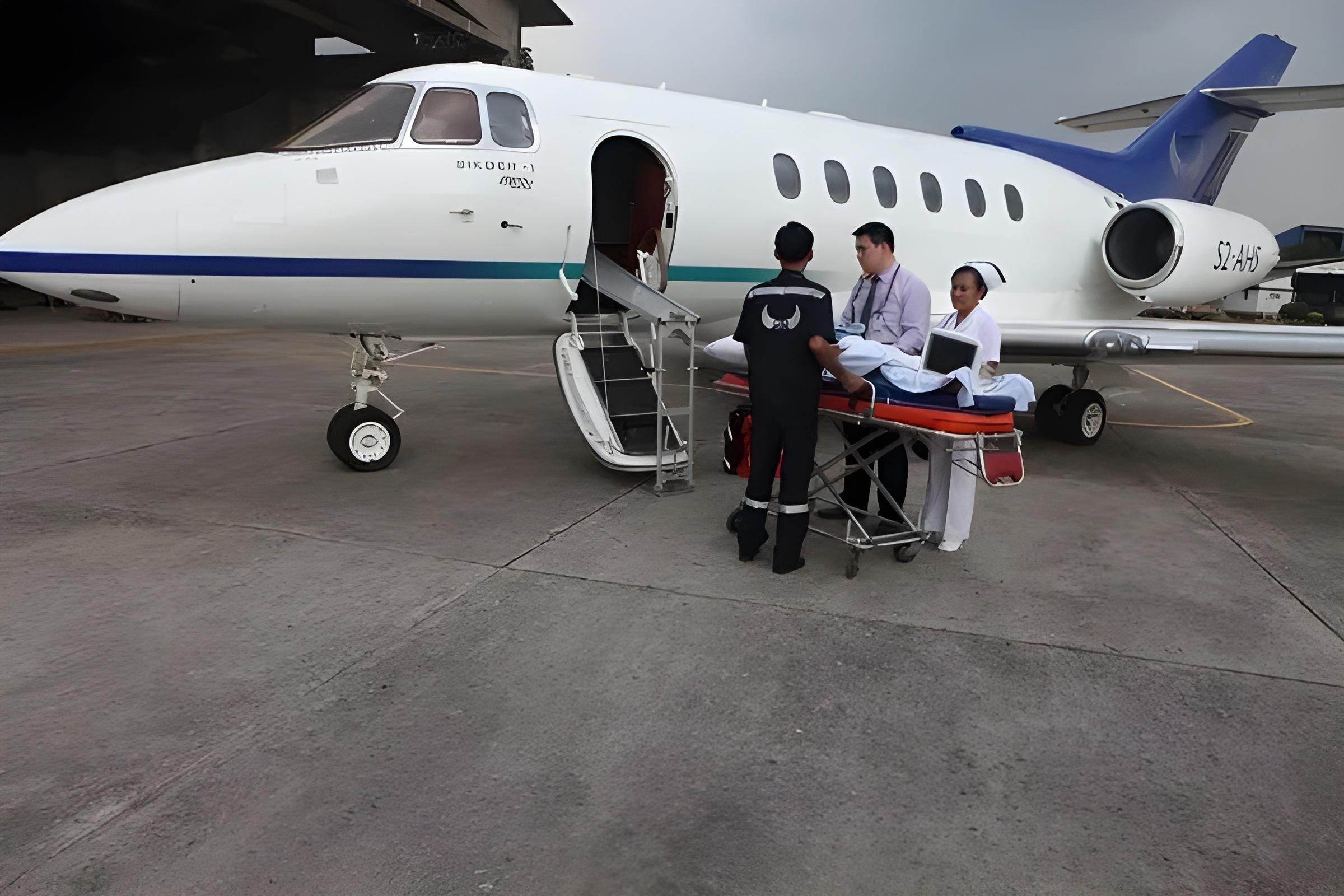
The aircraft is configured with the equipment the patient actually needs — cardiac monitors, oxygen delivery systems, infusion pumps for IV medications, suction devices, and advanced life-support supplies. Our Medical Director conducts a peer-to-peer review with the treating physician before any mission launches, confirming the patient’s stability thresholds and what the crew should watch for during the flight.
Ground ambulances at both the origin and destination are coordinated in advance. The receiving hospital confirms a physician is ready before the mission departs. Nothing about the transition is left to chance. If your loved one is hospitalized overseas, our article on how we coordinate hospital care worldwide explains in more detail how we bridge different healthcare systems to keep care continuous.
Case Study: Emergency Stroke Transport from Thailand
This kind of coordination is what made the difference for one family who found themselves facing exactly this situation. Michelle Green shared her experience:
“My father had a stroke while alone in Thailand. He was stuck in a hospital there and I had no idea what to do. The moment I called Brandy at Travel Care Air the wheels started turning. Brandy handled everything and before I knew it their nurse, Christina, was at my dad’s bedside. These two women are our heroes. Christina stayed in contact, put me at ease, and delivered my dad safely back to the United States. I pray you never find yourself in this situation, but if you do, do not hesitate to call Brandy. This company saved my father’s life.”
For families navigating a stroke emergency far from home, this is what it looks like in practice: a coordinator who answers the phone, takes ownership of the logistics, and keeps the family informed at every step while the clinical team focuses entirely on the patient.
For a deeper look at what that process feels like step by step, you can also read our guide on how to bring a loved one home from a foreign hospital.
The Importance of Early Coordination for Medical Flights
The single most important step a family can take after a loved one suffers a stroke abroad or far from home is to call early — before the situation deteriorates further.
Families who contact Travel Care Air while the patient is still relatively stable give the coordination team time to arrange optimal aircraft, build the safest route, obtain any required international flight permits, and align both the sending and receiving hospitals before the transport begins. Families who wait until the situation has become critical compress that window and limit options.
A consultation with Travel Care Air costs nothing and carries no obligation. You do not need to have insurance figured out. You do not need all the medical records in hand. The conversation can start from wherever you are. Read more about how missions come together on our Mission Stories page, and learn about international flight permits if your loved one is abroad.
Contact Travel Care Air for 24/7 Stroke Transport Assistance

Strokes do not happen during business hours. Neither do we. Travel Care Air has been helping patients and families for over 44 years, with crews trained in advanced cardiac life support (ACLS), pediatric advanced life support (PALS), and pre-hospital trauma life support (PHTLS). We have coordinated transports across six continents — and we answer the phone.
U.S./Canada: 1-800-524-7633
International: +1-715-479-8881
Online: Fill out our Contact Form — response within 15 minutes.
Frequently Asked Questions About Stroke Medical Flights
Can a stroke patient be transported by air ambulance?
Yes, in many cases. The decision depends on stroke type, severity, current neurological status, blood pressure stability, and the clinical demands of the planned route. Travel Care Air’s Medical Director reviews every patient individually before any mission is confirmed.
How soon after a stroke can a patient fly?
For commercial flights, general guidance recommends waiting at least two weeks after an ischemic stroke and six to eight weeks after a hemorrhagic stroke. Air ambulance transport may be considered earlier because the patient is under continuous clinical care throughout the flight — but this is determined on a case-by-case basis by a medical director.
How soon after a TIA can you fly?
The UK Civil Aviation Authority advises a minimum of two days after a TIA if symptoms have fully resolved, provided the patient has been clinically evaluated. For air ambulance transport, the timing is assessed individually. The risk of stroke in the 30 days following a TIA is elevated, which makes medically supervised transport the appropriate choice for travel during that window.
Does air medical transport improve outcomes for stroke patients?
Yes. Research shows that helicopter and fixed-wing air medical transport for stroke patients is associated with significantly better neurological outcomes, faster treatment times, and reduced mortality compared to long-distance ground transport. The primary reason is time: faster access to a stroke center means faster delivery of definitive treatment.
What are the risks of air travel after a stroke?
Key risks include reduced cabin oxygen at altitude, prolonged immobility increasing clot risk, pressure changes affecting brain tissue, and elevated recurrence risk in the weeks following a stroke. In an air ambulance, these risks are actively managed by a trained clinical crew throughout the flight.
Can a family member travel with the stroke patient?
In many cases, yes — depending on aircraft configuration, the equipment required, and the patient’s condition. Travel Care Air evaluates this individually and confirms availability during the planning phase.
What should I do if a family member has had a stroke abroad?
Call Travel Care Air immediately at 1-800-524-7633 (U.S./Canada) or +1-715-479-8881 (International), or fill out our contact form for a response within 15 minutes. You do not need all the answers before you call — that is precisely what the coordination team is here to help you work through.