
Last Updated: November 4, 2026
Quick Summary
Rural air evacuation is considered for time-critical conditions that need capabilities the local facility lacks, such as cardiac emergencies, rupturing aneurysms, severe trauma, compound fractures, intracranial bleeding, respiratory failure, and severe burns. Dispatch and treating clinicians decide the mode, since a stable patient with short ground transport time may do better by ground ambulance.
- One in 10 rural patients waits 30 minutes or more for emergency medical services to arrive.
- An air ambulance is needed when the condition exceeds local capability and air transport saves clinically meaningful time.
- The most common failure point in a rural air evacuation flight is patient packaging before departure.
- Fog, icing, high winds, and thunderstorms can ground a helicopter while a fixed-wing aircraft flies above the weather.
- Requesting a transfer starts with calls to confirm receiving facility acceptance and transport provider availability.
Table of Contents
- Why Rural Patients Face Longer Waits for Emergency Care
- 7 Medical Conditions Requiring Rural Air Evacuation
- When Is an Air Ambulance Needed? Clinical Criteria and Patient Stabilization
- Air Ambulance vs Ground Ambulance: How Transport Decisions Are Made
- What Happens During a Rural Air Evacuation Flight
- Medical Evacuation Cost and Emergency Medical Evacuation Insurance
- Requesting a Transfer for Your Patient or Family Member
- Frequently Asked Questions
Why Rural Patients Face Longer Waits for Emergency Care
One in 10 rural patients waits 30 minutes or more for emergency medical services to arrive, according to the National Rural Health Association’s rural EMS fact sheet, and 4.5 million people live in what researchers call an ambulance desert. That delay is the reason rural air evacuation exists as a distinct clinical decision rather than a luxury. Travel Care Air has coordinated air ambulance and medical escort transfers since 1980.
Distance is only half the problem; capability is the other half. A rural hospital may sit 90 minutes from a trauma center by road but have no neurosurgeon, no cath lab, and no ICU bed for a deteriorating patient.
If you are weighing whether a rural emergency warrants air transport, we published a companion piece on whether air ambulances are the right choice for rural emergencies that walks through the trade-offs in more detail.
7 Medical Conditions Requiring Rural Air Evacuation
Not every rural emergency needs a helicopter. These conditions share three traits: they deteriorate on a clock, they need a capability the local facility lacks, and ground transport time worsens the outcome. Together, those traits justify rural air evacuation. The table summarizes the seven categories; the subsections below explain the clinical circumstances that may prompt consideration of air transport, while making clear that dispatch and treating clinicians determine the appropriate mode.
| Condition | Why Time Matters | Typical Destination |
|---|---|---|
| Cardiac emergency | Muscle dies within the “golden hour” | Cath lab or cardiac ICU |
| Rupturing aneurysm | Minutes from hemorrhage to collapse | Neurosurgical center |
| Severe trauma | Hemorrhage and shock progress fast | Level I or II trauma center |
| Compound fracture | Infection and vascular risk climb | Orthopedic trauma service |
| Intracranial bleeding | Pressure damages brain tissue | Neurosurgery with CT capability |
| Respiratory failure | Oxygenation cannot wait | ICU with ventilator capacity |
| Severe burns | Fluid loss and airway swelling | Burn center |
Cardiac Emergencies and Rupturing Aneurysms
A heart attack is the clearest case for air transport. The Rural Policy Research Institute identifies heart attack, stroke, sepsis, and severe trauma as conditions requiring rapid treatment, and notes that delayed EMS activation and prolonged emergency transport are persistent rural challenges (Rural Policy Research Institute report on rural ambulance agencies).
A rupturing aneurysm is more deceptive. Symptoms can mimic a migraine until the bleed is catastrophic, and the only definitive treatment is neurosurgical. If the nearest hospital has CT but no neurosurgeon, the question is not whether to transfer but how fast.
Severe Trauma and Compound Fractures
Heavy equipment accidents, rollovers, and farm injuries produce trauma that rural hospitals stabilize but cannot definitively fix. A compound fracture carries open-bone infection risk and possible vascular damage, both needing orthopedic or vascular assessment most rural facilities cannot provide around the clock. Triggers that may prompt consideration of air transport include hemodynamic instability, a falling Glasgow Coma Scale, or a mechanism suggesting internal bleeding the local facility cannot fully evaluate.
Neurological Emergencies and Intracranial Bleeding
Stroke and intracranial bleeding are where rural air evacuation earns its reputation. Ischemic stroke may qualify for thrombectomy at a comprehensive stroke center, and that window is measured in hours. Hemorrhagic stroke and traumatic intracranial bleeding need neurosurgical evaluation, often with repeat imaging. Last-known-well time and current neurological status drive the destination decision more than imaging does. A patient who is awake and stable may travel by ground to a nearby stroke center; a declining exam with a long drive to neurosurgery is a different calculation, and the coordinator weighs aircraft availability and weather against the clinical clock.
Respiratory Failure and Severe Burns
Respiratory failure is a capability gap as much as a time gap. A rural hospital may have oxygen and a ventilator but not the intensivist coverage or advanced ventilation modes a deteriorating patient needs.
Severe burns add a second clock: fluid loss and airway swelling progress quickly, and a burn center’s resuscitation and wound care expertise is rarely available locally.
Pediatric, Obstetric, and Neonatal Emergencies
Three patient groups deserve separate mention. Pediatric emergencies may require pediatric intensive care and a crew comfortable with weight-based dosing and child-sized equipment; a rural hospital that stabilizes an adult may lack that capability for a child. Obstetric emergencies, including preterm labor, placental abruption, or severe preeclampsia, may need a labor and delivery unit and neonatal support, and the decision must account for both mother and fetus. Neonatal emergencies may require a specialized neonatal transport team and an incubator-equipped aircraft; not every air ambulance carries that capability, so confirming crew qualifications before wheels-up matters as much as flight time.
When Air Transport May Not Be the Right Choice
A condition on this list does not automatically mean air evacuation. A stable patient whose local facility can provide the needed care, or whose ground transport time is short, may be better served by ground ambulance. Because transport decisions depend on clinical judgment as well as logistics, trauma care training can help EMS teams assess patients and coordinate the safest level of care.
When Is an Air Ambulance Needed? Clinical Criteria and Patient Stabilization
An air ambulance is needed when the patient’s condition exceeds what the local facility can treat and the time saved by air transport is clinically meaningful.
- Time-critical condition. The patient will deteriorate measurably during a ground transport of the same distance.
- Capability gap. The receiving facility offers a service, such as neurosurgery, cardiac catheterization, or burn care, that the sending facility does not.
- Stabilization status. The patient can be stabilized enough for flight, or the flight crew can manage them en route.
That third point deserves emphasis. The World Health Organization’s 2025 guidance on medical evacuation addresses transport for patients with stable vital signs, minor injuries, or non-critical conditions who need only basic medical care.
For a deeper walkthrough of the clinical threshold, our guide on when an air ambulance is needed covers the criteria case by case.
Air Ambulance vs Ground Ambulance: How Transport Decisions Are Made
Ground ambulance wins on cost and availability for short distances and stable patients.
- Drive time versus flight time. A 3-hour ground transfer against a 35-minute flight changes the clinical math.
- Crew capability. A critical care flight crew can manage ventilation, vasopressors, and cardiac monitoring that a basic ground crew cannot.
- Weather and aircraft availability. Fog, icing, and wind can ground a helicopter while a fixed-wing aircraft flies above the weather.
The University of Arizona Center for Rural Health notes that air ambulances have become a crucial lifeline for many rural people as rural hospital infrastructure declines.
If you want the fuller picture on aircraft types, crew composition, and costs, our explainer on air medical transport covers how helicopter and fixed-wing flights differ.
What Happens During a Rural Air Evacuation Flight
A rural air evacuation flight follows a fixed sequence: referral and acceptance, crew assignment, aircraft positioning, patient packaging, in-flight monitoring, and handoff.
- Referral and acceptance. The sending physician contacts the receiving facility or a transport coordinator, who confirms bed and service availability. In rural transfers this can take longer because the regional center fields calls from a wide area; confirming early prevents a flight to a hospital that cannot admit the patient.
- Crew and aircraft assignment. A flight nurse and paramedic or respiratory therapist are assigned based on the patient’s condition, cardiac patients get a crew comfortable with invasive monitoring and vasoactive drips. The coordinator selects the aircraft: helicopter for shorter hops with a nearby landing zone, fixed-wing for longer distances or weather. Aircraft availability is a real rural constraint, and a crew may be positioned from another base, adding time before wheels-up.
- Aircraft positioning and landing zone selection. Rural hospitals may lack a helipad, so the crew coordinates with local emergency services for a safe landing area, which depends on daylight, terrain, and obstructions. Fixed-wing transports require an airport within ground-transport distance, and that ground leg is part of the total timeline.
- Patient packaging. Lines, airway, and monitoring are secured for flight. This is where most delays occur, and where a good crew prevents in-flight emergencies. The crew confirms stability and communicates any changes to the receiving team before departure.
- In-flight care. The crew monitors continuously, manages medications, and communicates with the receiving team. Altitude and cabin conditions can affect oxygen levels and equipment, and weather can require route changes or a diversion.
- Handoff. A structured report to the accepting physician or charge nurse closes the loop, including confirming any receiving-facility ground transport and giving the family a point of contact for updates.
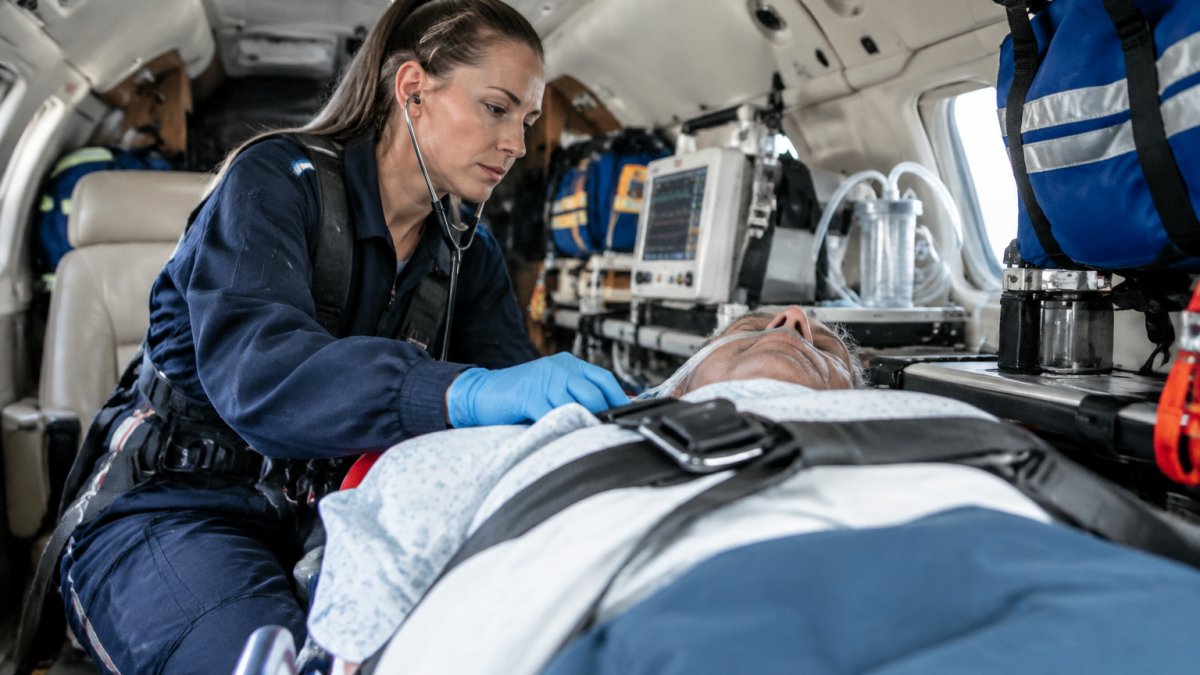
Watch out: the most common failure point is step four. A patient rushed onto an aircraft before lines and airway are secured creates an in-flight emergency at altitude, where options are limited.
Weather, Aircraft Availability, and Transport Limitations
Air transport is not always available or faster. Fog, icing, high winds, and thunderstorms can ground a helicopter while a fixed-wing aircraft flies above the weather, and fixed-wing still depends on an open airport and ground transport at both ends. Aircraft availability varies by region and time of day, and a crew may be committed elsewhere. A rural scene or hospital without a suitable landing zone may require a ground leg that erodes the time advantage.
What Families Can Prepare
Families can help by gathering the patient’s medication list, identification, insurance information, and advance directives, and by designating one point of contact for updates. Consent and authorization are handled by the treating clinicians and transport provider, and cost questions should go to the provider’s coordination team; they should not delay emergency care.
For a detailed bed-to-bed walkthrough, see how an air ambulance transfer works from start to finish.
Medical Evacuation Cost and Emergency Medical Evacuation Insurance
Medical evacuation cost is the question families ask last and worry about most. Air ambulance transport can be expensive.
Emergency medical evacuation insurance exists to absorb that exposure. Coverage limits, exclusions, and pre-authorization requirements vary significantly between plans, and the fine print matters more than the premium.
A 2025 study on medical evacuation from remote islands documented significant financial burden, particularly for cardiovascular cases (Frontiers in Public Health study on medical evacuation economics).
Before any transport, ask for a written estimate and confirm what the plan covers. Our article on whether life flight is covered by insurance explains what Medicare and private plans typically pay and where out-of-pocket costs grow.
Requesting a Transfer for Your Patient or Family Member
Requesting a transfer starts with two phone calls: one to the receiving facility to confirm acceptance, and one to a transport provider to confirm availability and crew capability. Everything else follows.
- Confirm the receiving facility has accepted the patient and has an available bed
- Document the clinical reason for transfer and the capability gap at the sending facility
- Confirm the patient’s current stability and what would make them unstable in flight
Rural emergencies rarely fail because of the aircraft. They fail in the hours before anyone decides to call one. If you are coordinating a transfer and the clock is already running, Travel Care Air can help: air ambulance and medical escort transfers since 1980, with flight nurse medical escorts, commercial stretcher services, and a dedicated air ambulance jet for patients who need a higher level of care in flight.
Frequently Asked Questions
What medical conditions may require an air ambulance from a rural area?
The conditions that most often need rural air evacuation are time-critical ones where ground transport would delay treatment. These include heart attack and cardiac arrest, stroke and intracranial bleeding, severe trauma such as compound fractures or heavy equipment accidents, respiratory failure, anaphylactic shock, severe burns, and rupturing aneurysms. Heart attack, stroke, sepsis, and severe trauma are widely recognized as conditions requiring rapid treatment. A receiving hospital’s clinical assessment ultimately decides whether air transport is medically necessary.
When is an air ambulance needed instead of ground transport?
Air transport is generally considered when the patient’s condition is time-critical, the ground route is long or inaccessible, or the needed care exists only at a distant higher-level facility. Distance and travel time matter most: rural patients often face longer waits for emergency services. Clinicians also weigh patient stability, weather, and aircraft availability. For stable patients with minor injuries or non-life-threatening conditions, basic medical transport is generally more appropriate than air evacuation.
Does emergency medical evacuation insurance cover rural air ambulance transport?
Coverage depends on the policy, so check the coverage limit and the definition of medical necessity before you need it. Air ambulance use can carry a substantial financial burden, particularly in remote settings; a 2025 study on medical evacuation in remote islands highlighted significant financial costs, especially for cardiovascular cases. Ask whether the plan covers interfacility transfers, not just accidents abroad, and whether it pays upfront or reimburses after the flight. Contact Travel Care Air for a quote on transport options for your situation.
How quickly can a rural patient be transferred by air ambulance?
Response time depends on aircraft location, weather, and crew availability, so no single figure applies to every case. What is documented is the gap air transport is meant to close: 4.5 million people live in an ambulance desert according to the National Rural Health Association’s 2026 fact sheet, and a study using data from 41 states found 2.3 million people in rural counties considered ambulance deserts. Rural Policy Research Institute reporting notes that prolonged emergency transport is a recognized rural challenge. Ask any provider for their actual response process and coordination steps before committing.
