
When a patient cannot sit upright for a flight, the travel plan changes fast. A stretcher on commercial flight can make it possible to move someone safely by air without paying for a private air ambulance, but it is not a standard ticket and it is not something you can arrange at the last minute. It is a specialist medical transport setup that depends on the patient’s condition, the airline, the route, and the aircraft.
In practice, a commercial stretcher flight is a regular passenger aircraft that has been modified to hold a stretcher space inside the cabin, usually with several seats blocked off for the patient and the medical team. The patient is typically moved door to door, with ground ambulance pickup, airport handling, in-flight monitoring, and transfer on arrival. For many families, that makes it one of the most practical middle-ground options between a business class seat and a full air ambulance.
At Travel Care Air, we coordinate stretcher flights on commercial aircraft as part of our broader medical transport services — and we field calls about this option often, because families frequently discover it exists only after they’ve already been told a standard ticket won’t work. We’ve been arranging medically supervised transport since 1980, and a commercial stretcher service is one of several tools we use when the goal is to match the right level of care to the patient’s actual clinical needs. If you’re trying to figure out whether this option fits your situation, this guide will walk you through exactly how it works, who it helps, and how the booking process unfolds. Contact us today.
What a stretcher on a commercial flight actually is
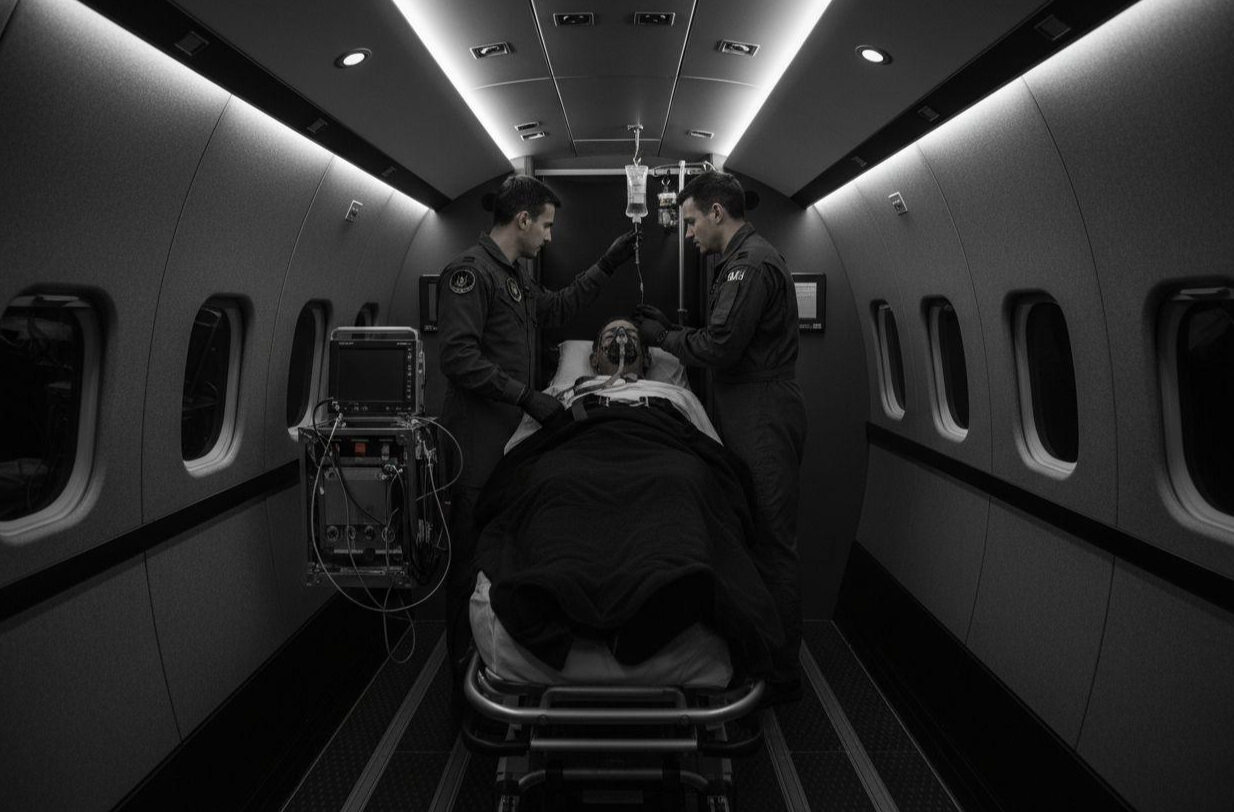
A stretcher on a commercial flight is exactly what it sounds like, but with a lot more coordination behind it. A medical transport provider works with the airline to install a stretcher area inside the cabin and reserve the surrounding space for the patient’s care. The setup is designed for people who need to lie flat during travel and cannot safely use a standard economy or business seat.
This is not the same as a hospital bed in the sky. The cabin is still a commercial aircraft, so space is limited, privacy is partial, and the medical team has to work within airline rules. That is why a commercial stretcher service usually includes a medical escort. The escort may manage oxygen, medication timing, pressure relief, toileting support, and basic monitoring throughout the journey.
A good way to think about it is this: the aircraft carries the patient, but the transport company carries the care plan. That is why these trips are often called bed-to-bed transport. The goal is to keep the patient stable from the original pickup point to the final destination, not just from gate to gate.
What makes it different from a normal flight
- The patient lies flat instead of sitting upright.
- Several seats may be removed or blocked off.
- A medical escort is usually assigned.
- The trip is coordinated in advance with the airline.
- Ground transfers are part of the same plan.
If you want a deeper breakdown of the logistics behind medical travel, see how air medical transport works step by step for families.
When a commercial stretcher makes sense
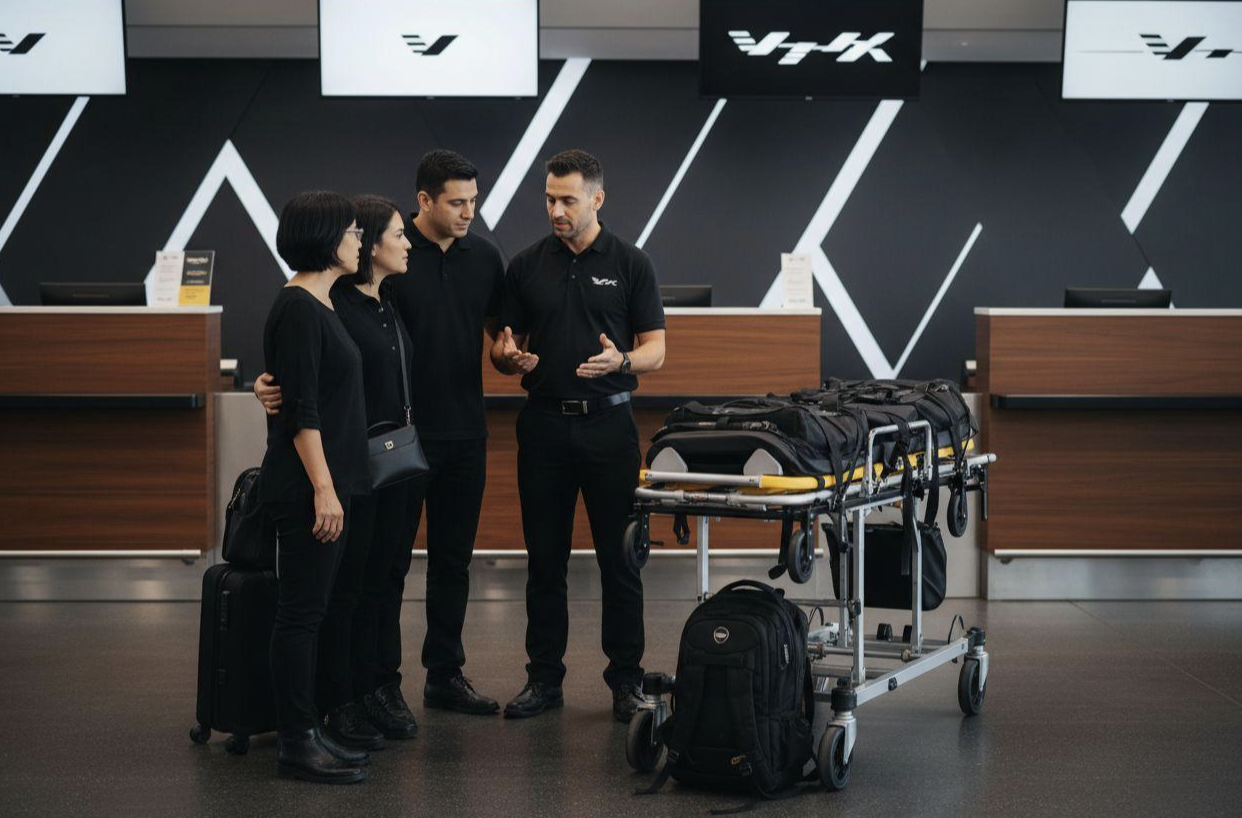
A commercial stretcher is usually the right fit when the patient is stable enough to travel on a commercial route, but not able to sit upright for long enough to use a regular seat. That often includes people recovering from surgery, people with serious mobility limitations, and patients who need a lie-flat position for comfort or safety.
It is often chosen when business class is not enough but an air ambulance would be more than the patient actually needs. That balance matters, because the cost difference between the options can be dramatic.
A stretcher flight may be a good option if:
- The patient cannot sit upright for the entire trip.
- The patient is stable enough for commercial flight.
- A lie-flat position is medically important.
- The route is available on an airline that allows stretcher requests.
- The family wants bed-to-bed coordination without the cost of a chartered air ambulance.
It is usually not the right option if the patient is medically unstable, needs ICU-level care, or may deteriorate during the flight. In those cases, a dedicated air ambulance is usually safer because it offers a higher level of onboard medical support and more flexibility around timing and routing.
A simple decision rule helps many families:
- Can the patient sit upright for takeoff, landing, and transfers?
- If yes, could a lie-flat seat or medical escort be enough?
- If no, is the patient stable enough for a commercial stretcher?
- If no again, does the patient need an air ambulance instead?
That framework is not a substitute for medical advice, but it is a useful way to narrow the options before you start booking.
How the booking and travel process usually works
A stretcher flight is a coordination project, not a one-click reservation. The earlier you start, the easier it is to line up the airline, route, documentation, and medical team. Some cases move quickly, but international itineraries almost always need more lead time.
The process usually looks like this:
- Medical assessment
The transport provider reviews the patient’s condition, mobility, medication needs, oxygen needs, and overall stability. - Fit-to-fly clearance
A physician confirms whether the patient can travel safely in a commercial cabin. Airlines may ask for forms such as MEDIF, which is the medical information paperwork used to support airline clearance. - Route and airline check
The provider confirms whether the chosen airline and aircraft can support a stretcher setup on the requested route. - Stretcher approval
The airline reviews the request and decides whether the configuration can be accepted. - Ground transport coordination
An ambulance or medical vehicle is arranged for pickup, airport transfer, and destination handoff. - Medical escort assignment
A nurse, paramedic, or appropriate medical professional is assigned based on the patient’s needs. - Final itinerary confirmation
The provider confirms flight times, connections, equipment, medications, and backup plans. - Day-of-travel handoff
The patient is moved from the sending location to the airport, boarded, monitored in flight, and transferred again on arrival.
The details can feel overwhelming, but that is exactly why families use a specialist service. The right provider is there to keep the pieces connected, especially when the patient is traveling after hospitalization or across borders.
Who qualifies, and who usually does not
A commercial stretcher is designed for patients who need to lie down, but are still stable enough for a commercial cabin. That sounds simple, yet the medical review is where most of the real decisions happen.
Patients who may qualify
- Post-surgery patients who must remain horizontal
- Bedbound older adults who cannot sit for long periods
- Stroke survivors who need lie-flat transport and supervision
- Patients with orthopedic injuries that prevent upright sitting
- People recovering from a major hospitalization but stable enough for commercial flight
Patients who often need a higher-acuity option
- Patients with unstable vital signs
- People who need continuous ventilator support or intensive monitoring
- Patients with uncontrolled chest pain, active bleeding, or rapidly changing symptoms
- Anyone whose condition is likely to worsen in transit
- Patients who cannot be safely transferred between stretcher, ambulance, and aircraft
The most important question is not just can the patient fly, but how much support will the patient need while flying. That is where the medical escort, the airline clearance, and the route all matter. A patient may be technically stable, yet still be a poor fit for a long trip with multiple transfers or tight connections.
Real-world examples help make this clearer:
- Post-surgery patient traveling from Toronto to LondonA patient recovering from abdominal surgery may need to lie flat and avoid strain during boarding. A commercial stretcher can be a practical middle option if the condition is stable.
- Stroke survivor needing lie-flat transportSomeone discharged from hospital but unable to tolerate an upright seat may need a stretcher plus a medical escort, especially if medication timing and pressure relief are ongoing concerns.
- Bedbound elderly traveler with family supportIf the patient cannot transfer safely into a seat but is otherwise stable, the stretcher setup can allow the trip without moving to a chartered aircraft.
- Transatlantic repatriation after hospitalizationWhen someone is being brought home after treatment abroad, the stretcher flight may be one part of a larger repatriation plan that also includes hospital discharge, ground ambulance coordination, and family communication.
Commercial stretcher vs business class vs air ambulance
A lot of families start by asking whether a lie-flat business class seat could solve the problem. Sometimes it can. Sometimes it cannot. The right answer depends on how long the patient can sit, how they transfer, and how much care they need in flight.
If you are trying to decide between a stretcher and a higher-acuity aircraft, Ground Transport vs. Air Ambulance is a useful companion guide.
The biggest differences usually come down to three things:
- Availability: not every airline or route can accept a stretcher request.
- Medical needs: the patient’s stability determines how much onboard support is required.
- Budget: commercial stretcher service is generally less costly than a private air ambulance, but still far more expensive than a standard ticket.
What families in Canada should know
For families arranging a stretcher on commercial flight to or from Canada, the most important thing is to start early with the airline medical desk or a transport specialist. Canadian itineraries can be straightforward when the patient is stable, but the answer is always route-specific, not universal.
Canadian airlines and international carriers serving Canada generally handle special-assistance requests through advance review, and the paperwork can include medical clearance forms, mobility notes, oxygen requirements, and physician statements. If the trip crosses borders, you also need to think about passport, visa, medication rules, and the rules of the destination country.
This is especially important if the patient is returning home after treatment abroad. In that case, the stretcher flight may be part of a broader medical repatriation plan. If that is your situation, Medical Repatriation Explained can help you understand how the larger process fits together.
A Canada-focused planning checklist should include:
- Airline medical clearance as early as possible
- Confirmed stretcher approval before booking the rest of the trip
- Ground ambulance pickup and destination transfer
- Medication letters and a current medication list
- Oxygen requirements, if any
- Passport, visa, and discharge paperwork
- A realistic plan for layovers, customs, and handoffs
The safest assumption is that the route will shape the plan. Even when the patient is stable, aircraft type, cabin layout, and carrier policy can affect whether a commercial stretcher is possible at all.
Documents and planning checklist
The paperwork can feel heavy, but it protects the patient and prevents surprises on travel day. Keep every document in one folder, and make sure someone traveling with the patient knows where it is.
Common documents you may need
- Physician letter
- Fit-to-fly clearance
- Airline medical forms, including MEDIF if requested
- Medication list with doses and timing
- Oxygen prescription or device details
- Mobility and transfer notes
- Passport and visa documents
- Insurance and payment confirmation
- Hospital discharge summary, if applicable
Practical items to prepare
- All essential medication in carry-on baggage
- Chargers and batteries for any approved medical device
- Comfortable clothing that makes transfers easier
- A spare change of clothes and basic hygiene items
- Contact details for the receiving facility or family member
A commercial stretcher trip goes more smoothly when families treat it like a medical transfer, not a flight booking. The more complete the paperwork, the fewer delays on the day of travel.
Risks, limitations, and how to reduce them
A stretcher flight can be a very good solution, but it is not risk-free. The patient is still traveling in a pressurized cabin, the cabin is still limited in space, and the journey still includes transfers that can be physically demanding.
Common risks and limitations include:
- Pressure sores from lying still for long periods
- Blood clot risk because the patient is immobile for extended periods
- Dehydration during a long trip
- Toileting limitations because cabin space is tight
- Turbulence discomfort during flight
- Connection stress if the route includes layovers or long ground transfers
- Privacy limits because the patient is still in a commercial cabin environment
You can reduce some of these risks by planning well:
- Keep the patient medically cleared for the specific itinerary
- Use a medical escort suited to the patient’s condition
- Avoid unnecessary connections when possible
- Ask about compression stockings or other clot-prevention measures if the doctor recommends them
- Keep medication timing consistent
- Make sure the ground transfers are coordinated, not improvised
The goal is not to eliminate every risk, because that is unrealistic. The goal is to lower the risk enough that commercial transport remains a safe and practical choice.
Frequently asked questions
Can a patient sleep on a commercial stretcher?
Yes. That is one of the main reasons people choose this option. The patient lies flat during the flight, but the exact setup depends on the airline and aircraft.
Can family members travel with the patient?
Often yes, but not always in unlimited numbers. Family seating depends on the available cabin space, the airline’s rules, and how much room the stretcher setup takes.
How many seats are blocked for a stretcher flight?
It varies by aircraft and carrier. The number can change based on the stretcher configuration, the route, and the airline’s approval.
Can oxygen be provided onboard?
Often it can, but only with advance coordination and the proper airline approval. The type of oxygen support and the documentation needed depend on the route and the carrier.
Can you use a stretcher on a domestic flight?
Sometimes, but it depends on the airline, the route, and the aircraft. Some itineraries are easier to approve than others, so early planning matters.
How long does approval take?
It depends on the medical review, airline response, and route complexity. A simple case may move quickly, while an international transfer can take longer.
Is a commercial stretcher covered by insurance?
Sometimes, but not automatically. Coverage depends on the policy, the reason for travel, and whether the transport is medically necessary. Always confirm before you commit.
A stretcher on commercial flight can be the right answer when a patient needs to lie down, but does not require the intensity or expense of a full air ambulance. The smartest approach is to start with the patient’s medical needs, then work outward to the route, the airline, the paperwork, and the ground transfers. When those pieces line up, commercial stretcher transport can turn a difficult move into a manageable one.
Contact Travel Care Air
When the pieces line up — the right patient, the right route, the right medical escort, and the right coordination — a commercial stretcher flight can turn a genuinely difficult move into a manageable one. Travel Care Air has been putting those pieces together for families since 1980, across six continents and every level of clinical complexity.
If you’re trying to figure out whether a commercial stretcher is right for your loved one, or whether a different transport option makes more sense for their condition, we’re here to help you think it through. There’s no obligation to call — just honest answers and a clear picture of what’s possible.
Contact Travel Care Air for a free consultation. We’re available 24 hours a day, 7 days a week, 365 days a year.
U.S./Canada: 1-800-524-7633
International: +1-715-479-8881
You can also explore how our air ambulance transfers work, review what medical repatriation insurance covers, or browse our Mission Stories to see how we’ve helped families navigate situations like yours.