
Travel Care Air has been coordinating fixed-wing medical transports since 1980 — domestic, national, and international. We are FAA-licensed, Department of Health authorized, and available 24 hours a day, 7 days a week. If you need to move a patient and aren’t sure whether fixed-wing transport is the right call, [contact us for a free consultation].
When a patient needs to move farther than a ground ambulance can reasonably cover, a fixed-wing air ambulance can close that gap quickly and safely. CMS says fixed-wing transport may be necessary when the patient’s condition requires rapid transport, great distances or other obstacles make ground travel impractical, or the pickup point is inaccessible by land or water, and FAA airport guidance shows that fixed-wing aircraft operate in the runway environment rather than the kind of off-airport landing zones helicopters use.
What a fixed-wing air ambulance is

In simple terms, a fixed-wing air ambulance is an airplane configured for medical transport. In practice, that can mean regional, national, or even international transfers with a flight team that includes aviation crew and critical-care clinicians, depending on the mission. Fixed-wing programs often provide regional, national, and international transport, staffed by RN/RN, RN/RRT, or RN/paramedic crews and two experienced pilots.
That matters because fixed-wing transport is not just a bigger version of a road ambulance. The aircraft is one part of a chain that has to account for timing, clinical stability, runway access, and handoff between facilities.
Common reasons a fixed-wing air ambulance is used include:
- Long-distance interfacility transfers when the drive would be too slow or too hard on the patient.
- International medical repatriation, where an organized flight team can move the patient back to the right hospital system.
- Cases where terrain, traffic, distance, or access limitations make land transport the wrong tool for the job.
When a fixed-wing air ambulance is the better choice
Speed is one of the biggest reasons fixed-wing aircraft are used. Fixed-wing speeds can exceed 250 mph, which helps when a patient needs to cover real distance rather than just skip over a short stretch of highway traffic. CMS likewise says fixed-wing transport may be needed when great distances or other obstacles prevent rapid delivery by ground ambulance.
This is why the choice often comes down to mission profile. Helicopters are excellent for on-scene response and shorter interfacility hops, while fixed-wing aircraft are built for longer stretches and wider service areas. Helicopter operations are often focused on a local radius, compared with fixed-wing programs that cover regional, national, and international missions.
If you are comparing transport modes, our guide to ground transport vs. air ambulance breaks down the decision in plain language.
For families and hospital teams, that usually means looking at the patient’s stability, the distance to the receiving facility, and whether the mission can be completed more safely in the air than on the road.
How a mission comes together
Most fixed-wing transports begin with a medical necessity review and a coordination call. CMS requires that ambulance transport, including air ambulance, be medically necessary, and other programs describe 24/7 communications teams that field requests and coordinate transport across regional, national, and international distances.
From there, dispatch matches the aircraft, crew, and equipment to the patient’s condition. That may mean ventilation support, oxygen, infusion pumps, or a specialty team, but it can also mean selecting the right airport and timing the ground transfers so the handoff stays smooth. CMS discussions of air ambulance work also describe fixed-wing missions in hospital-to-hospital and airport-to-airport terms, which shows how much coordination happens outside the aircraft itself.
A well-run mission should feel coordinated, not improvised. The best operators think about weather, fuel, altitude, cabin layout, and the receiving facility at the same time, because each of those details can change the patient’s comfort and the mission’s safety. FAA airport guidance makes clear that runway operations are tightly managed and affected by airfield and weather conditions.
At Travel Care Air, that coordination starts the moment you call. A real coordinator — not a voicemail — gathers the clinical picture, initiates a peer-to-peer review between our Medical Director and the treating physician, and begins building the transport plan. Ground ambulances at both ends, the receiving hospital’s acceptance, and crew configuration all happen in parallel so nothing waits on anything else.
What care looks like onboard
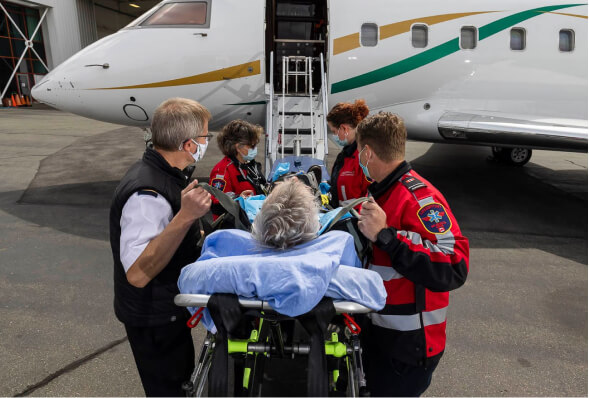
A fixed-wing air ambulance is built to keep treatment going while the aircraft is in motion. Manufacturer examples show oxygen, vacuum, and power supply systems designed for continuous monitoring and care, and some medevac cabins can support multiple patients plus additional seats for medical personnel.
On the clinical side, examples include cardiac monitors, ventilators, IV infusion pumps, and advanced drug supplies as standard capabilities in air medical programs, with crews made up of nurses, respiratory therapists, and paramedics depending on patient need. That is the difference between a medically staffed flight and a plain passenger trip with a stretcher.
For a fuller look at clinical gear, see the equipment on board an air ambulance.
In higher-acuity missions, that onboard setup can make the difference between a safe transfer and a risky delay, especially when the patient cannot afford repeated stops or a long ground ride.
Safety, crew, and the aircraft itself

Aircraft design has a direct effect on how easy and safe a medevac mission is. Crew makeup matters just as much as cabin design. Fixed-wing flights are often staffed by two pilots, with medical crews configured as RN/RN, RN/RRT, or RN/paramedic, and specialty teams added when the case requires it.
When you are evaluating a provider, ask how the aircraft is maintained, what training the pilots and clinicians receive, and how the company decides whether a mission can safely launch. Those questions are especially important when weather or long distances make the margin for error smaller.
Cost, coverage, and how to prepare
CMS says Medicare covers ground and air ambulance services, including fixed-wing and rotary-wing, when patients should not use other means of transportation, and it specifically reviews whether the transport itself and the level of service were reasonable and necessary.
CMS also notes that if a transport includes a ground leg to or from the aircraft, each leg can be evaluated separately. That is one reason the final bill can look more complicated than a single flight quote.
If you want a deeper breakdown of the financial side, how much an air ambulance costs explains the biggest drivers behind the price.
For families, the best preparation is usually practical. Gather current medication lists, recent records, insurance details, ID, and any comfort items the flight team approves, then keep one person responsible for updates so communication stays clear. If you need a broader packing checklist, our guide to packing for a medical flight is a useful next step.
FAQs
What is a fixed-wing air ambulance?
A fixed-wing air ambulance is an airplane configured to move a patient under medical supervision. Fixed-wing programs are used for regional, national, and international transport, while CMS treats the service as medically necessary when rapid transport is needed and ground or water transport is not appropriate.
How is it different from a helicopter air ambulance?
Helicopters are often used for scene response and shorter interfacility runs, while fixed-wing aircraft are better suited to longer distances and broader service areas. Helicopter operations are often focused on a local radius, compared with fixed-wing programs that cover regional, national, and international missions.
What equipment is usually onboard?
Common onboard capabilities include monitors, ventilators, IV infusion pumps, oxygen, vacuum systems, and dedicated power systems, with staffing adjusted to the patient’s needs. Some medevac aircraft can also be configured for multiple patients or specialty missions.
Is fixed-wing air ambulance covered by Medicare?
Medicare can cover fixed-wing air ambulance when the patient’s condition makes other transportation inappropriate and the transport is medically necessary. CMS also requires documentation that supports both the need for air transport and the level of service provided.
What should families ask before booking?
Ask who is on the crew, what aircraft will be used, how the sending and receiving facilities are coordinated, and what ground transport is included. If the provider can answer those questions clearly, you will usually have a much better sense of how the mission will work.
Contact Us
A fixed-wing air ambulance is not the answer for every situation, but when the trip is long, the patient is medically complex, and the handoff has to be handled with precision, it can be the safest and fastest route to the right care. The key is matching the aircraft, crew, and logistics to the patient — not the other way around.
If you are trying to make that call right now, Travel Care Air can help you think it through.
U.S./Canada: 1-800-524-7633International: +1-715-479-8881