
Last Updated: October 28, 2026
Quick Summary
To arrange medical repatriation, first confirm a receiving hospital at home will accept the patient, then request an initial medical assessment from a transport provider. The process follows four stages: assessment, transport selection, coordination, and handover, with fitness to fly confirmed by a clinician.
- Confirm the receiving hospital will accept the patient before booking any transport.
- A treating physician makes the medical call and the patient or next of kin gives consent.
- Air ambulance suits critical patients; medical escort suits stable patients on commercial flights.
- Typical repatriation costs fall between USD 15,000 and USD 40,000, varying by route.
- Get every entry and exit requirement confirmed in writing before booking.
Table of Contents
- When Medical Repatriation Is Needed and Who Decides
- The International Medical Repatriation Process, Step by Step
- First-Hours Checklist for Families and Care Teams
- Step 1: Request an Initial Medical Assessment
- Step 2: Choose the Transport Mode and Confirm Fitness to Fly
- Step 3: Coordinate Hospitals, Clearances, and the Handover
- Contingency Planning: What to Do When Plans Change
- Step 4: Confirm the Handover and Follow-Up
- Medical Repatriation Flight Cost: What Drives the Price
- Medical Repatriation Documents and Travel Clearances
- How Long Does Medical Repatriation Take?
- How to Compare Providers and Verify Credentials
- Insurance, Exclusions, and Out-of-Pocket Costs
- Request a Quote and Start the Repatriation Plan
- Frequently Asked Questions
When Medical Repatriation Is Needed and Who Decides
Medical repatriation is the planned transport of an ill or injured patient from a foreign country back home for continued care. It differs from a medical evacuation, which usually means moving a patient to the nearest adequate hospital. Families rarely plan for this, they need a clear process fast.
The need arises in a few common situations:
- A traveller suffers a stroke, heart attack, or serious fracture abroad
- An expatriate needs treatment that only exists at home
- A patient is stable but cannot fly on a commercial airline without medical support
- A hospital abroad recommends transfer to a specialist centre
Repatriation is uncommon. Research published in Swiss Medical Weekly’s study of ill and injured travellers found that fewer than 0.5% of travellers in the study required repatriation. Among those who were repatriated, 38% had medical conditions and 13% had surgical ones.
Who decides? Usually a treating physician makes the medical call, the patient or next of kin gives consent, and the transport provider confirms the patient is fit to fly. For an elderly patient abroad, the family often drives the decision. Our guide on how to arrange medical repatriation for an elderly patient abroad walks through that specific case.
The International Medical Repatriation Process, Step by Step
The international medical repatriation process follows four stages: assessment, transport selection, coordination, and handover. Each depends on the one before it, so skipping ahead costs time. Most guides omit the first few hours, before any provider is booked, use the checklist below to act quickly without overlooking essentials.
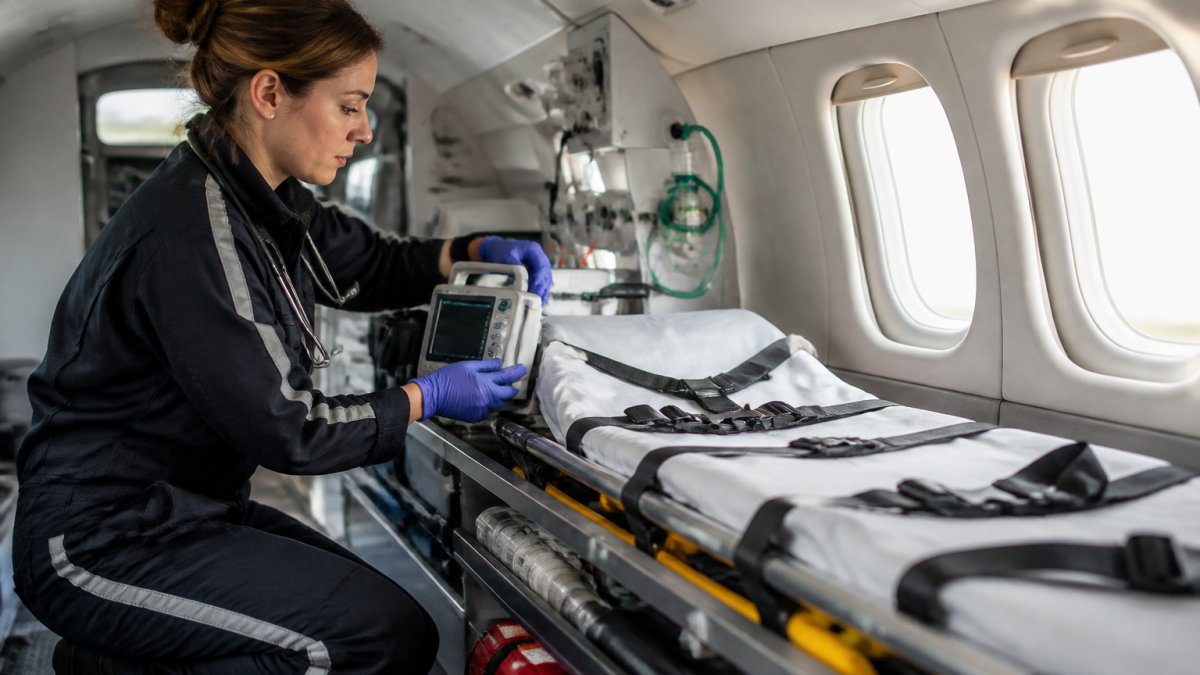
Coordinating these complex transfers requires a high degree of precision, as international medical logistics often intersect with sensitive legal and family arrangements such as those involved in managing international travel and medical logistics for surrogacy.
First-Hours Checklist for Families and Care Teams
Work through these in order. You do not need every answer before calling a provider, but having them ready speeds up the medical assessment.
- Confirm the patient’s exact location, treating hospital, and attending physician’s name and contact details
- Ask the treating physician for a written diagnosis, current vital signs, oxygen requirement, mobility status, and infection risk
- Confirm the patient’s passport location and visa status; check that the passport is valid for travel
- Identify the receiving hospital and specialist at home, and confirm they will accept the transfer
- Call the insurer or travel assistance hotline and open a case; ask what pre-authorization they require
- Designate one family spokesperson to communicate with the provider, hospital, and insurer
- Collect insurance policy details, including emergency assistance phone number and policy number
- Ask the treating hospital to begin preparing copies of medical records, imaging, and lab results
- Keep a written log of names, phone numbers, times, and reference numbers for every call
A common pattern is that families call a transport provider before confirming the receiving hospital will accept the patient. That reversal adds days. Confirm acceptance first, then book transport.
Step 1: Request an Initial Medical Assessment
Call a transport provider with the basics: patient name, age, diagnosis, current hospital, and destination. Ask the provider to confirm in writing what clinical information they need.
Step 2: Choose the Transport Mode and Confirm Fitness to Fly
| Transport Mode | Best For | Typical Use |
|---|---|---|
| Air ambulance | Critical or unstable patients | Long-haul, ICU-level care in flight |
| Medical escort | Stable patients on commercial flights | Short to medium routes, lower cost |
| Road ambulance | Short cross-border transfers | Regional moves, stable patients |
Fitness to fly is a clinical decision, not a scheduling one.
Step 3: Coordinate Hospitals, Clearances, and the Handover
Ask who attends the handover, what documents are transferred, and whether the receiving physician signs an acceptance form.
Contingency Planning: What to Do When Plans Change
Delays are common. Build a backup plan before the patient moves.
Keep a written contingency note with the provider’s after-hours number, the receiving hospital’s admitting office, and the insurer’s case reference. In a delay, you will not want to search for these under pressure.
Step 4: Confirm the Handover and Follow-Up
After arrival, confirm the receiving hospital has the full clinical summary, imaging, medication list, and transfer notes. Ask for a named contact and a timeline for the first clinical review.
Medical Repatriation Flight Cost: What Drives the Price
Medical repatriation flight cost depends on distance, aircraft type, medical staffing, and urgency. For a detailed breakdown of what international air ambulance costs include, see our full cost guide. A comparison published by Travel Care Air’s medical repatriation company comparison puts typical repatriation costs between USD 15,000 and USD 40,000, varying by route and other factors.
What pushes a quote up:
Medical Repatriation Documents and Travel Clearances
Paperwork is where transfers stall. You will typically need the patient’s passport and visa, medical records and a physician’s letter, a fitness-to-fly certificate, consent forms, and insurance details. Most guides do not explain that requirements change by country and direction of travel, and some documents must be issued within a specific window before departure.
Core Documents Checklist
-
Patient passport, valid for the period required by both origin and destination countries
-
Visa or entry permission for the patient and any accompanying family member
-
Medical records, imaging, lab results, and medication list
-
Physician’s letter describing diagnosis, treatment to date, and fitness to travel
-
Consent forms signed by the patient or next of kin
-
Insurance policy details and pre-authorization reference number
-
Receiving hospital acceptance letter or bed confirmation
-
Transport provider’s medical and operational documentation for the flight
Country-Specific Entry, Exit, and Medical Transport Requirements
Rules vary widely, so treat this as a verification framework rather than a fixed list. Confirm each item with the origin and destination authorities before booking.
- Exit requirements from the origin country: Some countries require an exit medical clearance or a letter from the treating hospital before a patient can leave. Ask the treating hospital’s international patient office whether an exit permit or medical clearance is needed.
- Entry requirements at the destination: Some countries require advance notice for patients arriving on a stretcher or with medical equipment, and some require a medical clearance or fit-to-fly certificate issued within a set number of days before arrival. Check with the destination country’s embassy or consulate and the receiving hospital’s international office.
- Visa and passport validity: Confirm the patient’s passport validity period and whether a medical visa or entry permission is required. Accompanying family members may need their own visas.
- Overflight and landing permits: These are separate from entry requirements. Ask which countries the flight will overfly and land in, and which permits are on the critical path. Our guide to international air ambulance permits explains the overflight, landing, FAA, and customs requirements.
- Customs and medical equipment: Confirm whether medical equipment, medications, and controlled substances require customs declarations or import permits at the destination.
- Ground ambulance access: Confirm that ground ambulance services can access the airport and the receiving hospital, and whether any local permits are needed.
Do not assume that a fitness-to-fly certificate accepted by the airline will satisfy immigration or health authorities at the destination. These are separate approvals, and a missing entry clearance can delay the patient at the airport.
How to Verify Requirements Before Booking
Use this sequence:
- Ask the treating hospital’s international patient office what exit documents the origin country requires.
- Ask the receiving hospital’s international office what entry documents and advance notice the destination country requires.
- Confirm with the destination country’s embassy or consulate whether a medical visa or entry permission is needed.
- Ask the transport provider which overflight, landing, and customs permits they handle and which they need from you.
- Get every requirement confirmed in writing, with the name of the person who confirmed it and the date.
Confirm requirements for both origin and destination before booking.
How Long Does Medical Repatriation Take?
How long medical repatriation takes depends on urgency and distance.
Factors that add time:
- Unstable patient condition requiring stabilization first
- Slow release of medical records from the treating hospital
- Permit and customs approval delays
- Bed availability at the receiving hospital
Build in buffer time for delays, and keep the family updated at each stage.
How to Compare Providers and Verify Credentials
Ask every provider the same questions before you commit:
- How many years have you operated, and do you own or contract your aircraft?
- What are the qualifications of your flight nurses and medical crew?
- Can you provide upfront pricing in writing?
- Who handles international permits and customs?
- What is your process for updating families during transport?
- Can you share references from hospitals or case managers?
Insurance, Exclusions, and Out-of-Pocket Costs
Insurance coverage is not guaranteed. U.S. Department of State guidance on medical evacuation notes that government financial assistance through its loan programs is available only in limited circumstances. Most travellers rely on travel insurance or a dedicated repatriation plan instead.
Check these exclusions before you assume you are covered:
Request a Quote and Start the Repatriation Plan
The hardest part of arranging international medical repatriation is the first phone call, high-stakes decisions under pressure, often with limited information and a patient who cannot wait.
Travel Care Air provides air ambulance and medical transport, including 24/7 air ambulance and medical escort services, and has a dedicated air ambulance jet. We offer flight nurse medical escorts and help coordinate transfers.
Get started with Travel Care Air and bring your loved one home safely. Request a quote today.
Frequently Asked Questions
What are the steps involved in the repatriation process?
Travel Care Air offers air ambulance, flight nurse medical escort, and commercial stretcher services tailored to individual patient situations. Contact the provider to discuss the patient’s circumstances and request a quote.
How much does a medical repatriation flight cost?
Travel Care Air has not provided pricing information. Request a quote for current pricing.
Does travel insurance cover medical repatriation?
Insurance coverage is not guaranteed. Contact your insurer to ask whether your policy covers medical repatriation.
What documents are needed for international medical transport?
Document requirements can vary by country and situation. Confirm requirements with the relevant authorities and care team.
