
Table of Contents
- When Is an Air Ambulance Needed: The Short Answer
- Air Ambulance vs Ground Ambulance: How the Choice Is Made
- Medical Air Transport Between Hospitals Explained
- Fixed-Wing Air Ambulance: When a Jet Beats a Helicopter
- How Quickly Can an Air Ambulance Be Arranged?
- Costs, Insurance, and Avoiding Surprise Bills
- Risks, Limits, and What to Do in an Immediate Emergency
- Frequently Asked Questions
Last Updated: October 21, 2026
When Is an Air Ambulance Needed: The Short Answer
An air ambulance is needed when a patient’s medical condition or location makes ground transport too slow, too risky, or simply impossible. At Travel Care Air, we’ve handled medical flights for more than 45 years, and the pattern is consistent: time and distance decide the answer. If a patient needs critical care that only a specialized center can provide, and that center is hours away by road, air transport moves to the front of the list. Below, we’ll show you exactly how that decision gets made, who makes it, and what to expect at each stage.
The Conditions That Point to Air Transport
Air transport makes sense in a narrow set of situations. Most patients travel by ground. The ones who fly usually share at least one of these traits:
- A life-threatening emergency where minutes change the outcome, such as a major trauma or a suspected stroke.
- A limb-threatening injury that needs a surgeon fast.
- A critically ill patient who needs a level of care the local hospital cannot provide.
- A location that roads cannot reach quickly, including islands, mountain areas, and rural regions.
- A long distance between the patient and the right specialist.
The common thread is medical necessity. A flight is justified when the care gap is real, not when it is merely convenient.
The question is never “can we fly this patient?” It is “does flying this patient get them to the right care fast enough to matter?” If the answer is no, ground transport is the better call.
Air Ambulance vs Ground Ambulance: How the Choice Is Made
The choice between air ambulance vs ground ambulance comes down to one calculation: which option gets the patient to definitive care sooner, without adding risk. Ground units handle the vast majority of calls. They are close, quick to dispatch, and easy to load. Air transport wins when that math flips.
A Practical Decision Framework
Most transport decisions are not made by families. They are made by treating clinicians, dispatchers, and transport medical teams who weigh five factors together.
1. Clinical urgency. Time-sensitive conditions change the math.
**2.
3. Road access and terrain. Islands, mountain passes, ferry crossings, unpaved roads, and seasonal closures can make ground transport impractical regardless of distance. In these cases, air may be the only realistic option.
4. Traffic and weather. Congested urban roads can double a ground ETA. But weather also grounds aircraft. A helicopter cannot fly in every condition, and no operator should pretend otherwise.
5. Aircraft and crew availability. A helicopter 40 minutes away may be slower to the patient than a ground unit 10 minutes away. Dispatch time, weather checks, and landing coordination all add to the clock.
Who Actually Makes the Decision
In an emergency, the decision usually starts with the responding paramedics or the emergency physician, who assess the patient and request air support through dispatch. In a planned hospital-to-hospital transfer, the sending physician determines medical necessity, the receiving hospital confirms acceptance and bed availability, and a transport coordinator arranges the aircraft and crew. Families rarely make the clinical call, but they can ask whether air transport has been considered and why.
The most common mistake families make is assuming a helicopter is always faster. Once you add dispatch time, weather checks, and landing coordination, a ground unit 10 minutes away often beats a helicopter 40 minutes out. Ask for the actual estimated arrival time, not the aircraft type.
Air transport is not automatically appropriate for every emergency. It is justified when the care gap is real, the time saved matters clinically, and the patient is stable enough to fly. If any of those three conditions is missing, ground transport is usually the better call.
Medical Air Transport Between Hospitals Explained
Medical air transport between hospitals is a planned transfer, not an emergency response. A smaller hospital stabilizes a patient, then moves them to a facility with the right specialists: a trauma center, a cardiac surgery unit, or a neonatal intensive care unit. These flights run on a different clock than 911 calls.
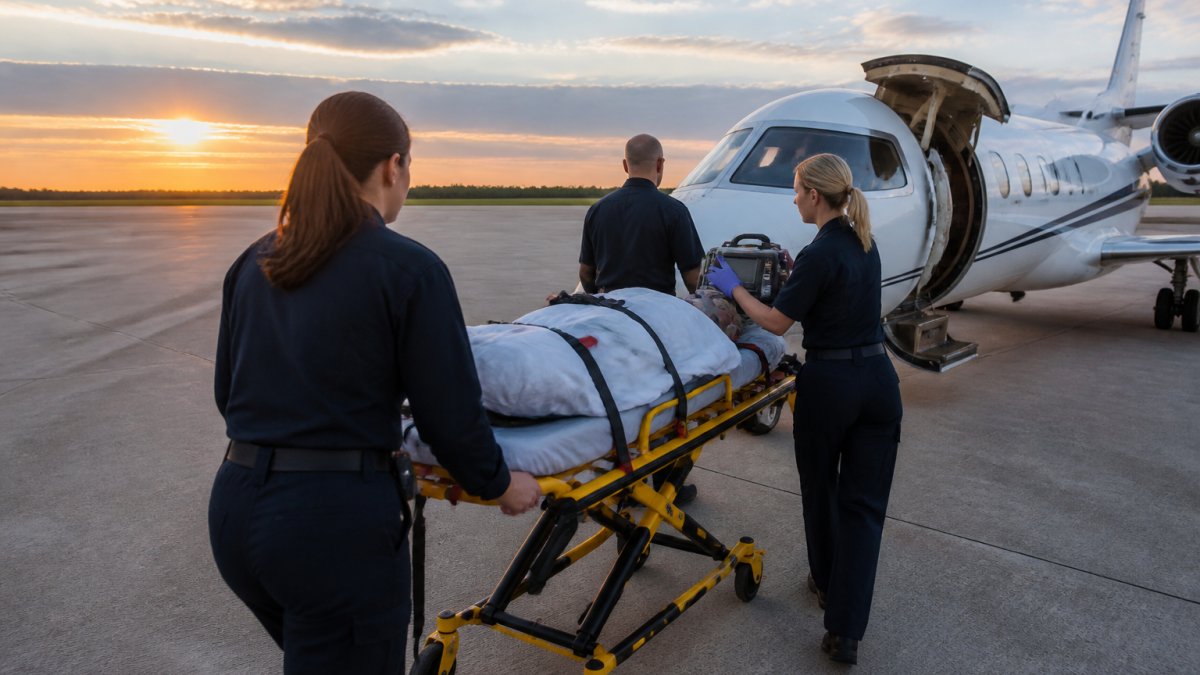
The process usually follows a clear sequence:
- The sending doctor determines the patient needs a higher level of care.
- The receiving hospital accepts the patient and confirms bed availability.
- A transport coordinator books the aircraft and medical crew.
- The flight team arrives, takes over care, and flies the patient out.
Onboard medical care is the point of these flights. A critical care team brings monitors, ventilators, and drugs that keep the patient stable in the air. For international moves, this same process covers medical repatriation, bringing a patient home for ongoing treatment.
Fixed-Wing Air Ambulance: When a Jet Beats a Helicopter
A fixed-wing air ambulance is the right choice for long-distance transfer. Helicopters excel at short hops, often under 150 miles, and at reaching places without runways. Fixed-wing aircraft fly farther, faster, and higher, which makes them the standard for cross-country and international transport.
Here is how the two compare:
| Factor | Helicopter | Fixed-Wing Aircraft |
|---|---|---|
| Best range | Short, local hops | Long-distance and international |
| Speed | Slower cruise speed | Faster cruise speed |
| Runway needed | No, lands at helipads | Yes, airports required |
| Typical use | Scene response, short transfers | Hospital-to-hospital, repatriation |
| Cabin space | Limited | Room for stretchers and full crew |
For a patient traveling from Southeast Asia to a home hospital in Europe or North America, a fixed-wing aircraft with a full medical crew is the only realistic option. A helicopter cannot make that trip.
How Quickly Can an Air Ambulance Be Arranged?
How quickly an air ambulance can be arranged depends on the type of flight. An emergency helicopter may launch within minutes of a call, weather permitting. A planned fixed-wing transfer typically takes longer, because it involves permits, bed confirmation, and crew scheduling.
For domestic transfers, coordination often moves quickly once the receiving hospital accepts the patient. International flights take more time. Overflight permissions, customs, and ground handling at both ends all need arranging, and that is where experienced coordinators earn their keep.
A realistic answer for families: ask the provider for a specific timeline in writing. Vague promises help no one. A provider that communicates clearly at the booking stage usually keeps communicating during the flight.
When you call, ask three questions: What is the estimated departure time? Who is my single point of contact? How will you update me during the flight? The answers tell you more about a provider than any brochure.
Costs, Insurance, and Avoiding Surprise Bills
Cost is the question every family asks, and it deserves a straight answer. Air medical transport is expensive to operate, and pricing varies widely by distance, aircraft type, crew, and country. We do not publish fixed rates because no honest operator can. What we can tell you is how to protect yourself.
- Ask for a written quote before you commit. Get the full figure, not a range.
- Ask what the quote includes. Crew, fuel, permits, and ground transport should be itemized.
- Check your insurance early. Coverage for air medical transport varies by policy and by country.
- Ask about payment terms upfront. No surprises after the flight.
Surprise billing is a real problem in this industry. The defense is simple: written quotes, itemized costs, and a provider willing to answer questions before you sign.
Risks, Limits, and What to Do in an Immediate Emergency
What to Do Right Now
If someone is seriously injured or ill, call your local emergency number first. Always. An air ambulance is not a substitute for dialing emergency services, and you should not try to arrange private air transport independently during an active emergency. Emergency dispatchers and responding medics can request air support through established channels if it is needed. Once the patient is in the hospital system, transport decisions move to the medical team.
Clinical Limits: When Flying Is Not Safe
Flying a patient carries real limits, and a good medical crew weighs them before the wheels leave the ground.
- Altitude and oxygen. Cabin altitude in most aircraft is lower than sea level pressure, which can affect oxygen levels. Patients with severe respiratory failure, certain cardiac conditions, or pneumothorax may need careful assessment and supplemental oxygen before takeoff.
- Patient stability. Some patients are too unstable to fly until they are stabilized. Uncontrolled bleeding, severe shock, or an unsecured airway usually means the patient stays on the ground until the treating team says otherwise.
- Pressure changes. Conditions involving trapped gas, such as certain bowel obstructions, recent eye surgery, or decompression sickness, may be contraindications to flight or require a pressurized cabin and specialist clearance.
- Infection control. Patients with highly contagious conditions may require isolation capabilities that not every aircraft has.
Operational Limits: Weather, Aircraft, and Airspace
- Weather. Fog, high winds, icing, and thunderstorms can ground an aircraft with no warning. A helicopter cannot fly in every condition.
- Aircraft range and runway access. Helicopters excel at short hops and reaching places without runways. Fixed-wing aircraft need airports and are better for long distances.
- Airspace and permits. International flights require overflight permissions, customs, and ground handling at both ends. These take time and can delay a planned transfer.
- Crew availability. A critical care crew, flight nurse, respiratory therapist, or physician, may not be immediately available in every region.
What Families Can Do
For a planned transfer, ask the sending physician whether the patient is stable enough to fly and what monitoring will be in place. Ask the transport provider how they handle weather delays and what the backup plan is. A provider that communicates clearly at the booking stage usually keeps communicating during the flight.
At Travel Care Air, we handle the planned side of this work: hospital-to-hospital transfers, medical repatriation, and long-distance moves with flight nurse escorts and stretcher services. Our team coordinates permits, customs, and ground handling so families and care teams are not left to sort it out alone. We have done this since 1980, and we keep families informed at every stage.
Frequently Asked Questions
When is an air ambulance needed instead of a ground ambulance?
An air ambulance is usually needed when ground transport would take too long or cannot safely move the patient. That means long distances, traffic or road conditions that delay a ground ambulance, remote or hard-to-reach locations, or a life- or limb-threatening emergency where rapid transport to a trauma center changes the outcome. Medical necessity is assessed by the treating clinician and the receiving hospital, not by the family alone. If a ground ambulance can reach definitive care within the safe window, it is typically the first choice.
Can an air ambulance transfer a patient between hospitals?
Yes. Medical air transport between hospitals is one of the most common uses of air ambulance services. A smaller or rural hospital may not have the specialists or equipment a critically ill patient needs, so the care team arranges a transfer to a larger receiving hospital. The sending hospital coordinates with the aircraft operator, and the patient travels with an onboard medical crew and specialized equipment. Planned interfacility transfers are usually arranged in advance rather than dispatched as an emergency.
How quickly can an air ambulance be arranged?
For an emergency, dispatch can begin within minutes of the call, but actual arrival depends on aircraft availability, distance, weather conditions, and crew readiness. Planned non-emergency transfers often take longer to arrange because the operator must confirm medical necessity, secure permits for international flights, and coordinate with both hospitals. When you call, ask for a realistic door-to-door timeline rather than just a dispatch time, and confirm who will update the family during the flight.
Does an air ambulance always mean a helicopter?
No. A helicopter is common for short-range emergency response and hard-to-reach areas, but a fixed-wing air ambulance is often used for long-distance and international transfers. Fixed-wing aircraft fly faster and farther, which suits medical repatriation and long-distance transfers between hospitals. The choice depends on distance, the patient’s stability, available aircraft, and whether the flight crosses borders. Some transports also use commercial flights with a flight nurse medical escort when the patient is stable enough.
When a patient needs to move and the distance is too great for a ground unit, the coordination burden falls on someone. Travel Care Air takes that burden off your team, with 24/7 availability, a dedicated air ambulance jet, and medical crews tailored to each patient’s condition. Get started with Travel Care Air and bring your patient home safely, wherever they are in the world.