
When someone you love has a bleed in the brain, the first hospital is not always the right hospital. A local emergency room can diagnose the bleed and keep the patient alive, but treating it often takes a neurosurgeon, a neurological ICU, and a team that sees these cases every day. When that care is hundreds or thousands of miles away, an air ambulance is how the patient gets there safely.
Travel Care Air has been coordinating medically supervised transports since 1980, including transfers for patients with intracranial hemorrhage, recent neurosurgery, and traumatic brain injury. This guide explains when an emergency neurological transfer is needed, how our medical team decides whether a patient can fly, what care looks like in the air, and what to do if you are making these decisions right now.
Need to talk to someone now? We are available 24/7/365, and a consultation costs nothing. Contact Travel Care Air or call U.S./Canada: 1-800-524-7633 | International: +1-715-479-8881.
What Counts as a Brain Bleed?
“Brain bleed” is a general term for intracranial hemorrhage, bleeding inside the skull. The type of bleed shapes how urgent a transfer is and what the receiving hospital needs to have ready:
- Intracerebral hemorrhage (ICH): bleeding directly into brain tissue, often tied to high blood pressure, blood thinners, or a vascular malformation.
- Subarachnoid hemorrhage (SAH): bleeding into the space around the brain, most often from a ruptured aneurysm.
- Subdural or epidural hematoma: blood collecting between the skull and the brain, usually after a fall, crash, or blow to the head.
- Bleeding after surgery or a procedure: a new or expanding bleed after a craniotomy, shunt, or other neurosurgical intervention.
Each of these can worsen quickly. Some patients are alert and talking when they reach a small hospital, then deteriorate within hours. That is one reason families and treating physicians often start planning a transfer early, while the patient is still stable enough to travel.
Why the First Hospital May Not Be Enough
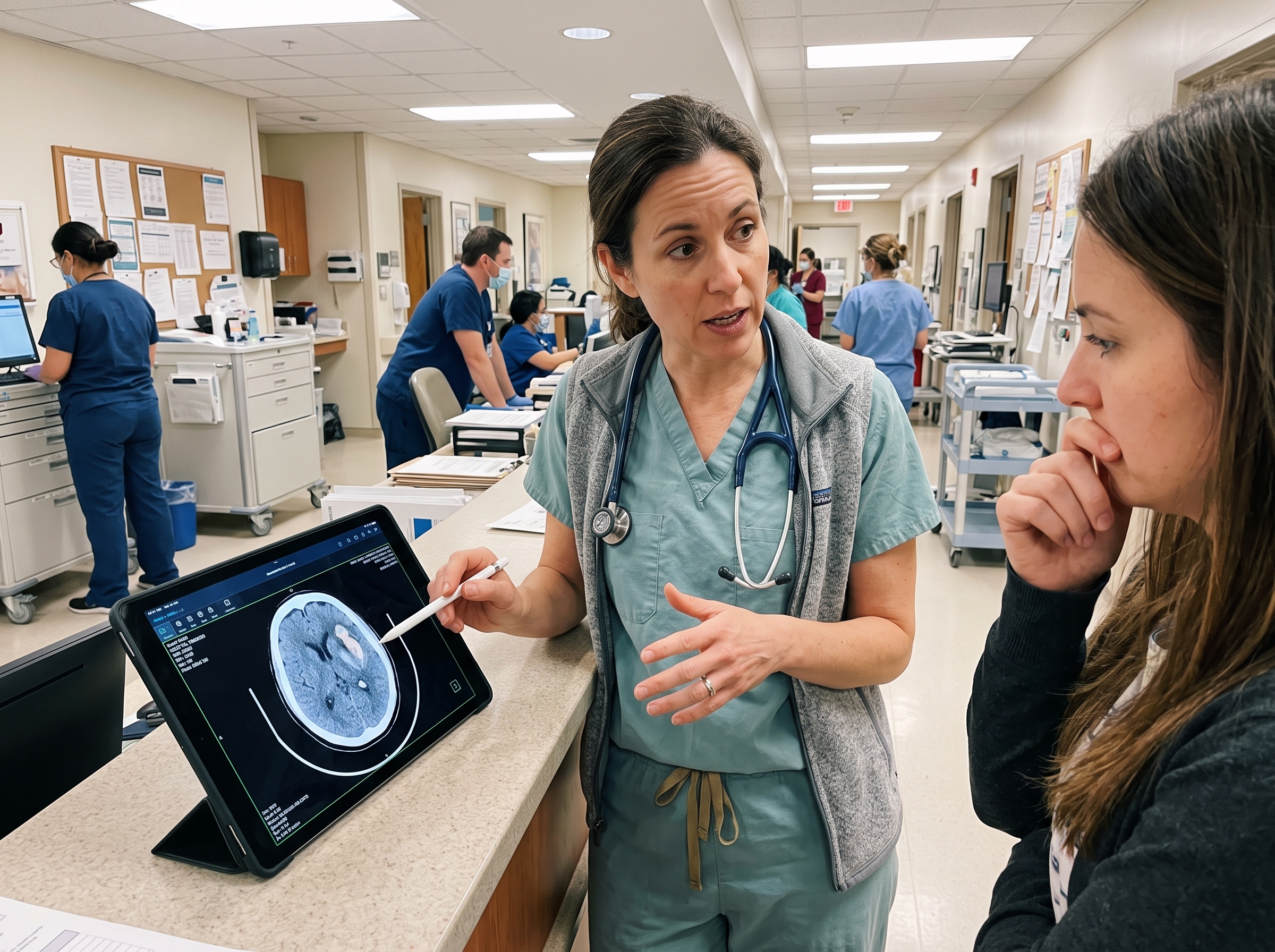
Many community and international hospitals do excellent emergency work, but they may not have a neurosurgeon on call, a neurointerventional team, or a neuro ICU that can monitor pressure inside the skull around the clock. The patient may need surgery to remove blood, a procedure to secure a ruptured aneurysm, or intensive monitoring that the first facility simply cannot offer.
Published stroke and aneurysm guidance reflects this. A recent clinical review describes aneurysmal subarachnoid hemorrhage as a medical emergency that calls for direct transfer to a specialized tertiary center. Abroad, the gap can be wider still. Across borders, medical records, discharge standards, and what a hospital calls “stable” vary from country to country, and those differences matter when a patient needs a neurosurgical center.
Signs That an Emergency Neurological Transfer May Be Needed
Only the treating physician can decide whether a transfer is medically appropriate. But these are the situations in which families most often hear the words “higher level of care”:
- The hospital has no neurosurgeon available, or has told the family that surgery is needed but cannot be done there.
- The patient has a ruptured or suspected ruptured aneurysm and the facility cannot treat it.
- Repeat imaging shows the bleed growing, or swelling is increasing.
- The patient is on a ventilator, or needs close monitoring of pressure inside the skull.
- The patient had brain surgery and needs to continue care at the surgeon’s home hospital, or at a center closer to family.
- The patient is stable now, but the local hospital cannot manage a sudden change.
If any of these sound familiar, an early call helps. The sooner our team knows the diagnosis and the clinical picture, the more time we have to plan aircraft, crew, and the receiving hospital.
Why Time Matters After a Brain Bleed
For some bleeds, the hours right after the event carry the greatest risk. In aneurysmal subarachnoid hemorrhage, studies consistently find that rebleeding is most common in the first 24 hours after the initial bleed, and that it is a major cause of poor outcomes. Other types of bleeds carry their own risks, including growth of the clot and swelling around the brain.
That does not mean every patient should be flown the same day. A patient who is too unstable to move safely may need to be stabilized first, and our medical team will tell you honestly when that is the case. What it does mean is that decisions about transfer should not wait while a family works out logistics alone. We run the logistics, so the clinicians can focus on the patient.
How Travel Care Air Decides Whether a Patient Can Fly
Every transport begins with a medical review. Before we commit to a route or timeline, our medical team evaluates the diagnosis, the type and location of the bleed, recent imaging, neurological status, airway and breathing, blood pressure, medications, and whether the patient has had surgery. Our Medical Director speaks directly with the treating physician to confirm that air transport meets the standard of medical necessity, and, when it does not yet, to identify what has to happen first.
Three questions guide that conversation:
- Is the patient stable enough to travel? Stable does not mean recovered. It means the team can safely manage the patient’s airway, blood pressure, and neurological status for the length of the journey.
- Has a receiving physician accepted the patient? We confirm that the neurosurgical or neuro ICU team at the destination has agreed to take the patient and knows the current clinical picture before the mission launches.
- Is the flight itself safe for this diagnosis? Altitude, cabin pressure, and flight time all affect patients with recent brain injury or surgery. We plan the profile of the flight around the patient, not the other way around.
For more on how this review works and why it protects patients, see Air Medical Transport Explained: When It’s Used, How It Works, and What It Costs and our family guide, How Does Air Medical Transport Work? Step-by-Step for Families.
Flying After Brain Surgery: What About Trapped Air?
Families often ask whether it is safe to fly right after a craniotomy or emergency brain surgery. One concern is pneumocephalus, air that remains inside the skull after surgery or head trauma. Gas expands as cabin pressure drops, and in theory trapped air inside the skull could raise pressure on the brain.
The research is more nuanced than a single rule. A systematic review of air travel with pneumocephalus found that conservative thresholds exist in models, but found no reports of lasting decompensation from pre-existing pneumocephalus during a flight, and it argued that the time course and cause of the air matter as much as its volume. A series of 21 military aeromedical evacuations concluded that pneumocephalus alone is not necessarily an absolute barrier to air evacuation. Other work supports confirming on imaging whether intracranial air is present before a long air transport.
What this means in practice: recent neurosurgery does not automatically rule out an air ambulance, and it does not automatically clear it either. It is exactly the kind of case our medical team reviews one patient at a time, with the surgeon’s records and imaging in hand. Recommended waiting periods for ordinary commercial travel after brain surgery vary widely between surgeons, which is one more reason to ask your neurosurgical team before anyone books a seat.
What Care Looks Like in the Air
An air ambulance functions as a flying ICU. For a patient with a brain bleed, the crew’s focus is protecting the brain from anything that could make the injury worse. Depending on the patient’s condition, in-flight care can include:
- Frequent neurological checks, so any change in alertness, pupils, or movement is caught and acted on right away.
- Blood pressure management, since pressure that runs too high or too low can both harm a patient with an acute brain injury.
- Airway and breathing support, including ventilator management for patients who cannot breathe on their own.
- Careful positioning and handling, with attention to head position and smooth transfers between stretcher, ground ambulance, and aircraft.
- Seizure precautions and medications on hand for patients at risk.
- Continuous monitoring of heart rhythm, oxygen levels, and other vital signs, with pumps managing IV medications.
Our crews include flight nurses and paramedics trained in advanced cardiac life support, pediatric advanced life support, and pre-hospital trauma care. Depending on the patient, the crew can also include respiratory therapists or a physician. You can see what is on board in The Equipment on Board an Air Ambulance: What’s Included.
Bed-to-Bed: How a Neurological Transfer Comes Together
No two missions are the same, but a typical emergency neurological transfer follows a familiar shape:
- The call. You reach our team any hour of the day. We ask for the diagnosis, the hospital, and the treating physician’s contact information.
- The medical review. Our Medical Director speaks with the treating physician and reviews records and imaging to decide whether and when the patient can fly.
- The receiving hospital. We confirm that a neurosurgeon or neuro ICU physician at the destination has accepted the patient.
- The plan. We arrange the aircraft, medical crew, flight clearances, and ground ambulances at both ends.
- Bedside to bedside. Our clinicians meet the patient at the sending hospital, review records and medications, stabilize the patient for transport, fly with them, and give a full clinical handoff at the receiving hospital.
This bed-to-bed model matters because the most vulnerable moments in any transfer are the handoffs. We manage each one as part of a single plan, so there is no gap in supervision from the first bed to the last.
Who Can Request a Transfer, and What If the Hospital Says No?

A transfer is a medical decision made with the treating physician, and it requires an accepting physician at the destination. Family members, however, can and should start the conversation. Ask the treating team directly whether the hospital has the neurosurgical and neuro ICU resources the patient needs, and, if it does not, whether a transfer to a higher level of care is appropriate.
In the United States, federal law (EMTALA) sets rules for how hospitals screen, stabilize, and transfer patients with emergency conditions, and a hospital with specialized capabilities generally must accept an appropriate transfer if it has the capacity. In practice, the quickest way through is usually physician-to-physician: the sending doctor calls the neurosurgical center, the receiving doctor accepts, and we coordinate the flight. If you are meeting resistance or confusion, call us. We deal with these handoffs every week and can help your family understand what is realistic.
Abroad, the process looks different. Discharge rules, record formats, and expectations about who arranges transport vary by country, and the U.S. Embassy can be a useful first call. Our guide on air ambulance and U.S. embassy services explains how embassy support and private medical transport fit together.
Domestic Transfers and International Repatriation
Domestic transfers most often move a patient from a community or rural hospital to a comprehensive stroke or neurosurgical center, or bring a patient back to a home hospital after surgery elsewhere. Many domestic missions can be organized within 24 to 48 hours once medical clearance and logistics are confirmed.
International repatriation is more complex. It can involve foreign hospitals, translated records, border clearances, and multiple flight segments, so planning usually takes longer. Our team has coordinated transports across six continents, and our guide to medical repatriation walks through the process from first call to landing.
After a brain bleed, families sometimes make two separate moves: an urgent transfer to a neurosurgical center, and later a transport home or to a rehabilitation facility once the patient is stable. We can plan either one, and the later move is often calmer and less urgent than the first.
What Does an Air Ambulance for a Brain Bleed Cost?
Cost depends on distance, aircraft, the level of medical crew, and whether the flight is domestic or international. Costs for a long international repatriation can run well into six figures, and a shorter domestic transfer costs considerably less. We provide a detailed estimate upfront, with no surprises, so your family can decide with the full picture. You can read more in How Much Does a Medevac Cost?
Insurance may cover part or all of the cost when the transfer is documented as medically necessary, and we can provide the paperwork your insurer requires. Our guide on what medical repatriation insurance covers can help you check your policy.
What to Have Ready When You Call
You do not need all of this to call us. Anything you can share speeds up the medical review:
- The patient’s diagnosis and the name of the hospital and treating physician.
- Whether the patient has had surgery, and when.
- Current condition: awake or sedated, on a ventilator or not, and on any oxygen.
- Recent CT or MRI results, if you have them.
- The destination hospital, if one has already been identified.
- Insurance information and the policy number for any travel medical coverage.
Read More Mission Stories
Every transport teaches us something, and families often tell us it helps to read how others got through it. Browse our mission stories to see how we plan and fly complex cases.
24/7 Air Ambulance Services for Neurological Emergencies

Brain bleeds do not happen on a schedule, and neither do we. Our air ambulance service is available 24 hours a day, 7 days a week, 365 days a year. We have been helping patients and their families for over 40 years. Our crews are trained in advanced cardiac life support, pediatric advanced life support, and pre-hospital trauma care, and we have handled transports across six continents. We answer the phone, every time.
If your family needs help, contact Travel Care Air for a consultation and flight quote or call U.S./Canada: 1-800-524-7633 | International: +1-715-479-8881. You do not need to have all the answers before you call. We will walk you through every step.
Frequently Asked Questions About Air Ambulance Transfer After a Brain Bleed
Can a patient with a brain bleed be transported by air ambulance?
Often, yes, but only after a medical review. Our medical team looks at the type of bleed, recent imaging, neurological status, airway, blood pressure, and any recent surgery, and speaks with the treating physician before committing to a flight. If the patient is not yet stable enough, we will tell you honestly and explain what needs to happen first.
When is an air ambulance needed after a brain bleed?
An air ambulance is usually considered when the patient needs a neurosurgeon, neurointerventional team, or neuro ICU that the current hospital does not have, and the distance or the patient’s condition makes ground transport too slow or unsafe. It is also used to bring patients home or closer to family after neurosurgical care.
How soon after a brain bleed can someone fly?
There is no single timeline. Recommended waiting periods for commercial flights after intracranial bleeding or brain surgery vary widely between surgeons and depend on the type of bleed, the treatment, and the patient’s recovery. Emergency transfers to a neurosurgical center are a different situation, because the risk of waiting may outweigh the risk of flying. Our Medical Director reviews every case with the treating physician.
Is it safe to fly after brain surgery?
It depends on the patient. One concern is air trapped inside the skull after surgery, which can expand as cabin pressure falls. Research suggests this is a patient-specific question rather than a blanket rule, and imaging can help show whether intracranial air is present. Always ask the neurosurgical team before planning any flight, commercial or medical.
What is the difference between an air ambulance and a commercial flight with a medical escort?
An air ambulance is a private aircraft configured as a flying ICU, with hospital-grade equipment and a medical crew devoted to one patient. A commercial flight with a flight nurse medical escort puts a clinician beside the patient in an airline cabin. Patients with an acute brain bleed, a ventilator, or unstable vital signs usually need the air ambulance. The right choice is made during the medical review.
Can a family member fly with the patient?
In many cases, yes. Whether a family member can come along depends on the aircraft, the medical equipment needed, and the patient’s condition. We evaluate this case by case during planning and will confirm for your specific mission.
How long does it take to arrange a neurological air ambulance transfer?
Many domestic missions can be organized within 24 to 48 hours once medical clearance and logistics are confirmed, and sometimes faster. International repatriations typically take 24 to 72 hours or longer, depending on the patient’s stability, location, and flight clearances. The sooner you call, the more room our team has to plan.
Will insurance cover an air ambulance after a brain bleed?
Coverage depends on your policy and on whether the transfer is documented as medically necessary. Some health and travel insurance plans reimburse part or all of the cost, and others do not. Contact your insurer right away, and we can provide the documentation they ask for.
What should I do if a family member has a brain bleed abroad right now?
Call Travel Care Air immediately for a free consultation. You do not need to have all the answers before you call. We will assess the situation, explain what transport would involve, give you an honest timeline, and provide a detailed cost estimate. You may also want to contact the nearest U.S. Embassy or consulate. Contact Travel Care Air or call U.S./Canada: 1-800-524-7633 | International: +1-715-479-8881.