
When a newborn needs care the hospital of birth can’t provide, the next few hours matter. A baby born early in a small community hospital, a newborn with a heart defect that needs surgery, an infant who is struggling to breathe: each may need to move to a higher-level neonatal intensive care unit (NICU), sometimes hundreds or thousands of miles away. NICU air ambulance transport makes that move possible by bringing intensive care into the aircraft, so the baby never goes without it.
For parents, this is often the most frightening part of an already overwhelming time. You may be recovering from delivery yourself while doctors explain that your baby needs to be flown somewhere else. This guide walks through how NICU air transport works, who cares for your baby in flight, what equipment is on board, and what you can expect as a parent.
Travel Care Air has coordinated bed-to-bed medical flights for families since 1980, including transports for our smallest patients. If your baby needs to be moved, or your care team has raised the possibility, we can talk you through it. Consultations are free and available 24/7/365. Contact Travel Care Air or call U.S./Canada: 1-800-524-7633 | International: +1-715-479-8881.
What Is NICU Air Ambulance Transport?

NICU air ambulance transport is the transfer of a critically ill or premature newborn between hospitals by aircraft, with a specialized medical team providing continuous neonatal intensive care during the flight. The baby travels inside a transport incubator, sometimes called an isolette, that controls temperature and protects the infant. The aircraft carries the ventilator, monitors, medications, and supplies needed to keep the baby stable from the sending NICU or nursery to the receiving one.
Most neonatal transports happen by ground ambulance or helicopter over short distances. Fixed-wing air ambulance becomes the right choice when the distance is long, when the right specialty center is in another state, or when a baby needs to come home from a hospital abroad. That long-distance, fixed-wing work is what Travel Care Air does.
Why Do Newborns Need to Be Transferred Between Hospitals?
Not every hospital that delivers babies can care for every newborn. The American Academy of Pediatrics classifies neonatal care in four levels:
- Level I units care for healthy, full-term newborns.
- Level II special care nurseries handle moderately ill or slightly premature babies.
- Level III NICUs provide full intensive care, including prolonged ventilator support.
- Level IV NICUs offer the most complex care, including surgical repair of congenital conditions and access to the full range of pediatric subspecialists.
When a baby’s needs exceed what the hospital of birth can provide, the care team arranges a transfer up to a higher level. Common reasons include:
- Prematurity, especially babies born very early who need prolonged ventilator support
- Respiratory distress that is getting worse despite treatment
- Congenital heart disease requiring cardiac surgery or catheterization
- Surgical conditions such as abdominal wall defects, intestinal problems, or a diaphragmatic hernia
- Brain injury from lack of oxygen around birth, which may require therapeutic cooling at a specialized center
- Pulmonary hypertension needing advanced therapies like inhaled nitric oxide or ECMO
- Need for a specific specialist who isn’t available locally
Babies also travel in the other direction. Once an infant is stable, many families request a “back-transport” to a NICU or nursery closer to home for the rest of their recovery.
How Does a NICU Air Transport Work, Step by Step?
Every neonatal transport is planned around the baby’s condition, but most follow the same sequence.
- The medical review. Before anything is booked, the transport team’s medical leadership speaks directly with the baby’s neonatologist. At Travel Care Air, our Medical Director holds that physician-to-physician conversation on every case to confirm the baby can be safely moved and what the crew will need to manage in flight.
- Acceptance at the receiving hospital. A transfer cannot launch until a physician at the receiving NICU formally accepts the baby and a bed is confirmed. We coordinate that acceptance before the mission begins.
- Building the crew and equipment. The team, the incubator, the ventilator, and the medications are matched to the baby’s specific needs, whether that’s oxygen support, cardiac medications, or infusions to keep blood sugar stable.
- Stabilization at the bedside. The transport team arrives at the sending hospital, reviews the records with the bedside nurses and doctors, and prepares the baby for the move. Many neonatal teams use a structured framework, such as the S.T.A.B.L.E. program, which focuses on blood sugar, temperature, airway, blood pressure, lab work, and emotional support for the family.
- Ground to aircraft. The baby moves from the NICU to a ground ambulance, then to the aircraft, all inside the transport incubator. We arrange the ground ambulances at both ends so there are no gaps.
- In-flight care. The crew monitors the baby continuously, adjusting oxygen, ventilation, fluids, and medications as needed.
- Bedside handoff. On arrival, the team delivers the baby directly to the receiving NICU and gives a full clinical report to the doctors and nurses taking over.
For a broader look at this process, see How Does Air Medical Transport Work? Step-by-Step for Families.
Who Cares for a Newborn During an Air Ambulance Flight?
Newborns are not small adults. Their breathing, temperature control, blood sugar, and medication doses are all different, and the clinicians caring for them in flight need neonatal-specific experience. A neonatal transport team commonly includes:
- A neonatal transport nurse with NICU experience and training in neonatal resuscitation
- A respiratory therapist experienced with neonatal ventilators, especially for babies on breathing support
- A neonatal nurse practitioner or neonatologist for the most complex cases
At Travel Care Air, we match the crew to the patient on every mission, and for a newborn that means building the team around neonatal care. Our crews are trained in pediatric advanced life support, and the same team stays with your baby from the sending bedside to the receiving one. For a closer look at how transport teams are structured, see Who Are the Medical Professionals on an Air Ambulance Team?
What Equipment Is Used to Transport a Newborn by Air?
A NICU air ambulance is configured to recreate as much of the NICU environment as possible. Depending on the baby’s needs, that typically includes:
- A transport incubator that keeps the baby warm, protects against drafts, and reduces noise and vibration
- A neonatal ventilator and oxygen and air supplies sized for newborn lungs
- Continuous monitoring of heart rate, breathing, oxygen levels, blood pressure, and temperature
- Infusion pumps for precise delivery of fluids and medications in very small volumes
- Neonatal airway and resuscitation equipment
- Specialty equipment when required, such as inhaled nitric oxide delivery or devices to maintain therapeutic cooling
You can see what’s standard on an air ambulance in our guide to the equipment on board an air ambulance.
How Does Altitude Affect a Newborn in Flight?
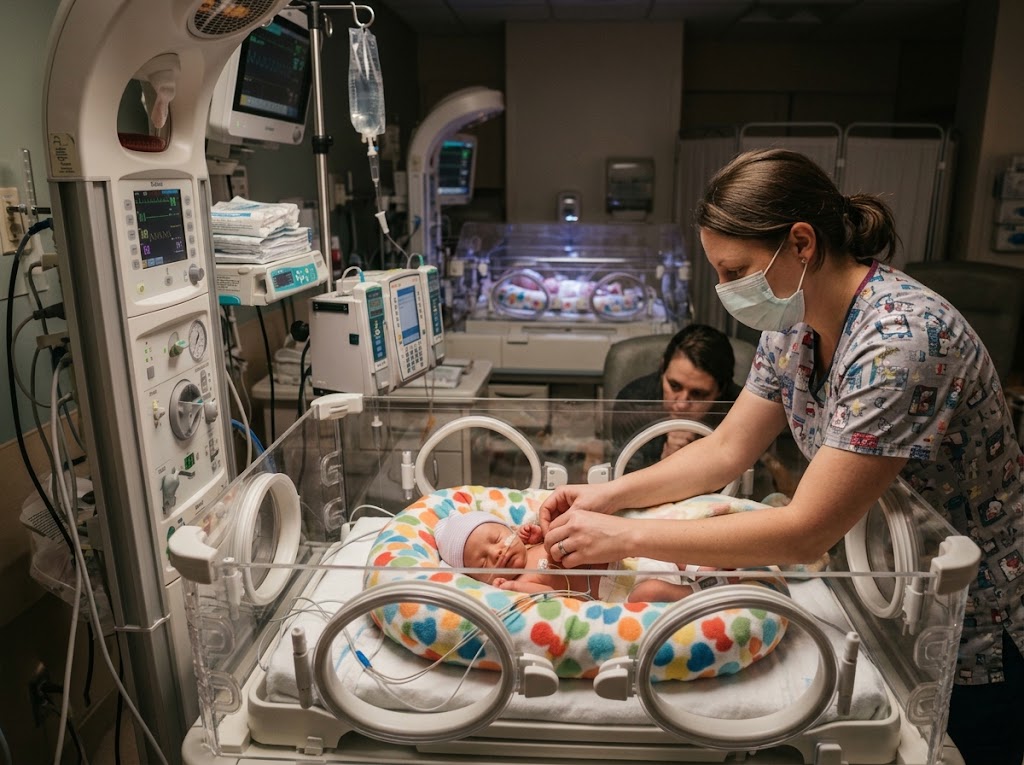
Flight creates challenges that don’t exist in a hospital, and newborns are especially sensitive to them. A neonatal transport team plans for each one before takeoff.
Oxygen levels. Aircraft cabins are pressurized to the equivalent of several thousand feet above sea level, which lowers the oxygen available in each breath. A baby who is stable on the ground may need more oxygen support in flight, and the crew adjusts in real time.
Gas expansion. Trapped gas expands as cabin pressure drops. For a baby with air in the chest, air in the bowel, or certain surgical conditions, that expansion can be dangerous. The medical team identifies these risks ahead of time, and in some cases the flight can be planned at a lower cabin altitude to limit expansion.
Temperature. Newborns, and premature babies especially, lose heat quickly. Every transfer between hospital, ambulance, and aircraft is a moment of risk, which is why the baby stays inside the warmed incubator the entire time.
Noise and vibration. Aircraft are loud and constantly vibrate, which can stress a fragile newborn. Incubators and ear protection help reduce both.
Blood sugar. Sick and premature newborns can develop low blood sugar quickly, so glucose levels are checked and IV fluids adjusted throughout the flight.
This is the same principle behind every medical flight we run. A crew trained in aeromedical care anticipates how the patient will respond to flight before it happens, not after.
Can Parents Fly With Their Baby on a NICU Air Ambulance?
In many cases, yes, one parent can travel on the aircraft with the baby. Whether there’s room depends on the aircraft, the amount of medical equipment, and the size of the crew. We confirm this during planning so you know before the day of the flight.
A few practical points for parents:
- If you recently gave birth, your own doctor may need to clear you to fly, especially after a cesarean delivery or complications.
- If you’re pumping breast milk, ask the sending NICU how to package and store it for the trip. Many NICUs will help you transport frozen milk safely.
- If you can’t fly with the baby, the receiving NICU will typically call you once your baby arrives and is settled, and you can arrange to travel separately.
You’ll be focused on your baby, and that’s where your attention should be. Part of our job is handling the logistics so you don’t have to.
What If a Baby Is Born Abroad and Needs to Come Home?
When a baby is born early or becomes critically ill while the family is traveling, the transport is more complex. Beyond the medical planning, a newborn needs travel documents to leave the country, and an infant born abroad has no passport yet.
For U.S. citizen parents, the U.S. Embassy or Consulate can help with a Consular Report of Birth Abroad and, in urgent medical situations, an emergency passport for the baby. Travel Care Air has worked alongside U.S. Embassies and Consulates for decades and can help families understand what’s needed. Learn more in our guide to air ambulance and U.S. Embassy services, and see how international repatriation works in Medical Repatriation Explained.
How Much Does a NICU Air Ambulance Cost, and Does Insurance Cover It?
The cost of neonatal air transport depends on the distance, the aircraft, the size and specialty of the medical crew, any specialty equipment, and whether the trip is domestic or international. Travel Care Air provides transparent, itemized quotes with no hidden fees, so you know what’s included before you decide.
Many health plans cover neonatal air transport when it is medically necessary, meaning the baby needs a higher level of care and ground transport isn’t appropriate. A few things to check:
- Add your baby to your health plan right away. Many plans give you a limited window after birth, often 30 days, to enroll a newborn. Call your insurer as soon as you can.
- Ask about prior authorization for planned transfers and back-transports. True emergencies are usually handled differently.
- Know your protections. For private group and individual health plans, the federal No Surprises Act limits surprise out-of-network billing for air ambulance services.
- Check travel insurance if the baby was born abroad. Domestic health insurance and Medicaid often won’t cover transport from another country, and many travel policies have specific rules about newborns.
For more detail, see Will My Health Insurance Pay for an Air Ambulance? and What Medical Repatriation Insurance Covers and Why You Need It. Travel Care Air can work directly with your insurer and provide the documentation needed to support a claim.
What Should Parents Ask Before Their Baby’s Transport?
Your baby’s care team will handle most of the clinical decisions, but you have every right to understand the plan. Useful questions include:
- Who will be on the transport team, and what neonatal experience do they have?
- Which NICU is receiving my baby, and has a physician accepted the transfer?
- Can I fly with my baby? If not, how will I get updates?
- What will the crew do if my baby’s condition changes during the flight?
- How long will the trip take, from bedside to bedside?
- What will my insurance cover, and what will I be responsible for?
For a broader checklist, see Questions to Ask Before Choosing an Air Ambulance Provider.
We’re Here When Your Baby Needs to Travel

When your newborn needs care in another city, state, or country, you shouldn’t have to figure out the logistics alone. Travel Care Air is available 24 hours a day, 7 days a week, 365 days a year. Since 1980, we’ve brought patients of every age home safely across six continents, with crews matched to each patient and every handoff coordinated from bedside to bedside. You can read some of those families’ stories in our Mission Stories.
We’ll speak with your baby’s medical team, explain what the transport would involve, and give you an honest timeline and a clear quote. Contact Travel Care Air for a free consultation and flight quote or call U.S./Canada: 1-800-524-7633 | International: +1-715-479-8881.
Frequently Asked Questions About NICU Air Ambulance Transport
Is it safe to fly a newborn on an air ambulance?
Yes, when the transport is medically appropriate and managed by a team experienced in neonatal care. Safety depends on the baby’s condition, gestational age, breathing support, and the distance involved. A medical review with the baby’s neonatologist confirms whether the baby can be safely moved and what the crew will need in flight.
How small can a baby be to fly on an air ambulance?
There’s no fixed minimum size. Even very premature babies are transported by air when they need care at a higher-level NICU. What matters is whether the baby can be stabilized for transport and whether the crew and equipment are right for that baby’s needs.
What is the difference between NICU levels?
Level I nurseries care for healthy newborns, Level II units care for moderately ill or slightly premature babies, Level III NICUs provide full intensive care including prolonged ventilator support, and Level IV NICUs offer surgical and the most specialized care. Babies are transferred when they need a higher level than their current hospital provides.
What is a back-transport?
A back-transport, or reverse transport, moves a baby from a higher-level NICU back to a hospital closer to home once the baby no longer needs the most intensive care. It lets families be near their baby for the rest of the recovery.
Can a newborn fly on a commercial flight with a medical escort instead?
Not if the baby is critically ill or needs intensive monitoring, oxygen, or a ventilator. Those babies need a dedicated air ambulance with an incubator and neonatal equipment. Commercial medical escort options are for patients who are stable.
How quickly can a NICU air transport be arranged?
Many domestic transfers can be arranged within 24 to 48 hours once the receiving NICU accepts the baby and medical clearance is confirmed. Urgent cases can move faster. International transports may take longer because of travel documents and foreign clearances.
Does a newborn need a passport to be flown home from another country?
Yes. A baby born abroad needs travel documents to leave the country. U.S. citizen parents can work with the U.S. Embassy or Consulate, which can often issue an emergency passport in urgent medical situations.
NICU air ambulance transport exists so that where a baby is born doesn’t decide the care that baby receives. With the right team, the right equipment, and a plan that covers every step from one NICU to the next, even the smallest and most fragile patients can be moved safely to the care they need.